Kilauea
Kilauea is recognized as the world’s most active volcano, distinguished by its frequent, typically nonexplosive eruptions of fluid, basaltic lava. Located on…
How does Kilauea compare to other active volcanoes in Hawaii and around the world?
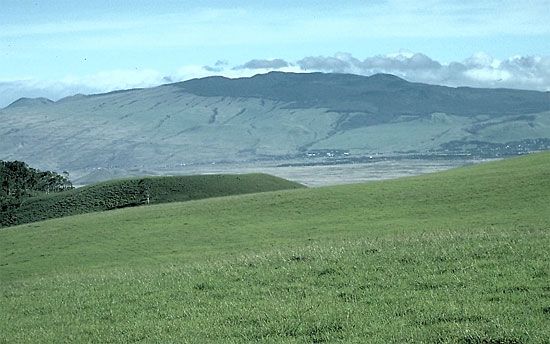
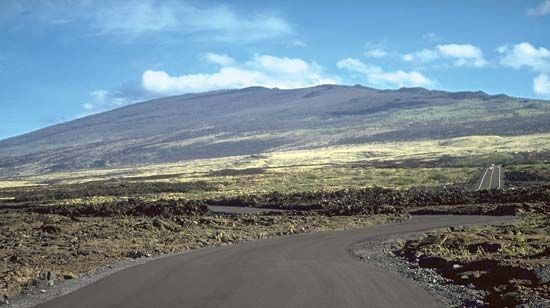
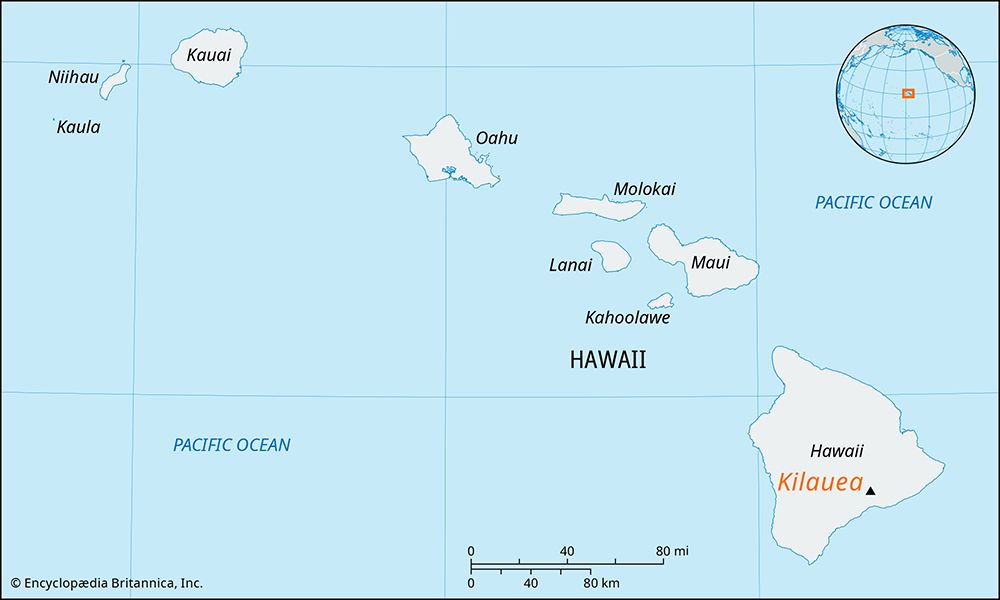
Kilauea is recognized as the world’s most active volcano, distinguished by its frequent, typically nonexplosive eruptions of fluid, basaltic lava. Located on the island of Hawaii, it is a shield volcano—a landform characterized by broad, gently sloping sides built by successive lava flows—which contrasts sharply with the steep, conical stratovolcanoes (such as Mount Vesuvius or Mount Pinatubo) common at plate margins.123
Compared to its neighbor Mauna Loa, Earth’s largest volcano, Kilauea is smaller and younger. While both are hot-spot volcanoes fed by the same deep-mantle source, they operate through separate magma conduits. Kilauea’s activity is often defined by a slow, steady effusion of lava, whereas Mauna Loa’s eruptions are typically more voluminous and rapid, exhausting its magma supply more quickly.245
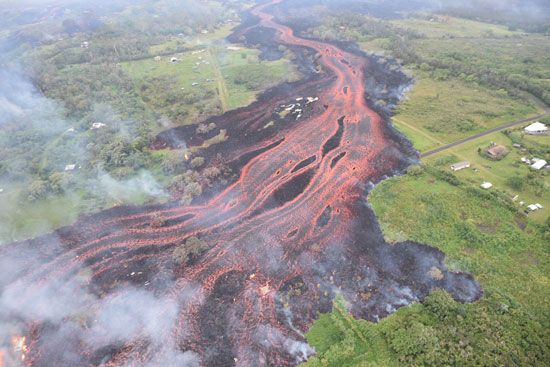
Unlike the explosive, high-viscosity eruptions of stratovolcanoes that often cause catastrophic disasters, Kilauea’s activity is generally contained within its caldera or rift zones. However, it remains a significant geological force capable of destructive lava flows and occasional explosive events, such as those seen in 1790, 1924, and 2018.132
What are the main features of Kilauea’s caldera and rift zones?
Kilauea’s volcanic structure is defined by its summit caldera and extensive rift zones, which serve as the primary conduits for its frequent eruptions.1
The Caldera
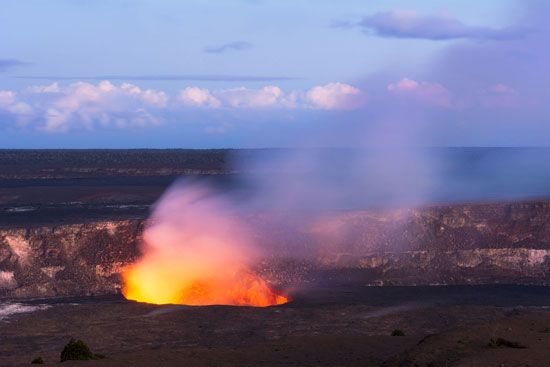
The summit of Kilauea, at an elevation of 4,090 feet (1,250 metres), has collapsed to form a broad, shallow caldera. This depression is nearly 3 miles (5 km) long and 2 miles (3.2 km) wide, covering an area of more than 4 square miles (10 square km).1
- Floor and Activity: The floor of the caldera is paved with recent lava flows and features Halema‘uma‘u, an inner crater that serves as the volcano’s most active vent.1
- Dynamics: Eruptions here are typically nonexplosive, often manifesting as a boiling lake of lava that may overflow onto the caldera floor.1
Rift Zones
Kilauea features lines of craters extending along east and southwest rift zones, which are essentially fissures in the volcano’s flanks.1
- East Rift Zone: This area is highly active and supports numerous pit craters, such as Makaopuhi. It has been the site of significant, destructive eruptions, including those in 1955, 1983, and 2018, which involved fissure openings and lava flows that reached residential areas.1
- Southwest Rift Zone: This zone also hosts volcanic features, such as the low volcanic dome known as Mauna Iki1.
What types of lava are commonly produced by Kilauea’s eruptions?
Kilauea primarily produces basaltic lava, a mafic, dark-colored rock with a relatively low silica content (approximately 45–53 percent), which gives it a lower viscosity compared to other volcanic rock types.910
The two most common forms of lava produced by Kilauea are identified by their Hawaiian names:10
- Pahoehoe: This lava is highly fluid and characterized by a smooth, billowy, or ropy surface. It typically forms when liquid lava flows beneath a thin, cooling crust, causing the surface to wrinkle into tapestry-like folds.911
- Aa: This lava is more viscous and features an exceedingly rough, jagged surface covered in loose, sharp blocks called clinkers. It is typically fed by rivers of lava flowing in open channels.910
While these two types have the same chemical composition, their physical appearance depends on factors such as eruptive temperature, flow speed, and the degree of stirring as the lava moves downslope. It is common for a flow to leave a vent as pahoehoe and transition into aa as it progresses and cools.91011
How do scientists monitor and predict eruptions at Kilauea?
Scientists monitor and predict eruptions at Kilauea primarily through the Hawaiian Volcano Observatory, which maintains a permanent presence to ensure early warning. Because volcanic eruptions pose significant hazards to life and property, researchers employ a variety of sophisticated techniques to track activity.1213
Key monitoring methods include:
- Seismology: Scientists use seismographs to detect earthquake tremors. A sharp increase in the frequency and intensity of these quakes often signals the upward movement of magma from the asthenosphere, serving as a primary indicator for the onset of an eruption.12
- Deformation Tracking: As rising molten rock fills magma chambers, the volcano may inflate. Researchers use tiltmeters to measure subtle changes in the slope angle of the ground, while laser beams are also used to detect surface deformation.1214
- Gas and Field Monitoring: Scientists utilize gas detectors to monitor emissions, as well as instruments sensitive to variations in magnetic and gravity fields12. Analyzing the composition of volcanic gases provides critical data regarding the movement and depth of magma.121
While these tools allow for useful forecasts, eruption prediction remains a complex science fraught with uncertainty, requiring a careful balance between public safety and the economic impact of evacuations.14
Sources
- Kilauea — Encyclopædia Britannica
- Hawaii Volcanoes National Park — Encyclopædia Britannica
- volcano - Mauna Loa , Hawaii, 1984 — Encyclopædia Britannica
- volcano - Intraplate volcanism — Encyclopædia Britannica
- volcanism — Encyclopædia Britannica
- stratovolcano — Encyclopædia Britannica
- volcano - Volcanoes related to plate boundaries — Encyclopædia Britannica
- volcano - Shield volcanoes — Encyclopædia Britannica
- lava — Encyclopædia Britannica
- 12 Lovely and Unusual Words for the Natural World | Pahoehoe — Merriam-Webster
- volcano - Lava flows — Encyclopædia Britannica
- geology - Volcanology — Encyclopædia Britannica
- volcano - Gas clouds — Encyclopædia Britannica
- volcano - Volcano forecasting and warning — Encyclopædia Britannica
Published on · 4 min read