Kilimanjaro
At high altitudes, typically above 8,000 feet (2,400 meters), the atmospheric pressure drops, causing the air to become thinner and the partial pressure of…
How does the altitude affect climbers and what precautions are taken to prevent altitude sickness?
At high altitudes, typically above 8,000 feet (2,400 meters), the atmospheric pressure drops, causing the air to become thinner and the partial pressure of oxygen to decrease. This results in a deficiency of oxygen in the body’s tissues, leading to altitude sickness. Symptoms include respiratory distress, fatigue, headaches, dizziness, nausea, and impaired coordination.12
To prevent or mitigate these effects, climbers can take several precautions:
- Acclimatization: The body naturally adapts to low oxygen levels over several days through processes like increased ventilation and red blood cell production.12
- Medication: The diuretic acetazolamide, when taken two to three days before ascent, can help prevent or reduce symptoms.1
- Supplemental Oxygen: Climbers often use mixtures of pure oxygen and air to relieve symptoms while at high elevations.1
- Descent: If symptoms become severe, the most effective and necessary treatment is to return to a lower altitude immediately.1
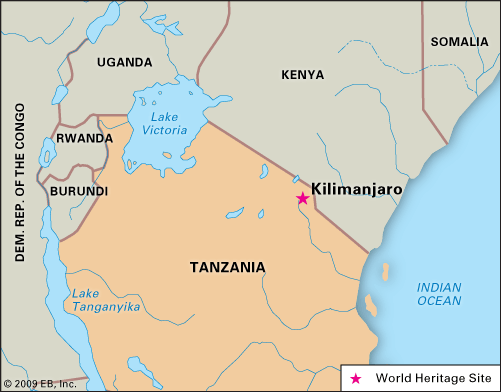
What role does Mount Kilimanjaro play in Tanzania’s tourism industry?
Mount Kilimanjaro is a cornerstone of Tanzania’s rapidly expanding tourism sector, serving as a major attraction for visitors from around the world. As the highest peak in Africa, the mountain draws thousands of hikers annually who attempt to reach the Kibo summit, which is accessible without specialized mountaineering equipment.34
The mountain’s significance is bolstered by Mount Kilimanjaro National Park, which was established in 1973 to protect the area above the tree line and its diverse ecological zones. Designated as a UNESCO World Heritage site in 1987, the park provides a protected environment that supports both conservation and recreational activities. The town of Moshi, located at the southern base of the massif, functions as the primary trading center and base for those preparing for their ascent. Together with the country’s extensive network of national parks and coastal attractions, Kilimanjaro plays a vital role in an industry that has accounted for a significant portion of Tanzania’s gross domestic product.453
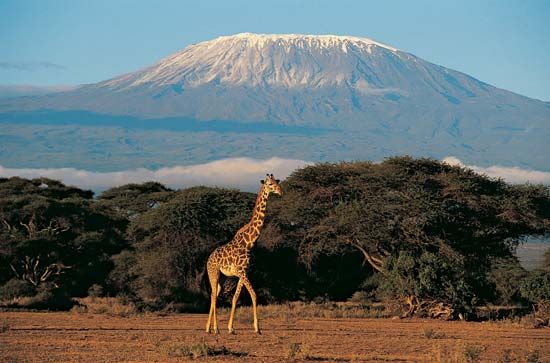
What is the geological history of Mount Kilimanjaro and how was it formed?
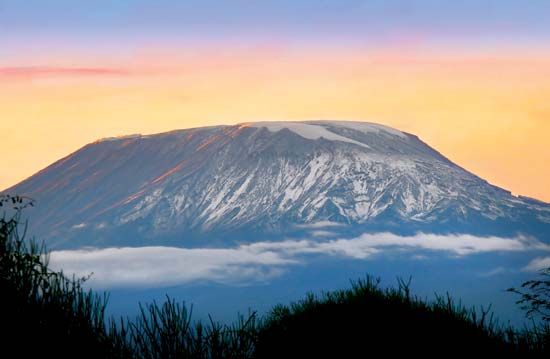
Mount Kilimanjaro is a massive volcanic complex located in northeastern Tanzania, situated near the intersection of fault lines associated with the East African Rift System. Its formation is linked to the extensive volcanism that has accompanied the development of the rift over the past 30 million years.637
The massif is composed of three distinct extinct volcanoes, which ceased activity in a specific chronological order:
- Shira: The oldest of the three, now existing as a ridge remnant at 13,000 feet (3,962 meters).67
- Mawensi: The second to become inactive, this peak serves as the older core of a former summit. It is highly eroded and jagged, reaching 16,893 feet (5,149 meters).67
- Kibo: The youngest and highest peak, rising to 19,340 feet (5,895 meters). It retains the classic shape of a volcanic cone and features a large caldera on its southern side. Within this crater, successive inner cones and fumaroles—vents that emit gases—provide evidence of residual volcanic activity.867
What is the cultural significance of Kilimanjaro to the local Chagga people and Tanzania as a whole?
Mount Kilimanjaro holds profound significance for the Chagga people, who have inhabited the mountain’s fertile southern slopes for generations. The mountain is central to their way of life, providing the essential resources for their highly organized agricultural society. By utilizing the unique ridge-and-valley relief of the massif, the Chagga developed sophisticated irrigation systems that allow for intensive, permanent cultivation of crops such as millet, plantains, and coffee, the latter of which has been a vital cash crop since the 1920s.311
Beyond its agricultural utility, the mountain is a defining feature of the region’s identity. The Chagga, who are among the most prominent and well-organized peoples in Tanzania, have built a society deeply rooted in the landscape, with social structures that include patrilineal descent and traditional age sets. For Tanzania as a whole, Kilimanjaro serves as a national icon and a primary economic engine, with its slopes supporting dense populations and its status as a World Heritage site driving significant international tourism.11123
Sources
- altitude sickness — Encyclopædia Britannica
- human respiratory system - High altitudes — Encyclopædia Britannica
- Kilimanjaro — Encyclopædia Britannica
- Tanzania - Services — Encyclopædia Britannica
- East African mountains - Tourism — Encyclopædia Britannica
- Kilimanjaro: Top Questions — Encyclopædia Britannica
- East African Rift System — Encyclopædia Britannica
- East African mountains — Encyclopædia Britannica
- Kilimanjaro — Merriam-Webster
- East African mountains - Geology — Encyclopædia Britannica
- East African mountains - The people of the East African mountains — Encyclopædia Britannica
- Chaga — Encyclopædia Britannica
Published on · 3 min read