East African Mountains
The mountains of East Africa are closely associated with the East African Rift System, a massive geological feature extending from the Red Sea to Mozambique.…
What are the major mountain ranges and peaks found in East Africa?
The mountains of East Africa are closely associated with the East African Rift System, a massive geological feature extending from the Red Sea to Mozambique. While most of these peaks are of volcanic origin, the region features several significant ranges and massifs.12
Major Mountain Ranges and Peaks
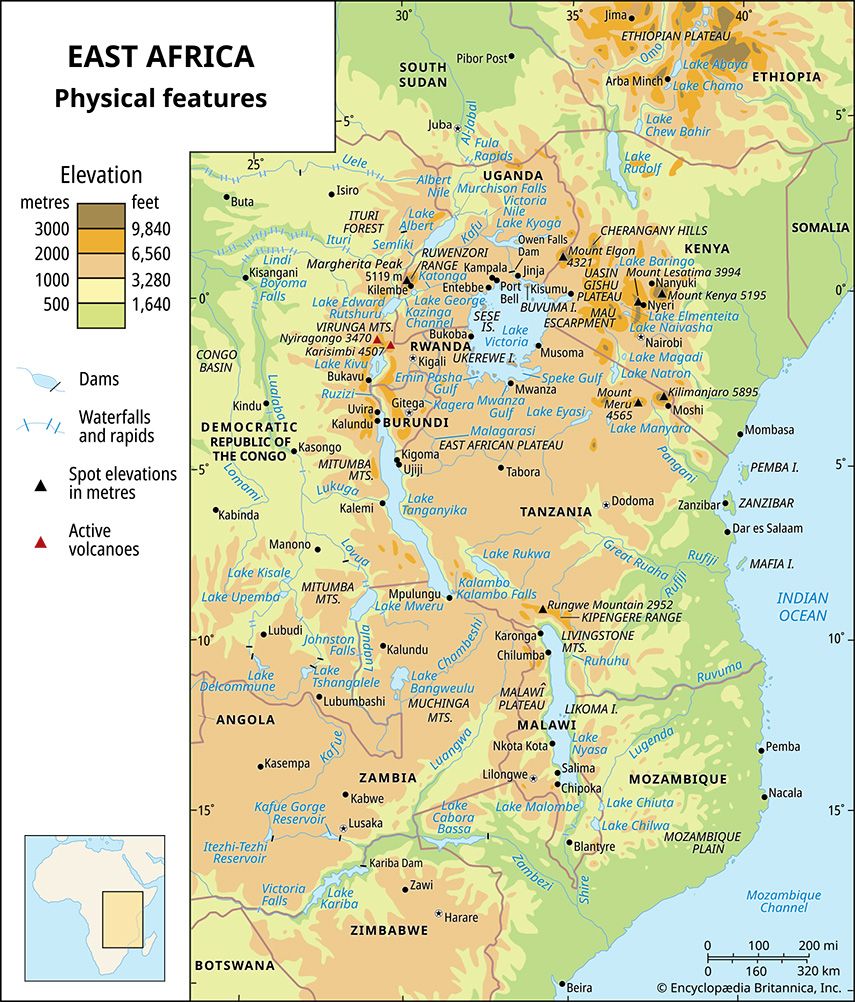
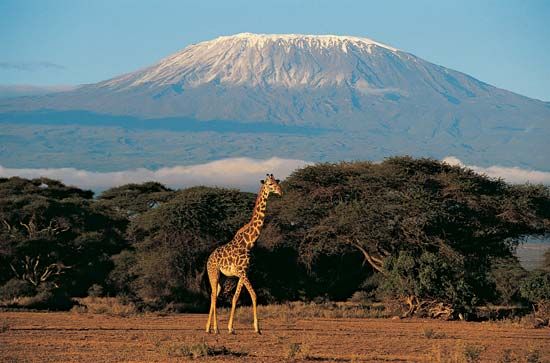
- Kilimanjaro: Located in Tanzania, this is the highest mountain in Africa. Its highest point is Uhuru Peak (19,340 feet) on the Kibo volcanic cone.34
- Mount Kenya: The second highest mountain in Africa, located in Kenya. Its primary peaks include Batian (17,057 feet) and Nelion (17,022 feet).45
- Ruwenzori Range: Situated on the Uganda-Congo border, this range is a non-volcanic horst. Its highest point is Margherita Peak (16,795 feet) on Mount Stanley.164
- Mount Elgon: Straddling the Uganda-Kenya border, its highest peak is Wagagai (14,178 feet).14
- Aberdare Range: Located in Kenya, its highest peak is Mount Lesatima (13,120 feet).14
- Virunga Mountains: A volcanic chain extending across the borders of Congo, Rwanda, and Uganda, featuring Karisimbi (14,787 feet).4
- Mount Meru: A volcanic peak in northern Tanzania reaching 14,978 feet.14
What unique flora and fauna can be found in the East African mountain ecosystems?
The East African mountains host unique ecosystems characterized by distinct altitudinal zones, where flora and fauna have adapted to isolated “islands” of habitat.73
Unique Flora
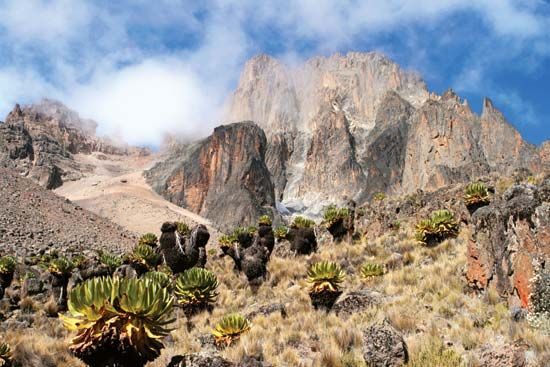
The most striking feature of the high-altitude Afro-Alpine zone is the presence of giant rosette plants, an example of convergent evolution. These include:2
- Giant Lobelia: Species such as Lobelia deckenii are iconic to these high elevations.82
- Giant Groundsel: Known as Dendrosenecio (or Senecio johnstonii cottonii), these plants use persistent dead leaf bases to insulate their stems against nightly freezing temperatures.82
- Other Vegetation: The landscape also features tussocky grasslands, everlastings, and Alchemilla (lady’s mantle). Lower slopes support montane forests with camphor, fig, cedar, yellowwood, and East African olive trees, often transitioning into bamboo forests.7
Unique Fauna
The mountains serve as refuges for diverse wildlife, with many species showing distributions that suggest a retreat from surrounding plateaus.3
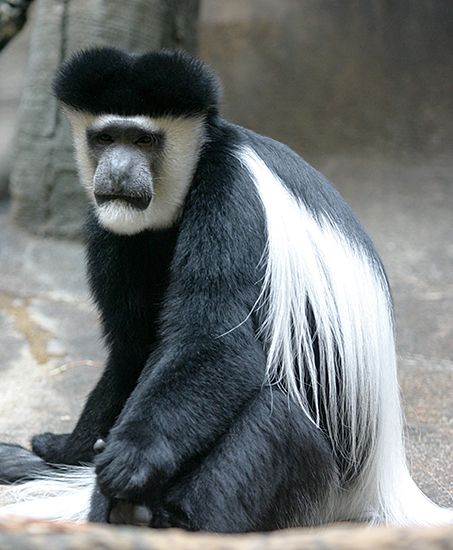
- Mammals: Forests are home to elephants, buffalo, eland, and various primates like black-and-white colobus and blue monkeys. The Virunga Mountains are famous for mountain gorillas and golden monkeys, while chimpanzees inhabit the Ruwenzori Range. In the high-altitude moorlands, the hyrax and the groove-toothed rat are common.83
- Birds: The region hosts specialized species such as the lammergeier, the mountain chat, and the scarlet-tufted malachite sunbird.3
How were the East African mountains formed geologically?
The East African mountains were primarily formed through the geological processes associated with the East African Rift System, a massive tectonic feature that has been developing for approximately 30 million years as the African and Arabian plates separate.1
Volcanic Origins
Most of the major peaks in the region, including Kilimanjaro, Mount Kenya, Mount Meru, and Mount Elgon, are of volcanic origin1. The rifting process involves the upwelling of magma, which causes the overlying lithosphere to uplift and stretch. This extensive volcanic activity, occurring along the faults of the rift system, created these high-altitude massifs.2121
The Ruwenzori Exception
The Ruwenzori Range is a notable exception to this pattern. Unlike the volcanic peaks, it is a gigantic horst—a block of the Earth’s crust that has been uplifted relative to the surrounding land—formed by tectonic forces rather than volcanic eruptions.1314
How do the East African mountains affect the region’s climate and weather patterns?
The East African mountains significantly influence the region’s climate by acting as barriers to air masses and forcing the uplift of moist air, a process known as orographic precipitation. In a region that is predominantly dry, these mountains serve as critical areas of high rainfall.1516
Precipitation Patterns
The mountains interact with Indian Ocean and Atlantic airstreams to create distinct moisture zones:
- Windward vs. Leeward: Mountains like Kilimanjaro, Mount Kenya, and Mount Elgon are typically wettest on their southern and southeastern slopes. Conversely, their northern flanks often receive less than 40 inches of rain annually due to the rain shadow effect.1516
- Altitude Effects: Precipitation generally increases with elevation up to about 10,000 feet. Above this “cloud ceiling,” rainfall decreases, creating arid conditions in high-altitude zones like the Afro-Alpine zone.1517
- Regional Extremes: The Ruwenzori Range is the wettest and cloudiest of the region’s mountains, with moist conditions reaching even the highest peaks.15
Temperature and Wind
Altitude dictates temperature, with higher elevations experiencing significantly cooler conditions, often falling below the freezing point. At summits exceeding 14,500 feet, precipitation frequently falls as snow. Additionally, the mountains influence local wind patterns by “funneling” air through valleys and creating mountain-valley wind circulations.1517
Sources
- East African mountains — Encyclopædia Britannica
- East African Rift System — Encyclopædia Britannica
- Ruwenzori Range — Encyclopædia Britannica
- Kilimanjaro: Top Questions — Encyclopædia Britannica
- East African mountains - Physiography — Encyclopædia Britannica
- Mount Kenya — Encyclopædia Britannica
- East African mountains - Plant life — Encyclopædia Britannica
- Kilimanjaro — Encyclopædia Britannica
- Exploring 7 of Earth’s Great Mountain Ranges - Ethiopian Highlands — Encyclopædia Britannica
- East African mountains - Animal life — Encyclopædia Britannica
- Mountain ecosystem - Flora — Encyclopædia Britannica
- Africa - Pleistocene and Holocene developments — Encyclopædia Britannica
- plate tectonics - Continental rifting — Encyclopædia Britannica
- Africa - Relief — Encyclopædia Britannica
- East African mountains - Climate — Encyclopædia Britannica
- East African lakes: Top Questions — Encyclopædia Britannica
- Highland climate — Encyclopædia Britannica
- Orographic precipitation — Encyclopædia Britannica
Published on · 4 min read