King Leopold Ranges
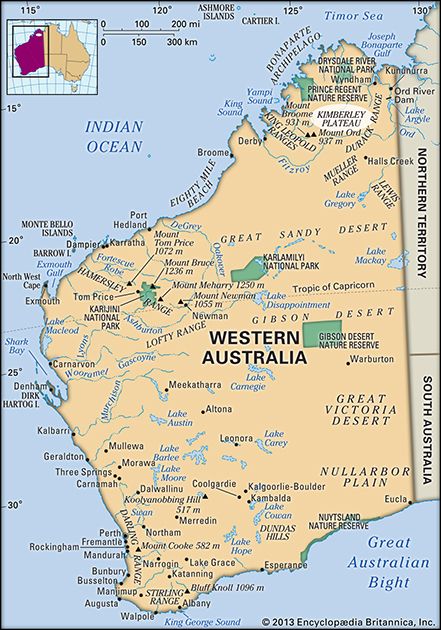
The King Leopold Ranges are a mountain chain located in northern Western Australia that form the southwestern boundary of the Kimberley Plateau.
What is King Leopold Ranges?
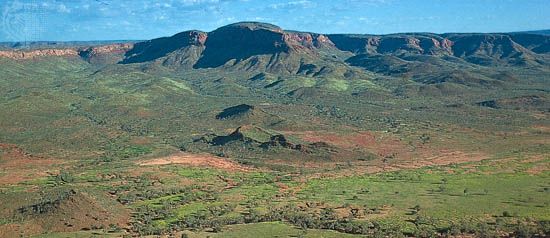
The King Leopold Ranges are a mountain chain located in northern Western Australia that form the southwestern boundary of the Kimberley Plateau.1
This well-dissected escarpment stretches approximately 150 miles (240 km) southeast from Collier Bay. While the ranges average about 2,000 feet (600 m) in height, they reach elevations exceeding 3,000 feet (about 915 m) at Mounts Ord and Broome. The landscape is characterized by scrub-covered, level-topped peaks that are deeply carved by several rivers, including the Fitzroy, Lennard, Adcock, and Isdel.1
The ranges were first sighted in 1879 by the explorer Alexander Forrest, who named the formation in honor of Leopold II, the king of the Belgians.1
What is the Kimberley Plateau?
The Kimberley Plateau is a vast, multisectioned plateau region located in northern Western Australia, covering approximately 162,000 square miles (420,000 square km). It extends from the rugged Indian Ocean coast in the northwest to the Fitzroy River in the south and the Ord River in the east.23
Composed primarily of sandstone with patches of basalt, the region is characterized by deep river gorges and is bounded to the southwest by the King Leopold Ranges. The area is sparsely populated, with an economy historically based on cattle ranching and, more recently, mining—notably for diamonds at the Argyle mine—and irrigated agriculture. The region is named after John Wodehouse, 1st Earl of Kimberley, who served as British colonial secretary.231
It is important to distinguish this Australian plateau from the city of Kimberley, a major diamond-mining center located in South Africa.4
Who was King Leopold II of Belgium?
Leopold II (1835–1909) was the king of the Belgians from 1865 to 1909. While he played a role in the development of the modern Belgian state, he is most infamously remembered for his brutal colonial rule in Africa.6
Driven by a desire for personal wealth and imperial power, Leopold established the Congo Free State in 1885, claiming a vast territory in Central Africa as his private property. Under the guise of a humanitarian and “civilizing” mission, he employed the explorer Henry Morton Stanley to secure treaties with local leaders.678
Leopold’s regime became notorious for its extreme exploitation of the Congolese people to extract resources, primarily ivory and rubber. His private army, the Force Publique, utilized forced labour, hostage-taking, and systematic mutilation to terrorize the population into meeting production quotas. These atrocities led to a massive demographic collapse, with the population estimated to have been reduced by up to 50 percent. Following international outcry, he was forced to relinquish control in 1908, and the territory was annexed as the Belgian Congo.67
What other mountain ranges are found in Australia?
Australia features a diverse array of mountain ranges beyond the well-known Great Dividing Range, which spans the eastern coast. Other significant mountain systems include:1011
- Flinders Ranges: Located in South Australia, this 500-mile-long region is known for its rugged gorges and Precambrian fossils. To the south, the highland region continues as the Mount Lofty Ranges.12
- MacDonnell Ranges: A series of parallel quartzite and sandstone ridges in the Northern Territory that extend east and west of Alice Springs.13
- Hamersley Range: Situated in the Pilbara region of Western Australia, this area is famous for its spectacular red gorges and includes Mount Meharry, the state’s highest point.3
- King Leopold Ranges: Limestone ranges that rise from the southern part of the Kimberley plateau in Western Australia.3
- Stirling Range: Located in the extreme south of Western Australia, this range rises to an elevation of 3,596 feet.3
- Darling Range: A north-south running scarp in Western Australia that separates the Yilgarn block from the coastal plain.3
Sources
- King Leopold Ranges — Encyclopædia Britannica
- Kimberley — Encyclopædia Britannica
- Western Australia - Relief — Encyclopædia Britannica
- Kimberley Plateau — Merriam-Webster
- Kimberley — Encyclopædia Britannica
- Leopold II — Encyclopædia Britannica
- Democratic Republic of the Congo - The Congo Free State — Encyclopædia Britannica
- Leopold II — Merriam-Webster
- Association Internationale du Congo — Encyclopædia Britannica
- Exploring 7 of Earth’s Great Mountain Ranges - Great Dividing Range — Encyclopædia Britannica
- Flinders Ranges — Encyclopædia Britannica
- MacDonnell Ranges — Encyclopædia Britannica
- Great Dividing Range — Encyclopædia Britannica
Published on · 3 min read