King William Island
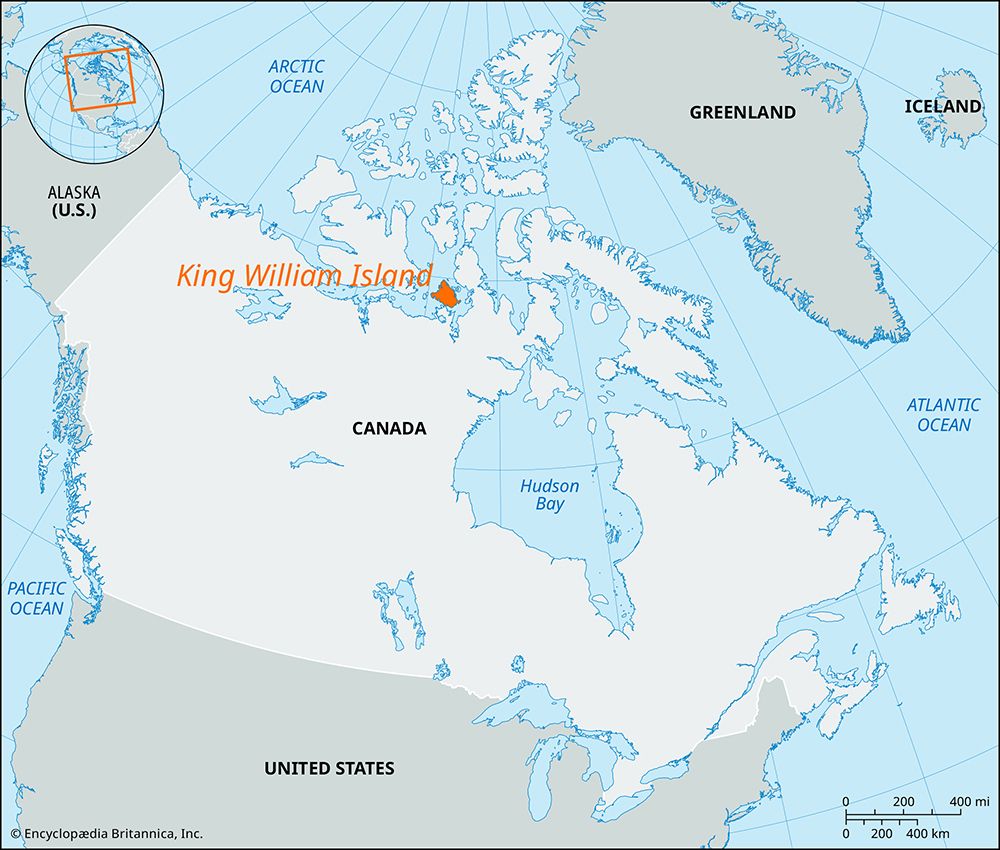
King William Island is an island located in the Canadian Arctic Archipelago within the territory of Nunavut. Situated between Victoria Island and the Boothia…
What is King William Island?
King William Island is an island located in the Canadian Arctic Archipelago within the territory of Nunavut. Situated between Victoria Island and the Boothia Peninsula, the island spans approximately 5,062 square miles (13,111 square km) and features a relatively flat terrain.1
Discovered in 1830 by James Ross, it was named in honor of the British monarch William IV. The island is home to Gjoa Haven, a community that served as a wintering site for explorer Roald Amundsen between 1903 and 1905.1
The island is historically significant as the site where the Franklin expedition—led by Sir John Franklin—met its tragic end while searching for the Northwest Passage. The expedition’s ships, the Erebus and the Terror, became trapped in the ice of Victoria Strait off the coast of the island in 1846. Archaeological remains of these vessels have since been discovered on the ocean floor nearby.23
What was the significance of the Northwest Passage for early explorers?
The Northwest Passage held immense significance for early explorers as a potential shortcut to East Asia. Following the disruption of traditional overland trade routes by the Ottoman Empire in the mid-15th century, European powers sought a viable maritime alternative to reach the East.4
For centuries, the passage represented a primary objective for explorers attempting to navigate around the North American land barrier encountered by Christopher Columbus. Establishing this route was viewed as a critical commercial goal that would bypass the long, arduous journeys around Africa or South America.4
Despite its allure, the quest for the passage proved to be one of the world’s most dangerous maritime challenges. Many expeditions, including those led by Sir John Franklin and Henry Hudson, ended in disaster due to treacherous ice conditions and the extreme Arctic environment. It was not until the early 20th century that Roald Amundsen successfully navigated the route, marking the culmination of centuries of exploration.4
How did Roald Amundsen successfully navigate the Northwest Passage?
Roald Amundsen successfully navigated the Northwest Passage between 1903 and 1906, marking the first time the route was completed by sea.54
He undertook the expedition with a crew of six aboard the Gjøa, a 47-ton converted herring boat. The small size of the vessel was a strategic advantage, allowing it to maneuver through the shallow, ice-choked channels of the Arctic Archipelago that had thwarted larger ships in previous attempts.54
The journey was arduous and required multiple winters in the Arctic:
- 1903–1905: Amundsen and his crew navigated the middle section of the passage, reaching Cape Colborne in August 1905.54
- 1905–1906: After completing the transit of the passage proper, ice forced the expedition to winter at Herschel Island off the coast of the Yukon territory.54
- 1906: The crew resumed their journey in August and successfully arrived in Nome, Alaska, later that month to a hero’s welcome.54
What are some of the challenges of living in the Canadian Arctic today?
Living in the Canadian Arctic presents a unique set of challenges shaped by extreme environmental conditions, geographic isolation, and the rapid pace of ecological change.
Environmental and Climatic Challenges
The region is characterized by a polar continental climate, where winters are intensely cold and often feature persistent, strong winds that create significant windchill. These conditions, combined with low visibility from drifting snow, make daily life and travel difficult. Furthermore, the landscape is underlain by permafrost, which thaws during the short summer into marshy terrain, complicating infrastructure development and maintenance.67
Ecological and Economic Pressures
The Arctic is highly sensitive to global warming, which is occurring at a faster rate there than in many other parts of the world. This warming has led to:8
- Habitat Loss: The rapid melting of sea ice threatens wildlife such as polar bears, which rely on ice for hunting and breeding.97
- Ecosystem Shifts: Rising temperatures are causing tundra ecosystems to change as shrubs and tree species migrate northward, potentially reducing the availability of traditional subsistence resources.8
- Industrial Impact: Economic activities, such as mining and oil exploration, have historically caused surface disturbances and pollution, leading to ongoing debates about balancing development with environmental protection.1078
Social and Administrative Factors
The region faces a persistent shortage of skilled labor, often requiring the recruitment of workers from the south, which necessitates high wage rates. While Indigenous populations have become increasingly active in advocating for their rights and environmental preservation through organizations like the Arctic Council, they continue to navigate the complexities of balancing traditional lifestyles with modern administrative and economic systems.111213
Sources
- King William Island — Encyclopædia Britannica
- Sir John Franklin — Encyclopædia Britannica
- Victoria Strait — Encyclopædia Britannica
- Northwest Passage — Encyclopædia Britannica
- Roald Amundsen — Encyclopædia Britannica
- Arctic - Climate of the Arctic — Encyclopædia Britannica
- Arctic - Administration — Encyclopædia Britannica
- Arctic - Human resources — Encyclopædia Britannica
- Arctic - Environmental concerns — Encyclopædia Britannica
- sea ice - The emerging impacts of recent changes to sea ice — Encyclopædia Britannica
- Nunavut - Health and education — Encyclopædia Britannica
- Arctic - Contemporary developments — Encyclopædia Britannica
- Arctic National Wildlife Refuge — Encyclopædia Britannica
- Arctic - History of settlement — Encyclopædia Britannica
- Tundra - Effects of human activities and climate change — Encyclopædia Britannica
Published on · 3 min read