Kingbird
Kingbirds, members of the genus Tyrannus within the family Tyrannidae, are small birds typically measuring about 20 cm (8 inches) in length. Despite their…
What are the distinctive physical characteristics of kingbirds?
Kingbirds, members of the genus Tyrannus within the family Tyrannidae, are small birds typically measuring about 20 cm (8 inches) in length. Despite their size, they are well-known for their pugnacious behavior toward much larger birds.1
Their physical characteristics include:
- Coloration: They are generally gray on their upperparts, while their underparts vary between white, gray, or yellow.12
- Crest: All species possess a concealed, erectile crest on the crown that is red, orange, or yellow.1
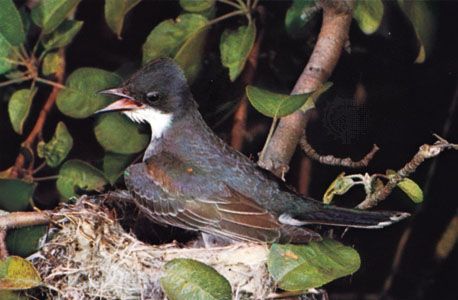
- Species-specific traits: The eastern kingbird is characterized by dark slate-gray upperparts, white underparts, and a white-tipped tail. In contrast, the western kingbird is light gray above and yellow below, featuring whitish edges on its outermost tail feathers.1
It is important to note that kingbirds are distinct from the prehistoric tyrannosaur, which was a large, predatory dinosaur with specialized teeth and a massive skull, rather than a small avian species.3
Where are kingbirds typically found in terms of habitat and geographic range?
Kingbirds (genus Tyrannus) are widely distributed across the Americas, with a geographic range extending from Canada down to Argentina.1
Geographic Range
- Eastern Kingbird (T. tyrannus): This species breeds across much of North America, ranging from the east coast of the United States to eastern Washington, Oregon, British Columbia, and the Northwest Territories. They typically winter in tropical America.14
- Western Kingbird (T. verticalis): These birds are found primarily in the western regions of North America, extending westward from the Great Plains.1
Habitat
Kingbirds are typically found in open country environments. They are commonly observed along roadsides, where they utilize perches to survey their surroundings. Because they are known to raid apiaries, they are sometimes referred to as “bee birds” or “bee-martins” due to their presence near areas where bees are kept.1
How many species of kingbirds are there, and what are some of the most common ones?
There are 13 species of kingbirds belonging to the genus Tyrannus and the family Tyrannidae. These birds are widely recognized for their pugnacious nature, often aggressively chasing birds much larger than themselves, such as crows or hawks.1
Among the most common species are:
- Eastern Kingbird (T. tyrannus): This species is characterized by its dark slate-gray upperparts, white underparts, and a distinct white-tipped tail. It is frequently found in open country and along roadsides.1
- Western Kingbird (T. verticalis): Found primarily in regions westward from the Great Plains, this bird features light gray upperparts and yellow underparts, with whitish edges on its outermost tail feathers.1
Both of these species share the characteristic of having a concealed, erectile crown patch that is typically red, orange, or yellow.1
How do kingbirds migrate, and what are their migration patterns?
Kingbirds, which belong to the family Tyrannidae, are migratory birds that travel between their breeding grounds in North America and their wintering grounds in tropical regions. For example, the eastern kingbird breeds across much of North America and migrates to tropical America for the winter.19
Migration Patterns and Physiology
Migration is a complex process driven by internal rhythms and physiological changes. Before migrating, kingbirds and other migratory birds undergo metabolic shifts, such as the accumulation of fat in body tissues, which provides the necessary energy for their long-distance journeys.10
While the pituitary gland prepares the birds physiologically for migration by responding to factors like day length, the actual initiation of flight is often triggered by ecological conditions, including food availability and weather patterns.10
Flight and Behavior
- Routes: Migratory birds often follow broad airways, with routes determined by geographical features like coastlines and river systems, as well as meteorological conditions such as wind direction.11
- Timing: Many flycatchers—the family to which kingbirds belong—are nocturnal migrants, typically performing their flights at night.11
- Gregariousness: Although kingbirds are known for their fierce individualism and pugnacity during the breeding season, many birds become gregarious during migration, often traveling in flocks.111
Sources
- Kingbird — Encyclopædia Britannica
- tyrannosaur - Skull and dentition — Encyclopædia Britannica
- kingbird — Merriam-Webster
- eastern kingbird — Merriam-Webster
- Coraciiform - Habitat selection and ecological diversity — Encyclopædia Britannica
- Passeriform - Territoriality and courtship — Encyclopædia Britannica
- tyrannosaur - Classification — Encyclopædia Britannica
- Kinglet — Encyclopædia Britannica
- Migration - Navigation and orientation — Encyclopædia Britannica
- Migration - Modes of migration — Encyclopædia Britannica
- Migration - Physiological stimulus of migration — Encyclopædia Britannica
Published on · 3 min read