Moa
Moa and the dodo were both extinct flightless birds, but they differed significantly in their evolutionary lineage, physical adaptations, and survival…
How do moa compare to other extinct flightless birds, such as the dodo?
Moa and the dodo were both extinct flightless birds, but they differed significantly in their evolutionary lineage, physical adaptations, and survival strategies.
Evolutionary Background
- Moa: Belonged to the order Dinornithiformes and are classified as ratites—birds characterized by a flattened breastbone lacking a keel for flight muscles. They are thought to be closely related to tinamous1.12
- Dodo: Classified in the order Columbiformes, making them close relatives of pigeonscolumbiform), making them close relatives of pigeons. Unlike the ratite moa, the dodo’s flightlessness was a secondary, specialized condition evolved from a flying ancestor.23
Physical and Behavioral Differences
- Size and Locomotion: Moa ranged from turkey-sized to giants reaching 3 meters (10 feet) in height. They were adapted for running and, according to Māori tradition, defended themselves by kicking. In contrast, the dodo was a stocky bird weighing roughly 9.5–23 kg (21–50 pounds) and lacked the specialized running adaptations of the moa.142
- Defense: Moa evolved in an environment without native land mammals, while the dodo lived on Mauritius and was famously “naive” to predators, having no natural defense against the humans and invasive species introduced to the island.423
What were the physical characteristics and size of the moa?
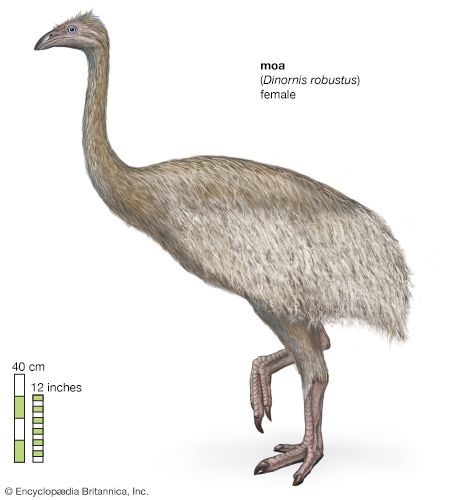
The moa (order Dinornithiformes) were a group of extinct flightless birds native to New Zealand that exhibited significant variation in size and physical structure.
Size and Stature
Estimates regarding the number of moa species vary widely, ranging from 9 to 64. Individual birds ranged from the size of a turkey to giants that were larger than an ostrich. Some of the largest species, such as Dinornis robustus and D. novaezelandiae, stood as tall as 3 to 3.7 metres (10 to 12 feet) and could weigh up to 250 kg (about 550 pounds).15
Physical Characteristics
- Ratite Features: As ratites, moa possessed a flattened breastbone that lacked the keel necessary for flight muscles.1
- Anatomical Traits: They exhibited features such as specific feather types, distinct palatal structures, and the persistence of skull sutures into adulthood.1
- Growth Rate: Studies of leg bone growth rings indicate that moa grew at an exceptionally slow rate, taking up to 10 years to reach full size, which contrasts sharply with modern birds that typically mature within 12 months.1
- Dietary Adaptations: Moa were browsers and grazers that consumed seeds, fruits, leaves, and grasses. To aid digestion, they used more than 3 kg (6.5 pounds) of stones in their gizzard to grind this vegetation.1
When did the first moa species evolve, and how long did they exist on Earth?
The fossil record for moa is relatively poor, which makes determining their exact evolutionary origins difficult. The earliest known remains of these birds are dated to the Late Miocene Age, which occurred between 11.6 million and 5.3 million years ago.1
Regarding their existence on Earth, moa were extinct by the time of human arrival in New Zealand, though the timing of their final disappearance varied by species. While the larger moa species likely became extinct by the end of the 17th century, evidence suggests that some smaller species may have persisted into the 19th century.1
How many different species of moa existed, and how did they differ from each other?
The number of moa species is a subject of ongoing scientific debate, with estimates ranging from as few as 9 to as many as 64 distinct species.
These birds were categorized into two primary families based on their size and physical characteristics:
- Family Dinornithidae (Greater Moa): This family included the giants of the order. These species were the largest, with some individuals reaching heights of up to 3.7 metres (12 feet) and weighing as much as 250 kg (about 550 pounds).
- Family Emeidae (Lesser Moa): This group comprised about two-thirds of the species within the order. These birds were significantly smaller, with some species being roughly the size of a turkey.
Despite these variations in size, all moa shared common ratite features, such as a flattened breastbone that lacked the keel necessary for flight, specific feather types, and the retention of certain skull sutures into adulthood.
Sources
- Moa — Encyclopædia Britannica
- Dodo — Encyclopædia Britannica
- Flightless bird — Encyclopædia Britannica
- Bird - Flightlessness — Encyclopædia Britannica
- moa — Merriam-Webster
- ornithopod — Encyclopædia Britannica
- dinosaur - Ornithopoda — Encyclopædia Britannica
- dinosaur - Dinosaur descendants — Encyclopædia Britannica
- Bird - Fossil birds — Encyclopædia Britannica
- moose — Encyclopædia Britannica
- mole — Encyclopædia Britannica
Published on · 3 min read