Kīrthar Range
The Kīrthar Range is a mountainous region located in southern Pakistan. Stretching approximately 190 miles (300 km), it runs from the Mūla River in…
What is Kīrthar Range?
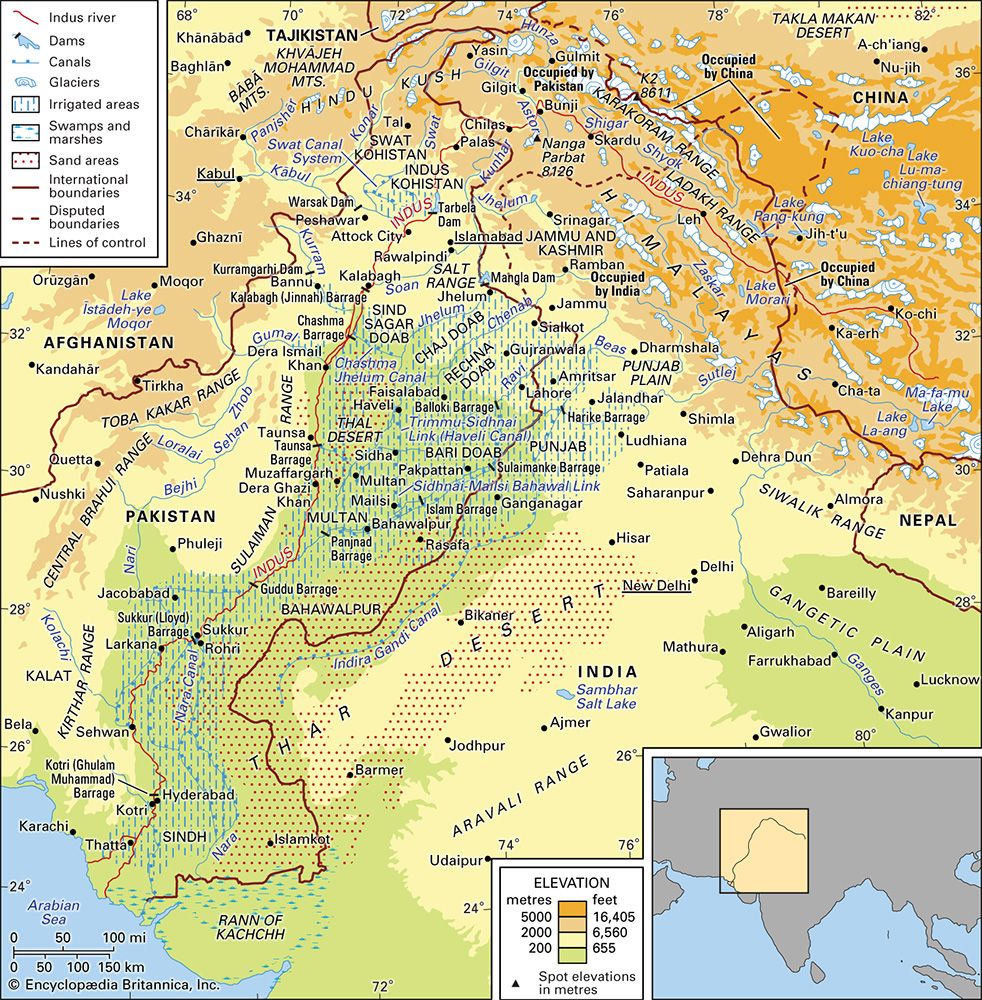
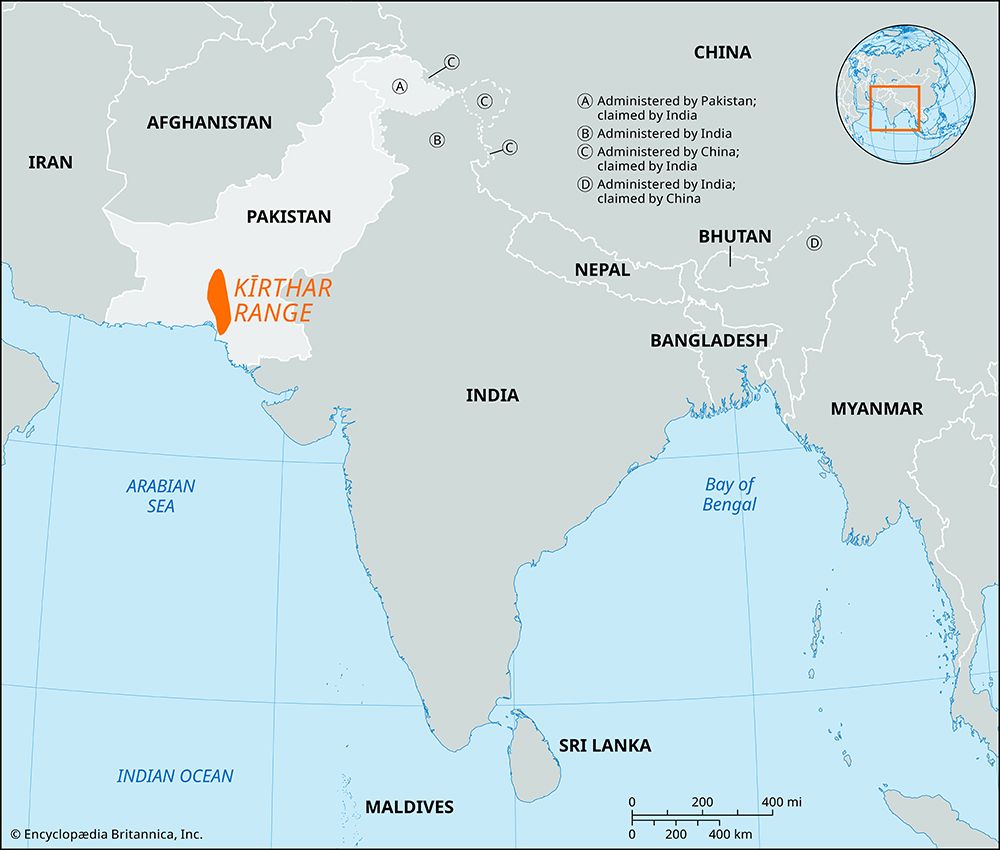
The Kīrthar Range is a mountainous region located in southern Pakistan. Stretching approximately 190 miles (300 km), it runs from the Mūla River in east-central Balochistān down to Cape Muāri, situated west of Karāchi on the Arabian Sea1.
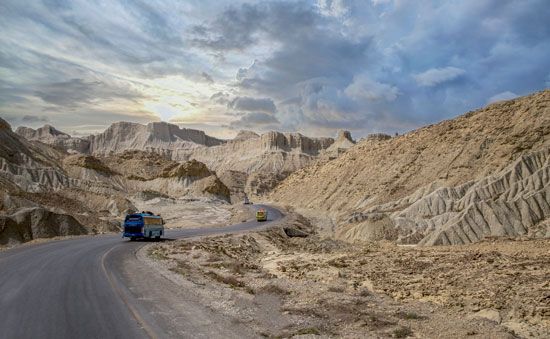
The range serves as a natural boundary between the Lower Indus Plain to the east and southern Balochistān to the west. Its topography is defined by a series of parallel, rocky ridges that increase in elevation from about 4,000 feet (1,200 meters) in the south to nearly 8,000 feet (2,500 meters) in the north. The region is drained by the Kolāchi River in the north and the Hab and Lyāri rivers in the south. The local population, which includes Baloch, Jāṭ, and Brahui tribes, primarily sustains itself through flock grazing.1
What is the significance of the Indus Plain?
The Indus Plain is a vast, fertile expanse covering approximately 200,000 square miles (518,000 square km) in Pakistan, serving as the agricultural heartland of the country. Its significance is defined by several key factors:23
Agricultural and Economic Importance
The plain is the primary source of Pakistan’s agricultural productivity. It relies on a complex irrigation system that transforms what would otherwise be arid, desert-like conditions into productive farmland. The region supports the cultivation of essential crops such as wheat, barley, and cotton. However, this reliance on irrigation has historically led to challenges, including soil salinization and waterlogging, which the government has attempted to mitigate through large-scale drainage projects.23456
Historical Significance
The Indus Plain was the cradle of the Indus civilization, one of the world’s earliest and most extensive civilizations. By mastering irrigated agriculture, early inhabitants of the valley were able to support large populations in major cities like Harappa and Mohenjo-daro, establishing a foundation for political and economic development in the region.57
Physical and Hydrological Role
The plain is built from alluvium deposited by the Indus River and its tributaries. While this sediment creates fertile soil, the river’s slow movement across the flat landscape makes the region prone to significant flooding, which can be both a source of life-giving silt and a destructive force for local communities.83
How do the Baloch and Brahui tribes live in this region?
The Baloch and Brahui tribes in the region of Balochistān share a lifestyle largely centered on pastoralism and flock grazing.910
Lifestyle and Subsistence
- Pastoralism: The Brahui are primarily nomadic goat herdsmen, while the Baloch traditionally raise camels, cattle, sheep, and goats.91
- Settlement Patterns: While traditionally nomadic, settled agricultural existence is becoming increasingly common among the Baloch. Their villages often consist of mud or stone huts, though in hilly areas, they may use temporary enclosures made of rough stone walls covered with matting.1
- Economic Activities: Beyond herding, the Baloch engage in carpet making and embroidery. In some areas, they practice primitive agriculture.1
Social and Cultural Organization
- Tribal Structure: The Baloch are organized into tribes (tuman) consisting of several clans, each acknowledging a chief. The Brahui are organized as a tribal confederacy, with 29 tribes owing loose allegiance to the khan of Kalāt.19
- Religion and Customs: Both groups are predominantly Sunni Muslims. While the Brahui follow Muslim rites, these practices often overlay traditional social customs. Notably, Brahui women are not strictly secluded.91
- Language: The Baloch speak the Balochi language, which is Indo-Iranian. The Brahui speak the Brahui language, which is unique in the region as a member of the Dravidian language family, remaining in isolation from the surrounding Indo-Iranian dialects.19
What are the main geographical features of Balochistan?
Balochistan is characterized by a diverse and rugged landscape, primarily defined by four major physical regions. Its geography is largely shaped by high mountain ranges, arid plateaus, and coastal plains.1510
Major Physical Regions
- Upper Highlands: Located in the central and northeastern areas, this region is bounded by the Sulaiman Range to the east and the Toba Kakar Range to the northwest. It includes the Quetta basin, which acts as a node of high mountain ranges.1510
- Lower Highlands: This region encompasses the eastern slopes of the Sulaiman Range, the Pab and Kirthar ranges in the southeast, and the lower ranges of Makran, Kharan, and Chagai in the west.1510
- Desert and Arid Plains: The northwest contains a true desert region featuring the Chagai, Kharan, and Makran deserts, as well as inland drainage basins and hamuns (playas) like the swamps of Lora and Mashkel.1510
- Coastal Plain: Extending northward from the Arabian Sea, the coastal track consists of level mud flats and sandstone ridges, separated from the interior plateau by the steep face of the Makran Coast Range.1510
The province is largely dry, experiencing continental extremes of heat and cold, and is mostly outside the influence of the Asian monsoon.15
Sources
- Kīrthar Range — Encyclopædia Britannica
- Pakistan: Top Questions — Encyclopædia Britannica
- Indus River - Physical features — Encyclopædia Britannica
- Pakistan - The Indus River plain — Encyclopædia Britannica
- Indus civilization - The recovery and study of the Indus civilization — Encyclopædia Britannica
- Indus civilization: Top Questions — Encyclopædia Britannica
- Indus River - Climate — Encyclopædia Britannica
- Indus River - Plant and animal life — Encyclopædia Britannica
- Brahui — Encyclopædia Britannica
- Baloch — Encyclopædia Britannica
- Pakistan - The Balochistan plateau — Encyclopædia Britannica
- Indus River - Navigation — Encyclopædia Britannica
- Indus River - People of the Indus River — Encyclopædia Britannica
- Primitive culture - Herding societies — Encyclopædia Britannica
- Balochistan — Encyclopædia Britannica
Published on · 4 min read