Kite
Kites are members of the family Accipitridae and are distinguished from other birds of prey by their relatively light build. Physically, they typically…
What are the physical characteristics that distinguish kites from other birds of prey?
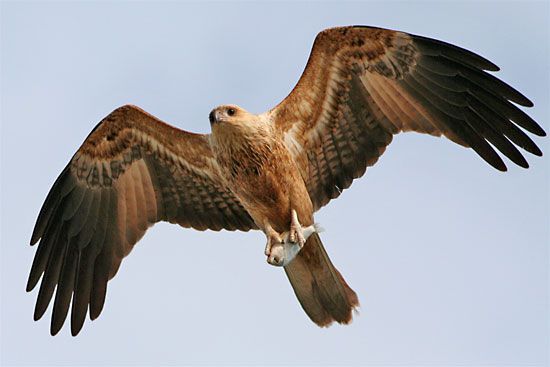
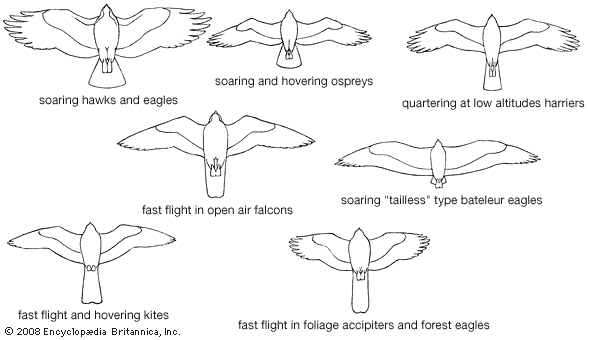
Kites are members of the family Accipitridae and are distinguished from other birds of prey by their relatively light build. Physically, they typically possess a small head, a short beak, and a partly bare face. Their most notable flight characteristics include long, narrow wings and a long tail, which allow them to be buoyant in the air, often gliding and flapping slowly with their wings angled back.1
While some species, such as those in the subfamily Milvinae, have narrow beaks with wavy-edged upper mandibles, others have specialized beaks, such as the sickle-shaped beaks of snail kites adapted for their specific diet. Unlike the broader wings and tails of hawks, which are optimized for maneuverability in wooded areas, the kite’s anatomy supports a graceful, soaring flight style. Additionally, some kites exhibit unique features like forked tails or distinct color patterns, such as the black shoulder patches found on the white-tailed kite.12
How are kites classified within the bird family, and what are some common species?
Kites are classified within the family Accipitridae, which also includes hawks, buzzards, and harriers. Within this family, kites are further categorized into three distinct subfamilies: Milvinae, Elaninae, and Perninae.12
Common Species
Kites are found globally in warm regions, with various species exhibiting specialized adaptations:
- Milvinae (True Kites): This group includes the red kite (Milvus milvus) and the black kite (M. migrans), both widely distributed across the Old World. The Brahminy kite (Haliastur indus) is common from India to Australia, while the buzzard kite (Hamirostra melanosternon) is found in Australia. New World members include the snail kite and the Everglade kite.1
- Elaninae: This subfamily includes the white-tailed kite (Elanus leucurus), which ranges from Argentina to California, and the African swallow-tailed kite (Chelictinia riocourii).1
- Perninae: A notable species in this group is the swallow-tailed kite (Elanoides forficatus), a striking black-and-white bird found in the Americas.1
Where are kites commonly found, and what types of habitats do they prefer?
Kites are found globally, primarily inhabiting warm regions across the world. Their distribution spans diverse environments, including parts of Europe, northern Africa, the Middle East, Asia, Australia, and the Americas.1
Regarding their preferred habitats, kites are highly adaptable to the specific needs of their diet and lifestyle:
- Wetlands and Marshes: Species such as the snail kite and the Everglade kite are closely associated with wetland environments, as they rely exclusively on snails found in these areas.1
- Tropical and Open Landscapes: Many kites, including the swallow-tailed kite, are most common in tropical regions, such as eastern South America, though they also range through Central America and parts of the United States. Others, like the white-tailed kite, thrive in open areas ranging from Argentina to California, where they hunt for rodents.1
- Human-Adjacent Areas: Some species, such as the Brahminy kite, are known to frequent areas where they can scavenge for fish and garbage.1
We could dive deeper into how specific environmental changes are impacting the populations of these birds.
How do kites use their tails in flight, and why is this adaptation important?
In the context of avian biology, the term “kite” refers to birds of prey within the family Accipitridae, rather than the tethered aerodynamic devices used for recreation. While the query conflates these two distinct subjects, it is important to clarify that the aerodynamic principles of a kite (the object) and the biological functions of a kite (the bird) are entirely different.
Biological Function of Tails in Birds
For birds, including kites, the tail is a critical component for flight and survival. A bird’s tail works in conjunction with its wings to provide stability, preventing the bird from falling while in the air. By adjusting the position of their tail feathers, birds can control their pitch, yaw, and roll, allowing for the graceful, buoyant flight characteristic of many kite species.38
Aerodynamics of Tethered Kites
In aeronautics, a “tail” serves a different purpose. Flat kites require a tail to generate drag, which keeps the nose of the kite pointed upward and provides directional stability, functioning much like a rudder on a boat. Conversely, many modern kite designs, such as the box kite or delta kite, are engineered for inherent stability and do not require a physical tail to fly successfully.59
Sources
- Kite — Encyclopædia Britannica
- What are the differences between hawks and falcons? — Encyclopædia Britannica
- kite - Aerodynamics — Encyclopædia Britannica
- Falconiform - Feet and beak — Encyclopædia Britannica
- kite - Kite structure — Encyclopædia Britannica
- Hawk — Encyclopædia Britannica
- kite - Asia — Encyclopædia Britannica
- Forktail — Encyclopædia Britannica
- fork-tailed — Merriam-Webster
- Why Do Animals Have Tails? — Encyclopædia Britannica
Published on · 3 min read