Kobus
The genus Kobus comprises approximately six species of antelopes within the family Bovidae, including waterbucks, lechwes, the kob, and the puku.
What are the main characteristics that define the Kobus genus?
The genus Kobus comprises approximately six species of antelopes within the family Bovidae, including waterbucks, lechwes, the kob, and the puku.1
Key characteristics of the genus include:
- Habitat: Members are native to sub-Saharan Africa and are typically found in herds near water sources, such as floodplains, swamps, woodlands, and plains.1
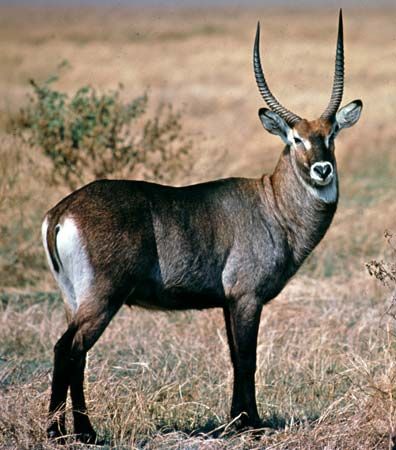
- Physical Traits: Shoulder heights range from 75 to 130 cm depending on the species. A defining feature of all males in the genus is the presence of long, heavily ridged horns that curve backward and then upward.1
- Diversity: Appearance varies significantly by species. Waterbucks are known for their coarse, shaggy coats, while the kob is characterized by a sleek, short coat. Some species exhibit distinct sexual dimorphism, where males display darker, blackish-brown coats compared to the reddish-brown females.1
- Behavior: Several species, such as the kob and lechwe, are noted for forming high-density breeding arenas known as leks.2
How many species are included in the Kobus genus, and what are their common names?
The Kobus genus consists of approximately six species of antelopes native to sub-Saharan Africa. These species are commonly known as:
- Waterbucks: Including the common waterbuck (K. ellipsiprymnus) and the defassa waterbuck (K. defassa).1
- Lechwes: Including the black lechwe (K. leche smithemani) and the Nile lechwe (K. megaceros).1
- Kob: Specifically the kob (K. kob), which includes subspecies such as the Uganda kob.1
- Puku: The puku (K. vardoni).1
These animals are generally associated with habitats near water, such as floodplains, swamps, and woodlands, and are characterized by the long, ridged horns found on all males of the genus.1
What is the typical habitat and geographical distribution of Kobus species?
Members of the Kobus genus are native to sub-Saharan Africa, where they are widely distributed across diverse environments.1
Typical Habitat
These antelopes are characteristically “edge” species that depend on proximity to water. They are typically found in herds within or near the following habitats:13
- Floodplains and Swamps: Many species, particularly lechwes, are highly adapted to marshy, soft-ground environments and rely on water to escape predators.13
- Grasslands and Savannas: Species like the kob prefer open savanna floodplains with short, green pasture.4
- Woodlands and Plains: They are frequently observed in woodland areas and open plains, provided these locations remain near reliable water sources.1
Geographical Distribution
The genus is found throughout Africa south of the Sahara. Specific distributions vary by species:1
- Kob: Ranges from Senegal in the west to the Ethiopian border in the east, extending southward into western Uganda and the eastern Democratic Republic of the Congo.3
- Lechwes: Found in the southern savanna, ranging from the southeastern Democratic Republic of the Congo through Zambia and northern Botswana to Angola, with the Nile lechwe inhabiting the Al-Sudd swamp in South Sudan.3
How do Kobus species differ from other antelope genera?
Members of the Kobus genus are distinguished from other antelope genera primarily by their specialized relationship with water and unique social behaviors. Unlike many slimmer, high-endurance plains antelopes, Kobus species are generally stocky and rely on proximity to water, often using it as a refuge from predators.13
Key differences include:
- Morphological Adaptations: While other antelopes may be built for speed, Kobus species exhibit a stockier build with strong legs and overdeveloped hindquarters, which facilitate a powerful bounding gallop. Their physical traits vary by species, ranging from the shaggy, coarse-coated waterbucks to the short-nosed, long-hooved lechwes adapted for swampy terrain.31
- Breeding Behavior: The genus is notable for its complex social structure. Along with the topi, Kobus species are among the few antelopes known to form high-density breeding arenas called leks, where males compete for females in concentrated areas.3
- Sexual Dimorphism: Males of all Kobus species possess long, heavily ridged horns that curve backward and upward, and they often display significant sexual dimorphism in coat color compared to females.13
Sources
- Kobus — Encyclopædia Britannica
- Kobus — Merriam-Webster
- kob — Encyclopædia Britannica
- lechwe — Encyclopædia Britannica
- kudu — Encyclopædia Britannica
Published on · 3 min read