Königssee
Königssee is a picturesque lake located in the state of Bavaria, southern Germany. Situated just south of the town of Berchtesgaden, the lake is nestled…
What is Königssee?
Königssee is a picturesque lake located in the state of Bavaria, southern Germany. Situated just south of the town of Berchtesgaden, the lake is nestled within the Berchtesgaden National Park and is surrounded by dramatic, sheer limestone mountains of the Berchtesgadener Alps.1
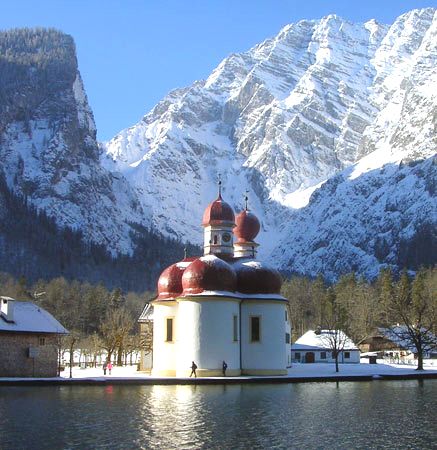
The lake spans 5 miles (8 km) in length and reaches a maximum depth of 617 feet (188 m). A notable landmark on its western shore is the St. Bartholomew pilgrimage church and hunting lodge, which historically served the prince-bishops of Salzburg and the Bavarian monarchy. Known for its clear waters, the lake is also home to populations of Alpine trout, specifically arctic char.1
What is the significance of Berchtesgaden National Park?
Berchtesgaden National Park is significant primarily for its role in environmental conservation. It serves to protect the original Alpine landscape, including its unique plants and animals, from the steady encroachment of urbanization.2
By preserving this ecosystem, the park ensures that the natural heritage of the Bavarian Alps remains intact for future generations. The park is also closely linked to the scenic beauty of the region, encompassing landmarks such as the Königssee, which is a major draw for the local tourist trade.23
How do the surrounding limestone mountains affect the lake’s environment?
The sheer limestone mountains surrounding Königssee play a fundamental role in shaping the lake’s environment. Geologically, the lake occupies a deep, narrow valley carved by glaciers during the Pleistocene Epoch, which created its characteristic depth and steep-walled basin.14
These mountains influence the lake’s water chemistry and appearance. The surrounding geology is rich in calcium and magnesium, which dissolve into the water as bicarbonate, a common trait among Alpine lakes. Furthermore, the erosion of the limestone terrain contributes to the lake’s sediment profile. While glacial runoff often introduces fine-grained rock flour that can influence the water’s color, the presence of these mountains also creates a sheltered environment that can affect water circulation patterns, potentially leading to specific thermal characteristics like the thermocline or, in some cases, limited winter circulation.45
What is the history of the St. Bartholomew pilgrimage church?
The St. Bartholomew pilgrimage church is located on the west shore of the Königssee in southern Germany. Historically, the site served a dual purpose, functioning as both a place of religious pilgrimage and a hunting lodge.
Ownership of the property transitioned through significant regional powers over the centuries. It formerly belonged to the prince-bishops of Salzburg before eventually passing to the kings of Bavaria. The church is named after St. Bartholomew, one of the Twelve Apostles, who is traditionally associated with missionary work and martyrdom in the 1st century CE.16
Sources
- Königssee — Encyclopædia Britannica
- Bavarian Alps — Encyclopædia Britannica
- Berchtesgaden — Encyclopædia Britannica
- Alpine lakes — Encyclopædia Britannica
- glacier - Glacier hydrology — Encyclopædia Britannica
- St. Bartholomew — Encyclopædia Britannica
Published on · 2 min read