Kookaburra
The kookaburra is deeply embedded in the linguistic and cultural heritage of Australia. The name itself is derived from gugubarra, a word from the Wiradhuri…
How do kookaburras fit into Aboriginal Australian folklore and culture?
The kookaburra is deeply embedded in the linguistic and cultural heritage of Australia. The name itself is derived from gugubarra, a word from the Wiradhuri language, which is an Australian Aboriginal language spoken in central New South Wales.1
While the bird is widely recognized for its distinctive call—often described as sounding like human laughter—it is also frequently referred to as the “bushman’s clock” because of its habit of calling at dawn and dusk. Beyond its role in language, the kookaburra is a significant figure in the Australian landscape, known for its territorial nature and its ability to hunt small vertebrates, including venomous snakes.2
Although the provided records highlight the bird’s etymological roots and its reputation in the Australian bush, they do not detail specific mythological narratives or spiritual roles within Aboriginal folklore.
Where are kookaburras native to, and in what habitats do they typically live?
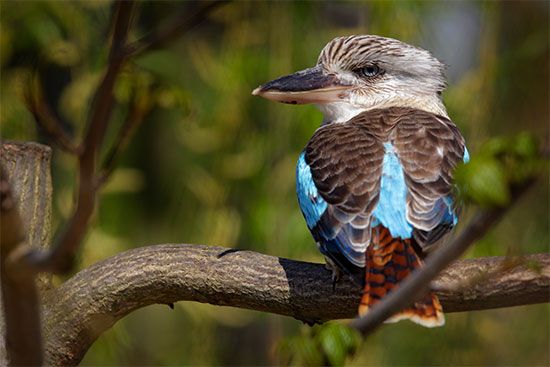
Kookaburras are native to eastern Australia, where they primarily inhabit woodland environments. While the laughing kookaburra (Dacelo novaeguineae) is indigenous to the eastern part of the continent, it has also been introduced to western Australia and New Zealand. Additionally, the related blue-winged kookaburra (D. leachii) is found across northern Australia.1
These birds are known for being territorial and typically nest in tree holes. As members of the kingfisher family, they are well-adapted to their woodland habitats, where they hunt a variety of prey, including invertebrates and small vertebrates such as venomous snakes.1
Why is the kookaburra’s call often described as a ‘laughing’ sound, and what purpose does it serve?
The kookaburra (Dacelo novaeguineae) is famous for its distinctive call, which is frequently described as sounding like “fiendish” or loud human laughter. This unique vocalization is so iconic that the bird is historically referred to as the “laughing jackass”.12
Regarding its purpose, the call serves as a vital tool for the bird’s social and territorial behavior. Kookaburras are highly territorial creatures that defend their home ranges year-round. By vocalizing, particularly at dawn and dusk—earning them the nickname “bushman’s clock”—they communicate with other members of their species to establish and maintain their territory. Because these birds are monogamous and often live in family groups where offspring remain to help raise subsequent broods, these vocalizations likely play a key role in maintaining group cohesion and signaling presence to rivals.1
How many species of kookaburra exist, and what are their main differences?
There are two primary species of kookaburra recognized within the genus Dacelo: the laughing kookaburra (Dacelo novaeguineae) and the blue-winged kookaburra (D. leachii).1
The main differences between these two species include:
- Vocalization: The laughing kookaburra is famous for its distinctive call, which mimics the sound of human laughter. In contrast, the blue-winged kookaburra does not produce this “laughing” sound.1
- Geographic Range: The laughing kookaburra is native to eastern Australia, though it has been introduced to western Australia and New Zealand. The blue-winged kookaburra is found across northern Australia.1
Both species belong to the kingfisher family and share similar characteristics, such as being woodland-dwelling birds that nest in tree holes and defend their territories.1
We could dive deeper into the evolutionary history of the kingfisher family or explore other unique avian species found in Australia.
Sources
- Kookaburra — Encyclopædia Britannica
- kookaburra — Merriam-Webster
Published on · 2 min read