Labrador Tea
Labrador tea refers to three species of low-growing, evergreen perennial shrubs in the Rhododendron genus, specifically R. groenlandicum (bog Labrador tea)…
How can you identify Labrador tea plants in the wild?
Labrador tea refers to three species of low-growing, evergreen perennial shrubs in the Rhododendron genus, specifically R. groenlandicum (bog Labrador tea), R. tomentosum (marsh Labrador tea), and R. columbianum (western Labrador tea).12
To identify these plants in the wild, look for the following characteristics:
- Habitat: They typically grow in cold, boggy areas.1
- Stems: The twigs are characteristically reddish.1
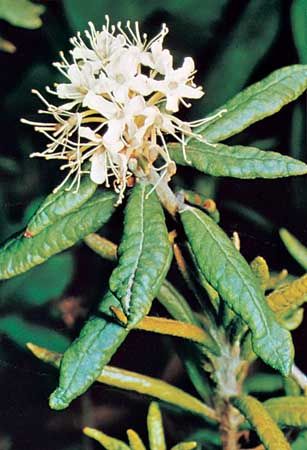
- Leaves: The leaves are elliptical with smooth, recurved margins. A key identifying feature is the presence of a rusty-colored “wool” on the underside of the leaves.1
- Flowers: The plants produce terminal clusters of white or creamy flowers, each about 2 cm (0.8 inch) wide, featuring five sepals and five petals.1
Please note that while these plants have been used traditionally for tea, they can be toxic, and caution should be exercised regarding their consumption.1
What other plants are closely related to Labrador tea?
Labrador tea plants belong to the genus Rhododendron within the heath family (Ericaceae), a diverse group comprising approximately 126 genera and 4,000 species of flowering plants.15
Because they are members of the Rhododendron genus, Labrador tea is closely related to a wide variety of woody plants, including:
- Ornamental Rhododendrons: This includes numerous species cultivated for their attractive flowers and foliage, such as the catawba rhododendron (R. catawbiense) and the great laurel rhododendron (R. maximum).4
- Azaleas: Many species formerly classified in their own genus are now included within Rhododendron and are widely grown for their vibrant blooms.54
- Rhodora: A specific species (R. canadense) native to northeastern North America that is known for producing rosy-purple flowers before its leaves emerge.4
Beyond the Rhododendron genus, the broader heath family includes other well-known plants such as blueberries, mountain laurel, and the various species of heath (Erica)5.
What are the traditional medicinal uses of Labrador tea?
The leaves of Labrador tea (Rhododendron groenlandicum, R. tomentosum, and R. columbianum) have a long history of use by Indigenous peoples for making tea and as a component in traditional herbal medicines.1
While these plants are valued for their traditional applications, it is important to approach their use with caution. The plants contain compounds that can be toxic, and their medicinal efficacy and safety profile are not clinically established.1
What are the different species of Labrador tea plants?
Labrador tea refers to three species of low-growing, evergreen perennial shrubs within the Rhododendron genus of the heath family. These plants were formerly classified in the genus Ledum, which was distinguished by having separate petals and capsules that open from the bottom first.14
The three species are:
- Bog Labrador tea (R. groenlandicum): Found in cold, boggy environments, this shrub grows to approximately 1 meter (3 feet) in height. It is characterized by reddish twigs, elliptical leaves with recurved margins, and a distinctive rusty “wool” on the underside of the leaves.1
- Marsh Labrador tea (R. tomentosum): A circumpolar species that is also native to eastern North America.1
- Western Labrador tea (R. columbianum): A closely related shrub native to the Rocky Mountain region. related shrub native to the Rocky Mountain region.1
While these plants have been used traditionally to make tea, it is important to note that they can be toxic.14
Sources
- Labrador tea — Encyclopædia Britannica
- Labrador tea — Merriam-Webster
- rhodora — Encyclopædia Britannica
- rhododendron — Encyclopædia Britannica
- Ericaceae — Encyclopædia Britannica
- heath — Encyclopædia Britannica
Published on · 2 min read