Lacustrine Ecosystem
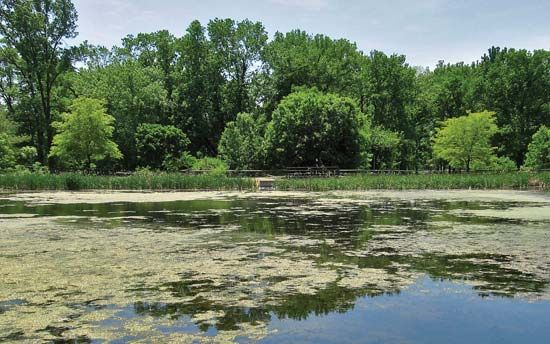
A lacustrine ecosystem refers to any lake or pond viewed as an ecosystem. Unlike lotic (riverine) systems characterized by flowing water, lacustrine…
What is a lacustrine ecosystem and what are its main characteristics?
A lacustrine ecosystem refers to any lake or pond viewed as an ecosystem. Unlike lotic (riverine) systems characterized by flowing water, lacustrine environments are defined by standing water.12
Main Characteristics
- Zonation: Lakes are typically divided into three habitat zones: the littoral (shallow, light-penetrating area with rooted plants), the limnetic (open water supporting plankton), and the profundal (deep, dark area).1
- Stratification: Larger, deeper lakes often exhibit stratification in temperature, light, and oxygen concentration, which dictates the distribution of aquatic life.1
- Chemical Composition: Salinity and nutrient levels vary based on geological erosion and human impact. Oxygen levels are critical and fluctuate due to biological processes like photosynthesis and decay, as well as seasonal water turnover.3
- Seasonal Dynamics: These systems experience significant seasonal changes, including thermal stratification and water mixing, which are essential for replenishing oxygen.13
What are the major zones of a typical lacustrine ecosystem?
A typical lacustrine ecosystem is generally organized into three major habitat zones based on depth and light penetration:1
- Littoral Zone: This is the shallow-water area near the shore. Because light penetrates to the bottom, this zone supports rooted aquatic plants and a variety of bottom-dwelling animals.1
- Limnetic Zone: This refers to the open water where light penetration is effective. It serves as the primary habitat for plant and animal plankton.1
- Profundal Zone: This is the deepwater area and lake bottom that lies beyond the reach of effective light penetration. It is inhabited by dark-adapted organisms.14
In addition to these zones, deeper lakes often exhibit thermal stratification, characterized by an upper layer of warmer water (the epilimnion) and a cooler lower layer (the hypolimnion), separated by a region of rapid temperature change known as the thermocline.5
What are the differences between lacustrine and riverine ecosystems?
The primary distinction between lacustrine (lentic) and riverine (lotic) ecosystems is the movement of water: lacustrine systems consist of standing water, while riverine systems are defined by unidirectional flow.13
Key Differences
- Water Dynamics: Lacustrine environments are characterized by standing water, where residence time is a critical factor. In contrast, riverine environments feature constant, unidirectional flow, which dictates the transport of nutrients and organisms downstream.13
- Biological Communities: In lacustrine systems, plankton are a major component of the food web. Conversely, plankton populations are typically absent in streams, where much of the energy is derived allochthonously (from outside the stream) and processed in a downstream sequence.8
- Adaptations: Organisms in riverine systems must evolve mechanisms to anchor themselves to the substrate to avoid being washed away by currents. In lacustrine systems, organisms are more adapted to stratified conditions involving light, temperature, and oxygen gradients.91
- Nutrient Cycling: Riverine ecosystems utilize “nutrient spiraling,” where nutrients are cycled as they are carried downstream. Lacustrine systems rely more on internal cycling, often influenced by seasonal water turnover and thermal stratification.819
How do seasonal changes affect lacustrine ecosystems?
Seasonal changes profoundly influence lacustrine ecosystems, primarily by driving thermal patterns that dictate the distribution of oxygen and nutrients. In temperate regions, these changes often result in a dimictic cycle, characterized by two periods of vertical mixing, or “overturn,” in the spring and autumn.10112
Thermal Stratification and Overturn
- Summer Stratification: As surface waters warm, they become less dense and form a distinct upper layer called the epilimnion, which is separated from the colder, denser hypolimnion by a transition zone known as the metalimnion. This stratification prevents mixing between the layers.10
- Autumn and Spring Overturn: As surface temperatures cool in autumn, the water density increases, causing the layers to sink and mix with the help of wind. This process replenishes oxygen throughout the water column. A similar turnover occurs in the spring after surface ice melts.1012
- Winter: Ice cover may form, protecting the lake from wind and potentially leading to oxygen depletion in deeper waters if the ice persists for long periods.212
These cycles are critical because they regulate the availability of dissolved oxygen and nutrients, which are essential for the survival of aquatic organisms.1012
Sources
- lacustrine ecosystem — Encyclopædia Britannica
- lake - Salinity, nutrients , and oxygen — Encyclopædia Britannica
- Inland water ecosystem - Running water — Encyclopædia Britannica
- hydrologic sciences - The physical characteristics of lakes — Encyclopædia Britannica
- lake - Topography of basins — Encyclopædia Britannica
- profundal — Merriam-Webster
- Marine ecosystem - Geography, oceanography, and topography — Encyclopædia Britannica
- Biosphere - Water currents — Encyclopædia Britannica
- Inland water ecosystem - Population and community development and structure — Encyclopædia Britannica
- lake - Vertical mixing and overturn — Encyclopædia Britannica
- Inland water ecosystem - Permanent bodies of standing fresh water — Encyclopædia Britannica
- Marine ecosystem - Seasonal cycles of production — Encyclopædia Britannica
Published on · 3 min read