Inland Water Ecosystem
Human activities have profoundly impacted the biodiversity of freshwater habitats, which have experienced an 83 percent decline in vertebrate populations…
How do human activities impact the biodiversity of freshwater habitats?
Human activities have profoundly impacted the biodiversity of freshwater habitats, which have experienced an 83 percent decline in vertebrate populations since 1970—the highest rate of loss among all ecosystem types. These impacts are driven by several interconnected factors:1
- Habitat Loss and Degradation: The conversion of wetlands for agriculture, urban expansion, and infrastructure—including draining, filling, and the canalization of rivers—destroys essential living spaces and food resources.231
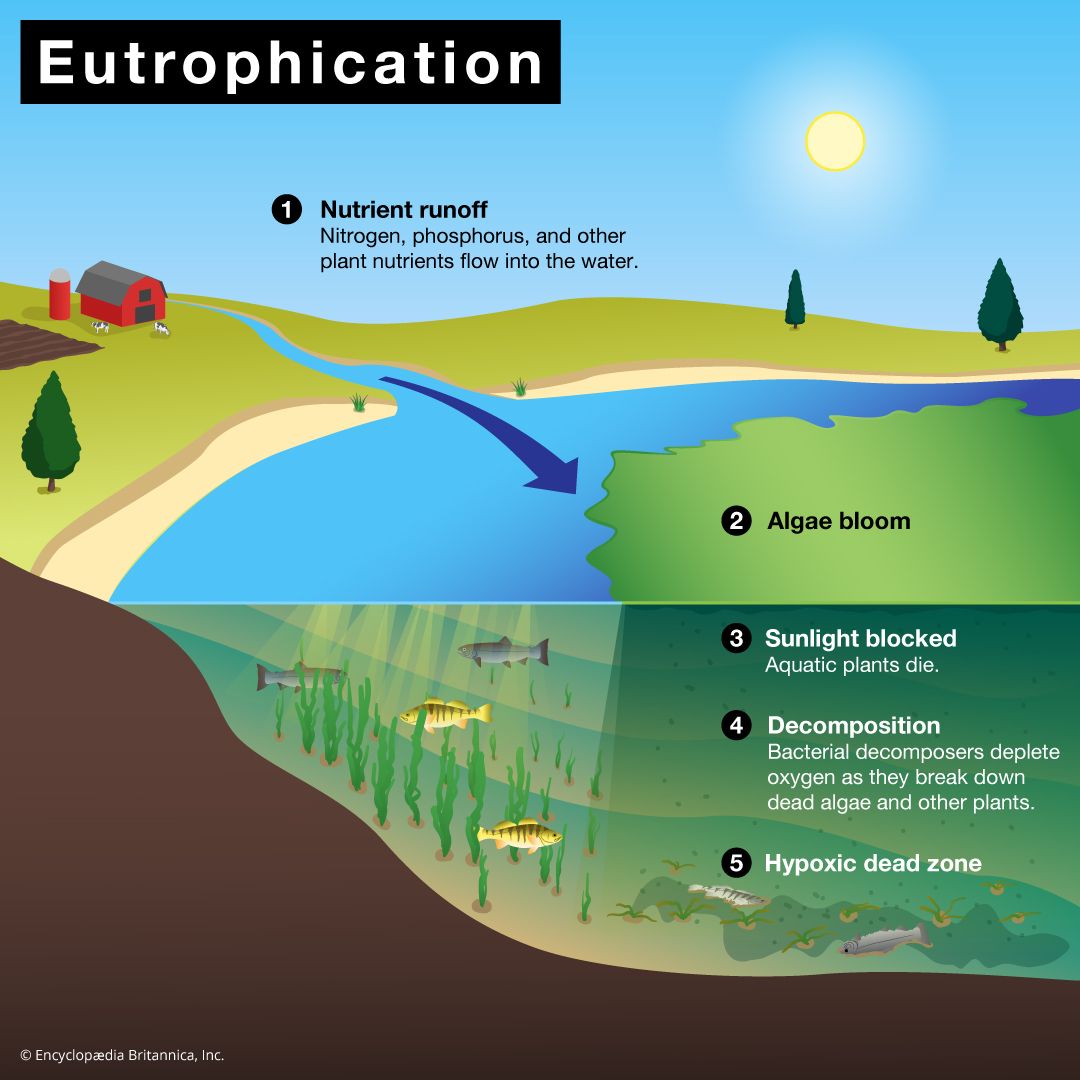
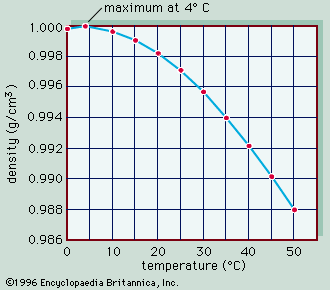
- Pollution: Industrial, agricultural, and domestic waste introduces toxic chemicals, heavy metals, and excess nutrients into waterways. Fertilizer runoff often triggers eutrophication and harmful algae blooms, while industrial thermal pollution can deplete dissolved oxygen, making survival impossible for sensitive species.432
- Invasive Species: Human activities facilitate the introduction of non-native species, which can outcompete native organisms for resources or act as predators, often leading to localized extinctions.35
- Overexploitation: The unsustainable harvesting of freshwater species for food, traditional medicine, and the pet trade significantly reduces population numbers.31
- Climate Change: Rapidly shifting temperatures and precipitation patterns disrupt established ecological balances, threatening species that cannot adapt or migrate.316
What are some examples of keystone species in freshwater habitats?
In ecology, a keystone species is an organism that exerts a disproportionately large influence on its environment relative to its abundance. By controlling dominant populations or providing essential resources, these species maintain the structure and biodiversity of their communities.48
In freshwater habitats, prominent examples include:
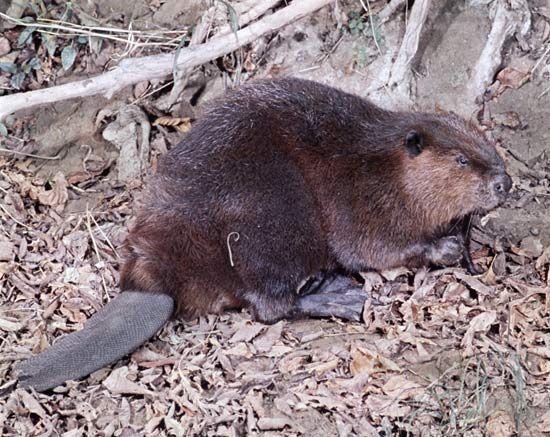
- Beavers: Often called “ecosystem engineers,” beavers significantly alter their environment by building dams. These structures create ponds and wetlands that provide critical habitats, food, and shelter for a wide variety of fish, waterfowl, and other aquatic organisms that would not otherwise thrive in those areas.9
- Top Carnivores: In many freshwater lakes, predatory fish such as bass and yellow perch act as keystone species by initiating trophic cascades. By regulating the populations of smaller fish and herbivorous zooplankton, these predators indirectly control the biomass of phytoplankton, thereby influencing water quality, nutrient cycling, and the overall balance of the ecosystem.10
How do seasonal changes affect inland water ecosystems?
Seasonal changes significantly influence inland water ecosystems by driving physical, chemical, and biological variations.
Thermal Stratification and Mixing
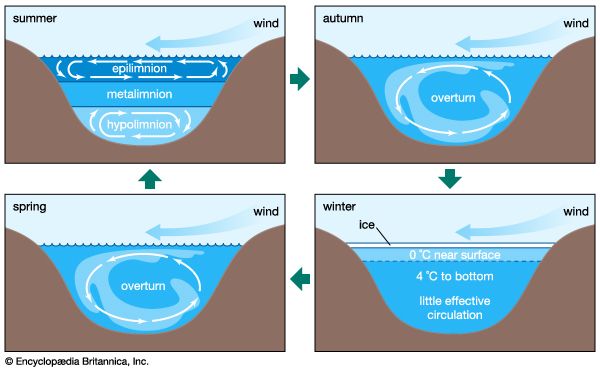
In deep, temperate freshwater lakes, seasonal temperature shifts dictate water movement. Many exhibit a dimictic pattern, where the lake undergoes two mixing periods—in spring and autumn—per year. During summer, these lakes stratify, forming a warm surface layer (epilimnion) that does not mix with the colder, deeper layer (hypolimnion). As autumn temperatures drop, the surface water cools and sinks, causing the lake to “overturn” and circulate completely until winter ice forms. This cycle repeats in the spring after the ice melts.14
Physicochemical and Biological Impacts
These thermal patterns regulate the distribution of dissolved gases and nutrients. In summer, oxygen levels may be high in the epilimnion but low in the hypolimnion, a critical factor for the survival of aquatic animals. Additionally, seasonal changes influence plankton production; in temperate regions, abundance often peaks in spring as daylight and temperatures increase, facilitating growth.1415
Hydrological Disturbances
In riverine systems and wetlands, seasonal cycles manifest through flooding. Floodplains are regularly inundated during wet seasons, which serves a vital hydrologic role by storing excess water and mitigating downstream flood crests.1617
What are the main types of inland water ecosystems?
Inland water ecosystems, which comprise less than 1 percent of the biosphere’s water, are primarily classified based on the movement of water into two main categories: lotic (running-water) and lentic (standing-water) systems.20
Lotic Ecosystems
Lotic habitats include rivers, streams, and brooks. These environments are characterized by the unidirectional flow of water, a generally linear morphology, and shallow depth. They are further divided into two zones:2021
- Rapids: Shallow areas with strong currents that keep the bottom clear and firm.22
- Pools: Deeper areas where reduced currents allow silt and debris to collect.22
Lentic Ecosystems
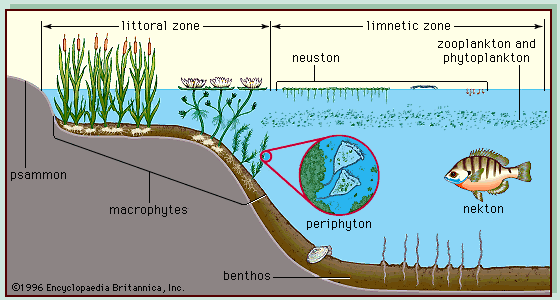
Lentic habitats include lakes, ponds, and marshes./science/pond), and marshes. Ponds are typically shallow with significant light penetration, while lakes are deeper and often exhibit thermal stratification. Lentic systems are frequently categorized into three habitat zones:2023
- Littoral: The shallow-water zone where light reaches the bottom, supporting rooted plants.23
- Limnetic: The open-water zone with effective light penetration, supporting plankton.23
- Profundal: The deep, dark bottom area beyond light penetration.23
Additionally, wetlands—which include bogs, swamps, and fens—represent complex ecosystems defined by soil saturation or flooding.24
Sources
- Wetland - Disturbances caused by humans — Encyclopædia Britannica
- water pollution: Top Questions — Encyclopædia Britannica
- endangered species - Balancing human activities with conservation — Encyclopædia Britannica
- Why do beavers build dams? — Encyclopædia Britannica
- biodiversity loss - Human-driven biodiversity loss — Encyclopædia Britannica
- invasive species — Encyclopædia Britannica
- Wetland - Effects of climate change — Encyclopædia Britannica
- trophic cascade — Encyclopædia Britannica
- macroinvertebrate — Encyclopædia Britannica
- mussel — Encyclopædia Britannica
- bivalve - Importance — Encyclopædia Britannica
- keystone species — Encyclopædia Britannica
- community ecology - Keystone species — Encyclopædia Britannica
- Inland water ecosystem - Permanent bodies of standing fresh water — Encyclopædia Britannica
- ice in lakes and rivers - The seasonal cycle — Encyclopædia Britannica
- Marine ecosystem - Seasonal cycles of production — Encyclopædia Britannica
- Wetland - Natural disturbances — Encyclopædia Britannica
- river - Floodplains — Encyclopædia Britannica
- sea ice - Interactions with the oceans , atmosphere , and climate — Encyclopædia Britannica
- Inland water ecosystem - The origin of inland waters — Encyclopædia Britannica
- lacustrine ecosystem — Encyclopædia Britannica
- Wetland — Encyclopædia Britannica
- Inland water ecosystem - Running water — Encyclopædia Britannica
- Inland water ecosystem - Population and community development and structure — Encyclopædia Britannica
- riverine ecosystem — Encyclopædia Britannica
Published on · 4 min read