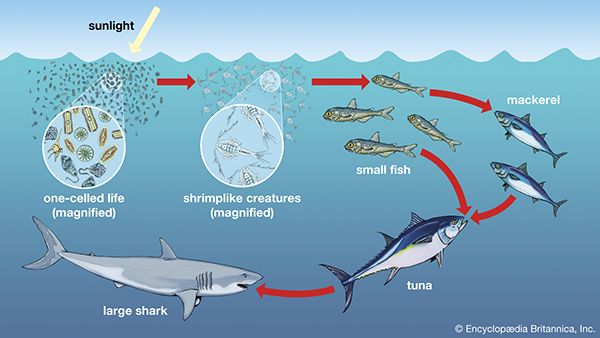
Marine Ecosystem
Marine food webs are complex, interconnected networks of feeding relationships that illustrate how energy and matter move through an ecosystem. While simple…
How do marine food webs function, and what role do primary producers play?
Marine food webs are complex, interconnected networks of feeding relationships that illustrate how energy and matter move through an ecosystem. While simple food chains depict linear paths of consumption, food webs account for the reality that most organisms consume, or are consumed by, multiple species across various trophic levels.12
The Role of Primary Producers
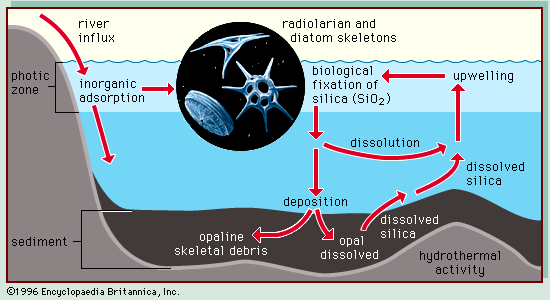
Primary producers, or autotrophs, form the base of the trophic pyramid. In most marine environments, these are phytoplankton—freely floating organisms that harness solar energy through photosynthesis to convert carbon dioxide and minerals into organic substances. In unique deep-sea habitats, chemoautotrophs serve as producers by using geothermal energy to fix carbon.2134
These producers are essential because they provide the foundational energy required by all heterotrophs, including zooplankton, fish, and marine mammals. As energy moves up the pyramid, significant amounts are lost as heat during metabolic processes, meaning higher-level consumers have less total energy available to them.52
How do human activities, such as fishing and pollution, affect marine ecosystems?
Human activities significantly alter marine ecosystems through various forms of pollution, overharvesting, and the emission of greenhouse gases. These interventions disrupt the delicate balance of marine life and the chemical composition of the oceans.
Pollution and Eutrophication
- Plastic Pollution: Millions of tons of plastic enter the oceans annually, originating from land-based sources like urban runoff and industrial waste. This debris harms marine life through entanglement and ingestion, often leading to mortality. As plastics break down into microplastics, they are consumed by organisms at all levels of the food web, potentially bioaccumulating toxic chemicals in their tissues.6
- Cultural Eutrophication: Human activities, particularly agriculture and industrial discharge, introduce excess nutrients like nitrogen and phosphorus into coastal waters. This triggers massive algal blooms; when these organisms die and decompose, they deplete oxygen levels, creating “dead zones” where marine life cannot survive.78
Overfishing and Trophic Cascades
The overharvesting of top predators, such as cod and sharks, triggers trophic cascades. The removal of these apex species allows populations of smaller predators or herbivores to explode, which in turn can decimate primary producers like kelp forests or alter the entire structure of the ecosystem.9
Ocean Acidification
The absorption of atmospheric carbon dioxide by the oceans has increased seawater acidity by approximately 30 percent since the Industrial Revolution. This ocean acidification reduces the availability of carbonate ions, making it difficult for calcifying organisms like corals and shellfish to build their skeletons and shells, threatening the stability of marine food chains.2
How does ocean acidification impact marine life and ecosystems?
Ocean acidification is the ongoing reduction in the pH of seawater caused primarily by the ocean’s absorption of excess carbon dioxide from the atmosphere. Since the Industrial Revolution, the ocean has absorbed a significant portion of human-generated CO2, leading to a 30 percent increase in acidity.811
Impacts on Marine Life
- Calcifying Organisms: Marine calcifiers, such as coral and shellfish, rely on carbonate ions to build their skeletons and shells. As acidity rises, these ions become less available, hindering growth and making these organisms more vulnerable to predators.811
- Physiological Stress: Larger animals like squid and fishes may suffer from acidosis, a condition where carbonic acid accumulates in body fluids, potentially impairing their respiration, growth, and reproduction.811
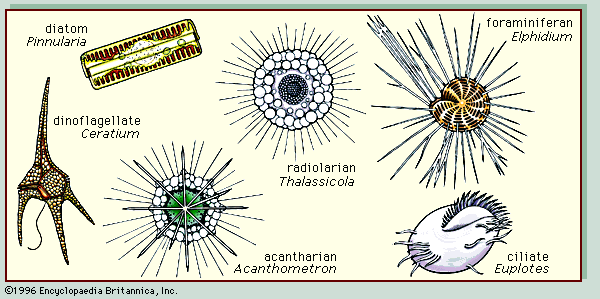
- Food Web Disruptions: The decline of foundational species like pteropods, foraminiferans, and coccoliths forces predators to switch food sources, which can destabilize entire food chains.811
Ecosystem Consequences
The degradation of coral reefs—vital centers of biodiversity—threatens the habitats of countless species. Furthermore, scientists predict that reduced phytoplankton populations could diminish the production of dimethyl sulfide, a gas that helps reflect solar radiation, potentially creating a positive feedback loop that intensifies global warming.8
What is the importance of coral reefs in marine ecosystems?
Coral reefs are among the most complex and biologically diverse ecosystems on Earth, second only to tropical rainforests in terms of species richness. They provide essential support for approximately 25 percent of all marine species, serving as critical habitats and nurseries for a vast array of fish, crustaceans, and other marine life.1314
The structural foundation of these ecosystems is built by stony corals, which secrete calcium carbonate skeletons. This process is significantly enhanced by a symbiotic relationship with zooxanthellae, photosynthetic algae that live within the coral tissues. Beyond providing physical structure, reefs act as “oases” of high productivity in the open ocean, facilitating rapid nutrient cycling and supporting complex food chains.131516
Furthermore, reefs provide vital environmental services, including protecting shorelines from storm surges and erosion. Because they harbor such high biodiversity, they are essential to the health of global marine environments and the sustainability of local fisheries.141718
Sources
- Marine ecosystem - The pelagic food chain — Encyclopædia Britannica
- primary productivity — Encyclopædia Britannica
- phytoplankton — Encyclopædia Britannica
- trophic pyramid — Encyclopædia Britannica
- food web — Encyclopædia Britannica
- plastic pollution - Plastic pollution in oceans and on land — Encyclopædia Britannica
- conservation - Pollution — Encyclopædia Britannica
- ocean acidification — Encyclopædia Britannica
- trophic cascade — Encyclopædia Britannica
- hydrosphere - Eutrophication — Encyclopædia Britannica
- Acid rain - Effects on lakes and rivers — Encyclopædia Britannica
- Ocean Acidification: How Carbon Dioxide Is Hurting the Seas — Encyclopædia Britannica
- Coral Bleaching: A Threat to Our Reefs — Encyclopædia Britannica
- mangrove: Top Questions — Encyclopædia Britannica
- coral reef - Corals and other reef-building organisms — Encyclopædia Britannica
- Marine ecosystem - Benthos — Encyclopædia Britannica
- coral reef - Biological factors — Encyclopædia Britannica
- artificial reef: Top Questions — Encyclopædia Britannica
- coral reef - Other threats — Encyclopædia Britannica
- coral reef - Winds , currents, temperature, and salinity — Encyclopædia Britannica
Published on · 4 min read