Ladyfish
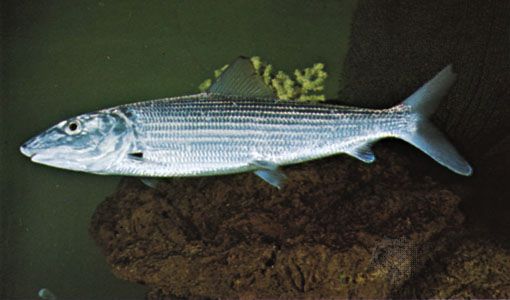
The ladyfish (Elops saurus) is a slender, pikelike fish belonging to the family Elopidae and the order Elopiformes. Primarily found in tropical coastal…
What is ladyfish?
The ladyfish (Elops saurus) is a slender, pikelike fish belonging to the family Elopidae and the order Elopiformes. Primarily found in tropical coastal marine waters, it is closely related to the tarpon and the bonefish.12
Key characteristics of the ladyfish include:
- Appearance: It is covered in fine silver scales and can reach lengths of up to 90 cm (35 inches) and weights of approximately 13.6 kg (30 pounds).12
- Anatomy: It features small, sharp teeth, a bony throat plate between its mandibles, and specialized grooves that allow its dorsal and anal fins to be depressed.1
- Behavior: As a predatory fish, it feeds mainly on other smaller fish. Like tarpons, ladyfish are known to “roll” at the surface, a behavior believed to facilitate the intake of air into their swim bladders.2
- Lifecycle: They are prolific breeders that spawn near the shore. Their larvae, known as leptocephali, are transparent, ribbonlike, and undergo a striking metamorphosis.2
The name “ladyfish” is sometimes applied to other marine species, such as the bonefish or the Spanish ladyfish (Bodianus rufus).13
What is a leptocephalus larva and how does it change as it grows?
A leptocephalus is the specialized, planktonic larva of various eels and related orders, including tarpons, gulpers, and bonefishes.45
Characteristics of the Leptocephalus
Typically, a leptocephalus is transparent, gelatinous, and laterally compressed, often resembling a leaf in shape. Its anatomy includes:45
- Body: An elongated, thin body with prominent W-shaped muscle segments (myomeres).4
- Teeth: Sharp, forward-directed larval teeth used for feeding.4
- Diversity: While many are ribbonlike, some species are deep-bodied, and they vary significantly in size, ranging from 5 cm to 45 cm at full growth.4
Metamorphosis
After spending months or even years floating in the open ocean, the larva undergoes a rapid metamorphosis to transition into a juvenile or adult form. During this process:5
- Body Shape: The body becomes cylindrical and significantly reduced in bulk, sometimes losing up to 90 percent of its weight.5
- Structural Changes: The larval teeth are lost, the snout becomes rounded, and the anal vent shifts toward the midpoint of the body.5
- Pigmentation: Larval melanophores (black pigment cells) typically disappear, though some may persist into the juvenile stage.5
- Development: The dorsal fin often shifts position, and the larva prepares for its adult mode of life, whether in deep-sea, shallow-water, or freshwater environments.5
Why do ladyfish and tarpons need to breathe air at the surface?
Ladyfish and tarpons breathe air at the surface because they are primitive teleosts that possess an open duct connecting their alimentary tract to their swim bladder. This anatomical feature allows them to take in air at the mouth and pass it into the swim bladder, which functions as an accessory breathing organ.9210
This adaptation is particularly vital for survival in the stagnant, low-oxygen environments—such as brackish pools or creeks—where these fish often spend their postlarval life. In the case of tarpons, the swim bladder is highly vascularized and lunglike; they are considered obligate air breathers and will die from asphyxiation if they are prevented from reaching the surface, even when inhabiting well-oxygenated water. For both species, the behavior of “rolling” at the surface is a direct mechanism to facilitate this essential intake of atmospheric air.92
How do scientists distinguish between ladyfish and bonefish?
Scientists distinguish between ladyfish and bonefish primarily through their taxonomic classification, as they belong to different orders within the superorder Elopomorpha.
- Taxonomy: Ladyfish belong to the order Elopiformes (family Elopidae), while bonefish are classified in the order Albuliformes.1
- Physical Features: The ladyfish is characterized by a slender, pikelike body covered in fine silver scales, and it possesses a distinct bony throat plate between its mandibles. In contrast, the bonefish (Albula vulpes) is a slender, silvery fish known for its small scales and is a distinct species from the ladyfish, though the name “ladyfish” is sometimes colloquially applied to it.2112
- Classification History: Historically, these groups were sometimes classified together because they both lacked the specialized eel-like characteristics found in other members of the superorder Elopomorpha. However, modern taxonomists now place them in separate orders due to their distinct evolutionary lineages.1
Sources
- ladyfish — Encyclopædia Britannica
- elopiform — Encyclopædia Britannica
- ladyfish — Merriam-Webster
- eel - Form and function — Encyclopædia Britannica
- leptocephalus — Merriam-Webster
- eel - Natural history — Encyclopædia Britannica
- Animal development - Metamorphosis — Encyclopædia Britannica
- Animal development - The larval stage — Encyclopædia Britannica
- lungfish - Adaptations for breathing — Encyclopædia Britannica
- fish - The respiratory system — Encyclopædia Britannica
- swim bladder — Encyclopædia Britannica
- bonefish — Merriam-Webster
Published on · 3 min read