Eel
Eels are distinguished from most other fishes by several key anatomical characteristics. Their primary defining features include:
What are the defining characteristics of eels that distinguish them from other fish?
Eels are distinguished from most other fishes by several key anatomical characteristics. Their primary defining features include:1
- Body Shape: Eels possess an elongated, snake-like body that is rarely laterally compressed.1
- Fin Structure: They lack pelvic fins entirely. Furthermore, they feature a continuous dorsal, anal, and caudal fin that runs around the tail tip, though these fins are often greatly reduced in size.12
- Gill and Skeletal Modifications: The gill chamber is modified and displaced posteriorly, away from the head. The opercular apparatus (gill covers) is reduced, and the pectoral girdle is detached from the cranium.12
- Skin: Their bodies are typically scaleless.1
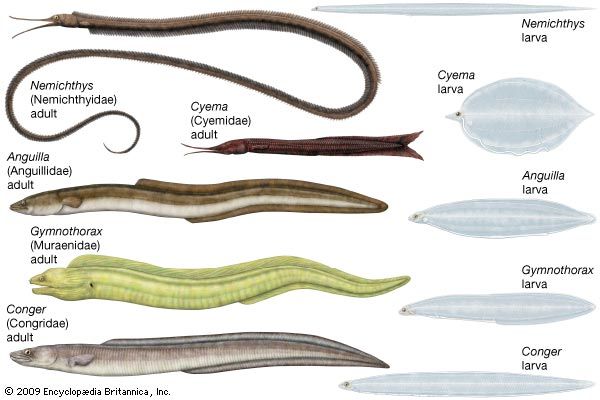
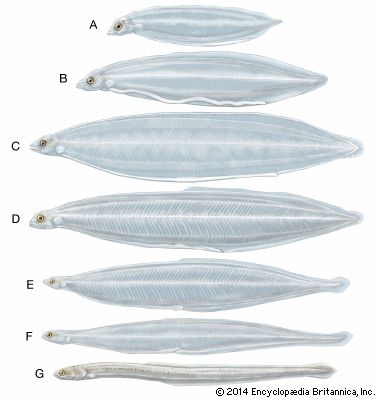
- Larval Stage: Eels undergo a unique developmental phase known as a leptocephalus, a transparent, leaflike larva that floats in the open ocean before metamorphosing into the adult form.13
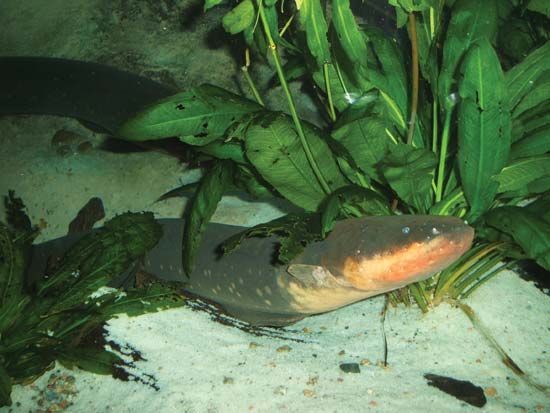
It is important to note that while some fish like the electric eel share the name and an elongated body, they belong to a different order (Gymnotiformes) and are distinct from true eels (Anguilliformes).2
How are eels classified within the fish family, and what are some common species?
Eels are classified within the order Anguilliformes, which belongs to the superorder Elopomorpha. This group is characterized by the presence of a unique, transparent, leaflike larval stage known as a leptocephalus. While the higher-level classification of the order remains a subject of scientific study, it is generally divided into three suborders: Anguilloidei, Muraenoidei, and Congroidei.451
The order encompasses 15 families, approximately 141 genera, and more than 790 species. Some common and notable species include:4
- Freshwater Eels (Family Anguillidae): These are highly valued as food and are the only family within the order that spends a significant portion of its life in freshwater. They belong to the genus Anguilla.46
- Morays (Family Muraenidae): Often brightly colored and voracious, these are common in tropical and subtropical reef environments.4
- Congers (Family Congridae): A diverse group found in all oceans, ranging from shallow waters to considerable depths.4
- Snake Eels and Worm Eels (Family Ophichthidae): A large family known for their burrowing habits.4
- Snipe Eels (Family Nemichthyidae): Deep-sea (bathypelagic) species recognized by their greatly extended jaws.4
How do eels reproduce, and what is special about their life cycle?
Eels possess a remarkable and complex life cycle characterized by a unique larval stage and extensive migrations. Most eels are catadromous, meaning they spend the majority of their lives in freshwater before migrating to the ocean to spawn.2
The Life Cycle
- Spawning: Mature adults migrate to specific oceanic spawning grounds, often located over the continental slope or in deep ocean basins. For example, European and American freshwater eels travel to the Sargasso Sea to reproduce and subsequently die.92
- Leptocephalus Stage: Eggs hatch into a transparent, leaflike larva called a leptocephalus. These larvae float in the upper layers of the ocean for months or even years, dispersing via ocean currents.92
- Metamorphosis: Upon reaching coastal waters, the leptocephalus undergoes a dramatic metamorphosis. They lose their leaflike shape, become cylindrical “glass eels,” and develop pigmentation to become elvers.92
- Growth: Elvers migrate into freshwater, where they grow into “yellow eels.” After 10 to 15 years, they transform into “silver eels,” develop enlarged eyes, and begin their final journey back to the sea to complete the cycle.2
How do electric eels produce and use electricity?
Despite their name, electric eels (Electrophorus) are not true eels but are actually a type of South American knifefish related to piranhas and tetras.10
How They Produce Electricity
Electric eels generate electricity using three specialized electric organs—the main organ, Hunter’s organ, and Sach’s organ—which are composed of modified muscle cells called electrocytes.10
When triggered by the neurotransmitter acetylcholine, these cells allow potassium ions to flow, creating a small electrical discharge. Because these cells are stacked in a series, the firing of one cell triggers a cascade, resulting in a collective discharge that can reach up to 860 volts.10
How They Use Electricity
- Prey Capture: High-voltage pulses from the main and Hunter’s organs stun prey, preventing injury to the eel’s mouth from spiny fish. They may also curl their bodies around prey to double the electric field strength, fatiguing the prey’s muscles.10
- Navigation and Communication: Sach’s organ produces lower-voltage pulses that function like a biological radar, helping the eel navigate murky waters and communicate.10
- Defense: Eels use electrical shocks to deter predators. They can deliver more powerful shocks by leaping out of the water, which prevents the current from being dampened by the surrounding medium.10
Sources
- eel - Form and function — Encyclopædia Britannica
- eel - Natural history — Encyclopædia Britannica
- fish - Annotated classification — Encyclopædia Britannica
- eel — Encyclopædia Britannica
- eel - Critical appraisal — Encyclopædia Britannica
- eel - Annotated classification — Encyclopædia Britannica
- Did you know? — Merriam-Webster
- eel - General features — Encyclopædia Britannica
- Migration - Catadromous fish — Encyclopædia Britannica
- electric eel — Encyclopædia Britannica
- 14 Questions About Aquatic Animals Answered - Which undersea creatures are known for making electricity? — Encyclopædia Britannica
Published on · 4 min read