Gulper
A gulper refers to any of nine species of deep-sea fish that belong to three distinct families. While some authorities classify them within the order…
What is gulper?
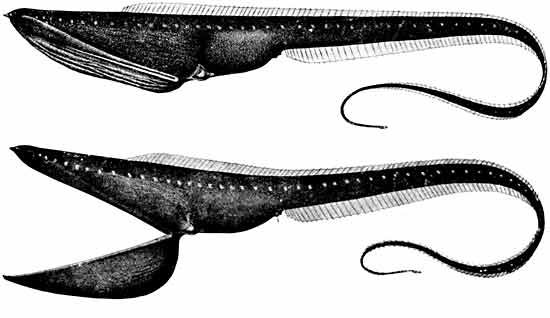
A gulper refers to any of nine species of deep-sea fish that belong to three distinct families. While some authorities classify them within the order Anguilliformes (eels), others place them in their own order, Saccopharyngiformes.12
These fish are typically found at depths of 2,700 meters (9,000 feet) or more. They are characterized by their soft, tapered bodies, long tails, and greatly expandable stomachs that allow them to consume large prey. Many species are solid black and may possess light-producing organs.1
The families Eurypharyngidae and Saccopharyngidae are particularly noted for their enormous mouths; in the Eurypharyngidae, the mouth is actually longer than the body itself. In contrast, members of the family Monognathidae have mouths of more standard proportions. Like true eels, gulpers share a unique leptocephalus larval stage during their development.132
What is a leptocephalus larva?
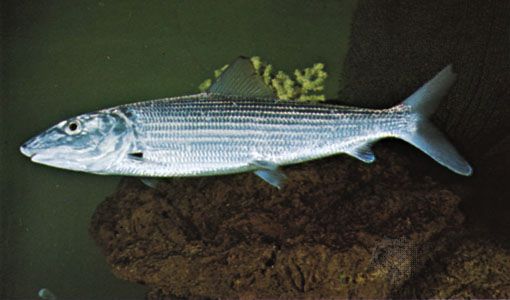
A leptocephalus (plural: leptocephali) is the unique, transparent, and gelatinous larval stage of eels and several other related orders, including tarpons, bonefishes, and gulpers.43
Characteristics
Typically elongate and laterally compressed, these larvae are often described as leaflike in appearance. They possess prominent W-shaped muscle segments known as myomeres and sharp, forward-directed larval teeth. While they are usually 5 to 10 cm long, some species can reach up to 45 cm. They inhabit the upper 500 meters of the open ocean, where they drift as plankton for periods ranging from a few months to over two years.43
Metamorphosis
Leptocephali are markedly different from their adult forms. Before reaching maturity, they undergo a dramatic metamorphosis in which they:
- Become cylindrical and significantly reduce in body mass (sometimes by up to 90 percent).3
- Lose their larval teeth and transparent appearance.43
- Develop adult features such as rounded snouts and specific fin structures.3
Because these larvae look so different from the adults, they were historically misidentified as a distinct group of fishes before their true relationship to eels was understood.3
How do deep-sea fish survive in high-pressure environments?
Deep-sea fish have evolved specialized physiological and morphological adaptations to survive the extreme hydrostatic pressure, cold, and darkness of their environment.6
Managing Pressure
The most significant challenge at extreme depths is the immense pressure, which increases by one atmosphere for every 10 meters of depth. To survive this, many deep-sea fish have evolved to lack air-filled compartments, such as swim bladders, which would otherwise compress or collapse under such force. While some shallow-water fish use these organs for buoyancy and depth control, deep-sea species often have reduced or entirely absent swim bladders.789
Sensory and Morphological Adaptations
Because these environments are aphotic (lacking light), deep-sea fish exhibit unique traits to navigate and find food:
- Bioluminescence: Many species possess luminous organs to attract prey or potential mates in the darkness.6
- Specialized Anatomy: Mid-water species often feature huge mouths and enlarged eyes to maximize their ability to detect and capture scarce food resources. In contrast, bottom-dwelling (benthic) forms typically have smaller eyes and mouths.6
- Energy Efficiency: To cope with the limited food supply, these fish often rely on particles of organic matter drifting down from the surface or maintain chemoautotrophic bacterial associations.10
What are some other unique adaptations of deep-sea creatures?
Deep-sea creatures have evolved a remarkable array of adaptations to thrive in the extreme conditions of the aphotic zone. Beyond the absence of swim bladders to manage pressure, these organisms utilize specialized strategies to survive in a dark, cold, and food-scarce environment:
- Bioluminescence: Many deep-sea organisms, such as anglerfishes, lantern fishes, and hatchetfishes, possess photophores. These light-producing organs are used to attract prey, signal potential mates, or perform counter-illumination—matching the intensity of sunlight from above to disguise their silhouettes from predators below.13614
- Chemosynthesis: In the absence of sunlight, organisms near hydrothermal vents rely on chemoautotrophic bacteria. These bacteria oxidize sulfur to produce energy, supporting complex communities of clams, mussels, and worms that have evolved symbiotic relationships with them.15
- Specialized Feeding Mechanisms: Deep-sea bivalves have developed unique methods to capture food. For example, some species have modified their gills into septa that create pressure changes to suck in prey, while others possess atypical structures that allow them to capture small crustaceans and worms directly.16
- Physiological Resilience: To survive in near-freezing temperatures, some species, such as Notothenid fishes, produce specialized proteins in their blood that function as biological antifreeze.14
Sources
- gulper — Encyclopædia Britannica
- gulper — Merriam-Webster
- eel - Natural history — Encyclopædia Britannica
- eel - Form and function — Encyclopædia Britannica
- leptocephalus — Merriam-Webster
- deep-sea fish — Encyclopædia Britannica
- Marine ecosystem - Physical and chemical properties of seawater — Encyclopædia Britannica
- swim bladder — Encyclopædia Britannica
- Biosphere - Hydrostatic pressure — Encyclopædia Britannica
- fish - The respiratory system — Encyclopædia Britannica
- Mechanoreception - Generalized hydrostatic pressure — Encyclopædia Britannica
- life - Temperature and desiccation — Encyclopædia Britannica
- Bioluminescence - The role of bioluminescence in behavior — Encyclopædia Britannica
- How do sea otters stay warm? — Encyclopædia Britannica
- bivalve - Food and feeding — Encyclopædia Britannica
- Marine ecosystem - Organisms of the deep-sea vents — Encyclopædia Britannica
- gigantism — Merriam-Webster
Published on · 3 min read