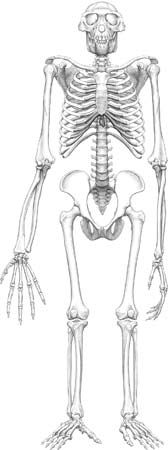
Lagar Velho
The Lagar Velho site provides significant insight into the symbolic behavior and social practices of early humans in the Iberian Peninsula approximately…
What can the Lagar Velho remains tell us about the diet and lifestyle of early humans in the region?
The Lagar Velho site provides significant insight into the symbolic behavior and social practices of early humans in the Iberian Peninsula approximately 25,000 years ago, though it offers limited direct evidence regarding their specific diet.
The discovery of a four-year-old child’s skeleton reveals that these early populations practiced elaborate burial rituals. The body was placed in a rock shelter with pierced deer teeth and shell ornaments, and covered with red ochre pigment, while pine branches were burned in the grave pit. These findings suggest a complex culture that valued ritualized mourning and symbolic expression.1
Anatomically, the remains present a mosaic of Neanderthal and modern human features, such as well-developed arm musculature and a modern-like chin. This has led researchers to propose that early modern humans may have interbred with and absorbed local Neanderthal populations as they expanded westward.1
How has the Lagar Velho discovery influenced theories about Neanderthal-modern human interactions?
The discovery of the Lagar Velho child’s skeleton has been a pivotal piece of evidence in the debate regarding the relationship between Neanderthals and modern humans. Because the remains exhibit an anatomical “mosaic”—combining modern traits like a chin and narrow torso with Neanderthal features such as robust arm musculature and specific leg proportions—many paleoanthropologists interpret the specimen as evidence of interbreeding.12
This finding supports a model suggesting that as early modern humans migrated westward across the Iberian Peninsula approximately 28,000 years ago, they did not simply replace Neanderthals but instead absorbed local populations. This perspective aligns with broader scientific shifts; while earlier morphological studies often emphasized the distinctiveness of the two groups, modern genetic research confirming that Eurasians carry approximately 2 percent Neanderthal nuclear DNA has reinforced the theory that they interbred and were not entirely separate biological species2.1
How old is the Lagar Velho child skeleton, and why is it important?
The Lagar Velho child skeleton is approximately 25,000 years old. Discovered in 1998 near Leiria, this find is significant for two primary reasons:
- Anatomical Mosaic: The remains exhibit a unique combination of Neanderthal and modern human features. While the child possessed modern traits like a chin and a rounded braincase, it also displayed Neanderthal characteristics such as robust arm musculature and short lower legs. This suggests that early modern humans may have interbred with and absorbed local Neanderthal populations as they expanded across the Iberian Peninsula.1
- Symbolic Burial: The site provides the first evidence in Iberia of an elaborate burial ritual. The child was interred with pierced deer teeth and shell ornaments, covered in red ochre, and placed in a pit where pine branches had been burned, indicating complex social and symbolic behavior.1
What controversies or debates surround the interpretation of the Lagar Velho remains?
The interpretation of the Lagar Velho remains has been a subject of significant debate within paleoanthropology, primarily centering on the significance of the specimen’s “anatomical mosaic.”
The core controversy involves whether the combination of Neanderthal and modern human features—such as the presence of a chin alongside robust arm musculature and short lower legs—is definitive evidence of interbreeding. Proponents of the hybridization model argue that the specimen represents a descendant of a population resulting from the mixing of these two groups as modern humans expanded into the Iberian Peninsula.12
Conversely, the debate is complicated by broader questions regarding human classification. Historically, researchers have struggled to define the threshold of biological difference between these groups. While morphological studies often emphasized their distinctiveness, the discovery of the Lagar Velho child fueled arguments that the two groups were not entirely separate biological species. This has since been contextualized by genetic research, which indicates that modern Eurasians carry approximately 2 percent Neanderthal nuclear DNA, suggesting that interbreeding was a reality rather than a mere theoretical possibility.12
Sources
- Lagar Velho — Encyclopædia Britannica
- Neanderthal - Neanderthal classification — Encyclopædia Britannica
- Vindija — Encyclopædia Britannica
Published on · 3 min read