Lake Amadeus
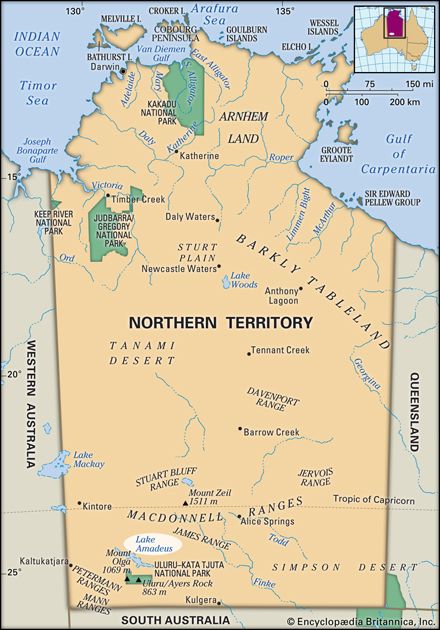
Lake Amadeus is a large, salty mud basin located in the southwestern Northern Territory of Australia. It sits within a shallow trough that collects sediments…
What is Lake Amadeus?
Lake Amadeus is a large, salty mud basin located in the southwestern Northern Territory of Australia. It sits within a shallow trough that collects sediments from the nearby MacDonnell and Musgrave ranges.1
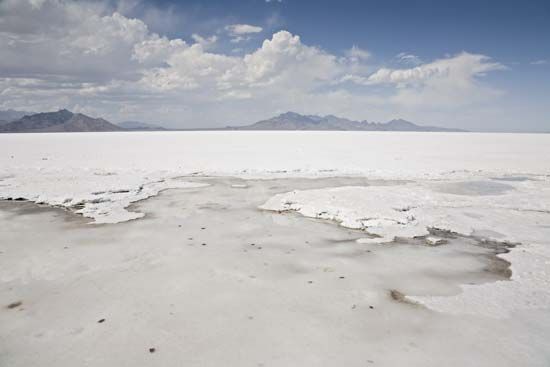
The feature is characterized by its intermittent nature: it occasionally holds a few inches of water, reaching dimensions of up to 90 miles (145 km) long and 12 miles (20 km) wide, covering approximately 340 square miles (880 square km). During dry periods, it functions as a salt flat, or playa.1
The lake was named by explorer Ernest Giles in 1872 in honor of King Amadeus of Spain. While the area is largely arid, the region supports some cattle farming through the use of underground water, and natural gas extraction occurs to the north of the basin.1
What is a playa or salt flat?
A playa is a flat-bottomed depression located in interior desert basins or near coasts in arid and semiarid regions. These landforms are among the flattest on Earth, often featuring slopes of less than 0.2 meters per kilometer.3
Characteristics and Formation
Playas occupy the central basins of desert plains and require interior drainage where evaporation significantly exceeds water inflow. They are periodically covered by water, which may originate from surface runoff or storm surges. As this water slowly evaporates or infiltrates the ground, it leaves behind deposits of salt, sand, and mud.3
Because of their varied appearance and regional naming conventions, playas are known by many terms, including:
- Salt flat or alkali flat: A playa containing high concentrations of precipitated, glistening salts.34
- Clay pan or hardpan: A salt-free playa.3
- Pan: A term commonly used for small playas in Australia and South Africa.3
Some playas, such as the Bonneville Salt Flats in Utah, are remnants of ancient lakes that existed during the Pleistocene Epoch. These surfaces can become as solid as concrete, making them ideal for activities like speed trials.5
Who was the explorer Ernest Giles?
Ernest Giles was a prominent 19th-century explorer recognized for his contributions to the mapping of the Australian interior. During the 1870s, his expeditions through Western Australia and the central regions of the continent earned him a place among the nation’s celebrated explorer-heroes.1
In 1872, Giles led an expedition that brought him to the large, salty mud basin in the Northern Territory that he named Lake Amadeus in honor of King Amadeus of Spain. His work, alongside that of contemporaries like John Forrest, was instrumental in filling in the geographical knowledge of the Australian continent during a period when land exploration was considered the most significant field of discovery.101
How do salt lakes form in arid environments?
Salt lakes in arid environments form primarily in closed, or endorheic, interior basins where drainage is internal and runoff does not reach the sea. These environments are characterized by a climatic balance where evaporation rates consistently exceed the combined input of precipitation, surface runoff, and groundwater discharge.1112
The formation process involves several key factors:
- Endorheic Drainage: Because these basins lack outlets, water can only leave the system through evaporation or seepage. As water evaporates, it leaves behind dissolved minerals, leading to a gradual accumulation of salts over time.111213
- Fluctuating Water Levels: Inflow is often sporadic, occurring during seasonal storms or flash floods. When water enters these basins, it expands and deepens; subsequent evaporation reduces the volume, concentrating the remaining salts.1114
- Mineral Precipitation: As the brine becomes increasingly concentrated, various salts precipitate out of the solution. This often creates a “zoned” effect, where less-soluble minerals like carbonates and sulfates form outer rings, while highly soluble salts like sodium chloride accumulate in the center.8
- Climatic Sensitivity: Because these lakes depend on a delicate balance between water input and output, they are highly sensitive to long-term climatic shifts and human-induced water diversion, which can lead to rapid increases in salinity and the exposure of lake beds.12
Sources
- Lake Amadeus — Encyclopædia Britannica
- list of lakes - Australia — Encyclopædia Britannica
- playa — Encyclopædia Britannica
- salt - Solar evaporation — Encyclopædia Britannica
- salt flat — Merriam-Webster
- alkali flat — Encyclopædia Britannica
- Bonneville Salt Flats — Encyclopædia Britannica
- playa - Physical characteristics — Encyclopædia Britannica
- North American Desert - Geology — Encyclopædia Britannica
- Australia - Culture — Encyclopædia Britannica
- playa - Saline minerals — Encyclopædia Britannica
- sedimentary rock - Nonmarine environment — Encyclopædia Britannica
- Inland water ecosystem - Saline lakes — Encyclopædia Britannica
- playa - Surface relief and structures — Encyclopædia Britannica
- arroyo — Encyclopædia Britannica
- mineral deposit - Seawater or lake water — Encyclopædia Britannica
- salinity — Encyclopædia Britannica
- Inland water ecosystem - Temporary bodies of standing fresh water — Encyclopædia Britannica
Published on · 3 min read