Lake Erie
Lake Erie is distinct among the Great Lakes due to its limited depth and volume. It is the shallowest of the five lakes, featuring a mean depth of only 62…
How does Lake Erie compare to the other Great Lakes in terms of depth and volume?
Lake Erie is distinct among the Great Lakes due to its limited depth and volume. It is the shallowest of the five lakes, featuring a mean depth of only 62 feet (19 metres). In comparison, the other lakes have significantly greater mean depths, ranging from 195 feet in Lake Huron to 483 feet in Lake Superior.1
Regarding water capacity, Lake Erie holds the smallest volume of the system, containing approximately 116 cubic miles (484 cubic km) of water. This is substantially less than the other lakes; for instance, Lake Superior holds 2,900 cubic miles, and even Lake Ontario, which has a smaller surface area, holds 393 cubic miles of water. Because of its shallow basin and smaller volume, Lake Erie is highly sensitive to environmental changes compared to the deeper, more massive lakes in the chain.21
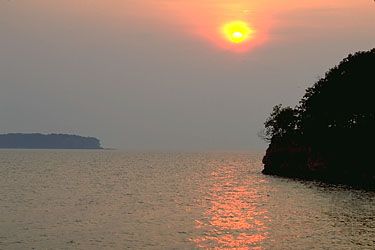
What are the geographical characteristics of Lake Erie, including its size and location?
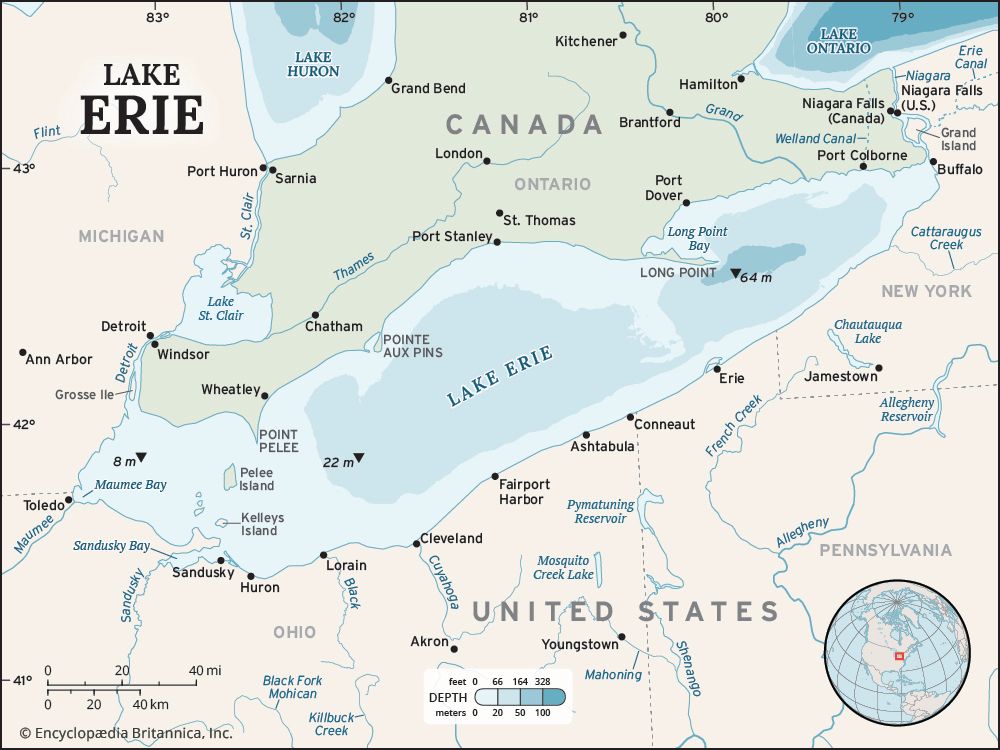
Lake Erie is the fourth largest of the five Great Lakes of North America. It serves as a natural border between Canada (Ontario) to the north and the United States (Michigan, Ohio, Pennsylvania, and New York) to the west, south, and east.3
Geographical Dimensions
- Surface Area: The lake covers 9,910 square miles (25,670 square km).31
- Length and Width: Its major axis extends 241 miles (388 km) from west-southwest to east-northeast, with a maximum width of 57 miles.3
- Drainage Basin: The total area of its drainage basin is 30,140 square miles (78,062 square km).3
- Elevation: It sits at a mean surface height of approximately 570 feet (170 metres) above sea level.32
Physical Characteristics
Lake Erie is the shallowest of the Great Lakes, with a mean depth of 62 feet (19 metres) and a maximum depth of 210 feet. Due to its shallow nature and smaller volume of 116 cubic miles (484 cubic km), it has a relatively short water-retention time of 2.6 years.321
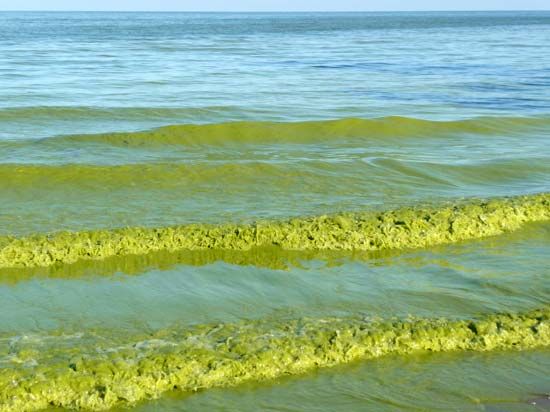
How does the water temperature of Lake Erie vary throughout the year?
The water temperature of Lake Erie follows a seasonal cycle driven by atmospheric conditions and wind-driven mixing. During the summer, the lake develops a stratified thermal structure, with a warmer, less dense layer of water (the epilimnion) resting above colder, denser water. Because Lake Erie is the shallowest of the Great Lakes, this thermal gradient often reaches the lake bottom, meaning a deep, cold layer (hypolimnion) may not exist across the entire basin.56
As air temperatures drop in the autumn, the surface layer cools and eventually mixes with the deeper water, leading to an isothermal state where the temperature is uniform throughout the water column. During winter, the lake’s significant exposure to wind prevents the formation of a stable, lake-wide ice cover. Consequently, the water remains in a state of constant mixing, keeping temperatures very near 0° C (32° F) throughout the winter months.56
What are the main tributaries that feed into Lake Erie?
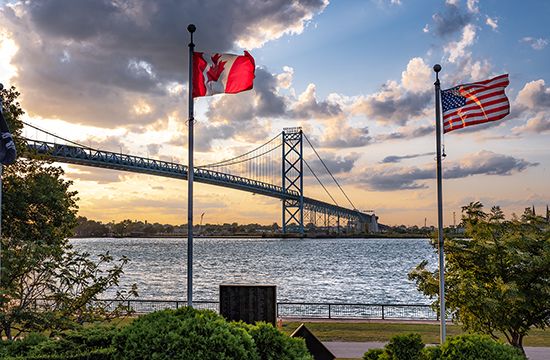
Lake Erie receives its water supply from a variety of rivers across the United States and Canada. The most significant contributor is the Detroit River, which carries the discharge from Lake Huron into the western end of the lake.37
Other principal tributary rivers include:
- Michigan: The Huron and Raisin rivers.3
- Ohio: The Maumee, Portage, Sandusky, Cuyahoga, and Grand rivers.3
- New York: Cattaraugus Creek.3
- Ontario: The Grand River.3
While these rivers feed the lake, it is important to note that Lake Erie ultimately discharges its water at its eastern end through the Niagara River.3
Sources
- Great Lakes - Physiography of Great Lakes — Encyclopædia Britannica
- Areas and Volumes of the Great Lakes — Encyclopædia Britannica
- Lake Erie — Encyclopædia Britannica
- Great Lakes - Hydrology and climate — Encyclopædia Britannica
- ice in lakes and rivers - Changes in temperature structure — Encyclopædia Britannica
- lake - Heat transfer — Encyclopædia Britannica
- Detroit River — Encyclopædia Britannica
Published on · 3 min read