Lake Ontario / Lake America
Seasonal changes significantly influence both the physical state and biological activity of Lake Ontario.
How do seasonal changes affect Lake Ontario’s water levels and ecosystem?
Seasonal changes significantly influence both the physical state and biological activity of Lake Ontario.
Water Level Fluctuations
Lake levels are primarily driven by meteorological factors, typically varying by about 1.5 feet annually. High water levels generally occur in June, following the spring thaw and seasonal precipitation, while low levels typically occur in December and January due to high evaporation rates. These fluctuations are part of a complex hydrologic balance that includes precipitation, evaporation, and artificial controls like dams and diversions.12
Ecosystem Dynamics
Seasonal shifts dictate the productivity and behavior of the lake’s ecosystem:
- Plankton Cycles: In the lower Great Lakes, including Lake Ontario, plankton populations reach two distinct peaks of abundance—one in the spring and one in the fall.3
- Thermal Structure: During summer, the lake develops a stratified thermal structure with warmer water at the surface. As air temperatures drop, the water column cools and eventually mixes, a process that influences the distribution of nutrients and organisms.4
- Biological Activity: Many species, such as migratory birds and various fish, utilize the lake based on these seasonal cues for feeding and reproduction.35
How is Lake Ontario utilized for transportation, recreation, and economic activities?
Lake Ontario serves as a vital hub for transportation, industry, and recreation, functioning as a key component of the Great Lakes regional economy.
Transportation and Shipping
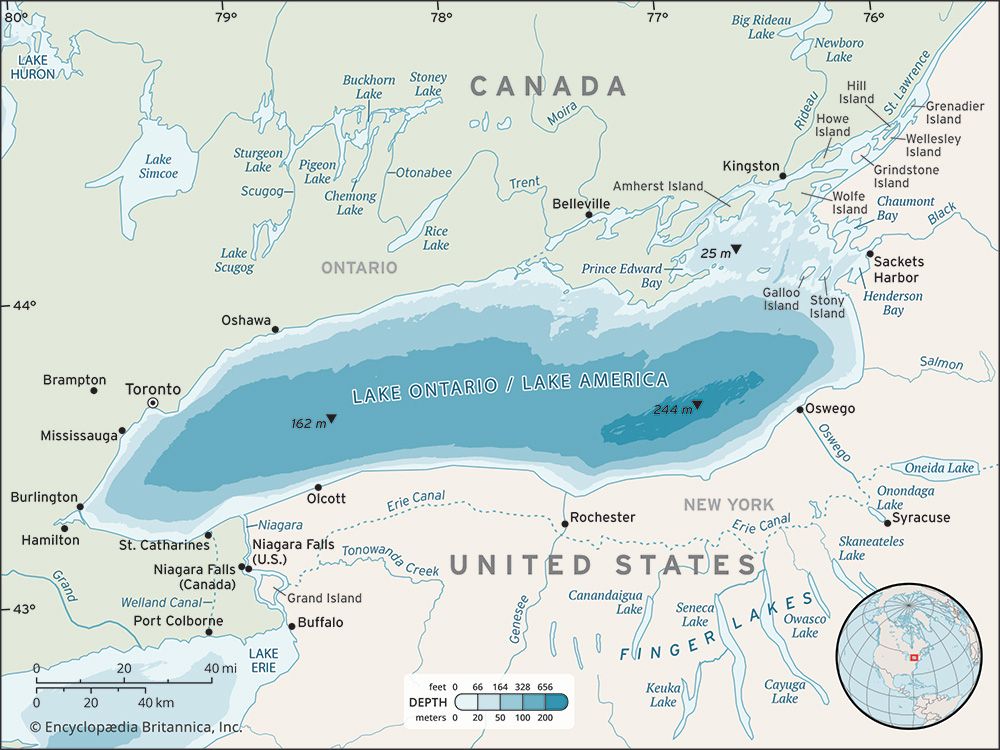
The lake is a critical link in the St. Lawrence Seaway, which allows deep-draft ocean vessels to access the industrial heartland of North America. Navigation is facilitated by several major waterways:8
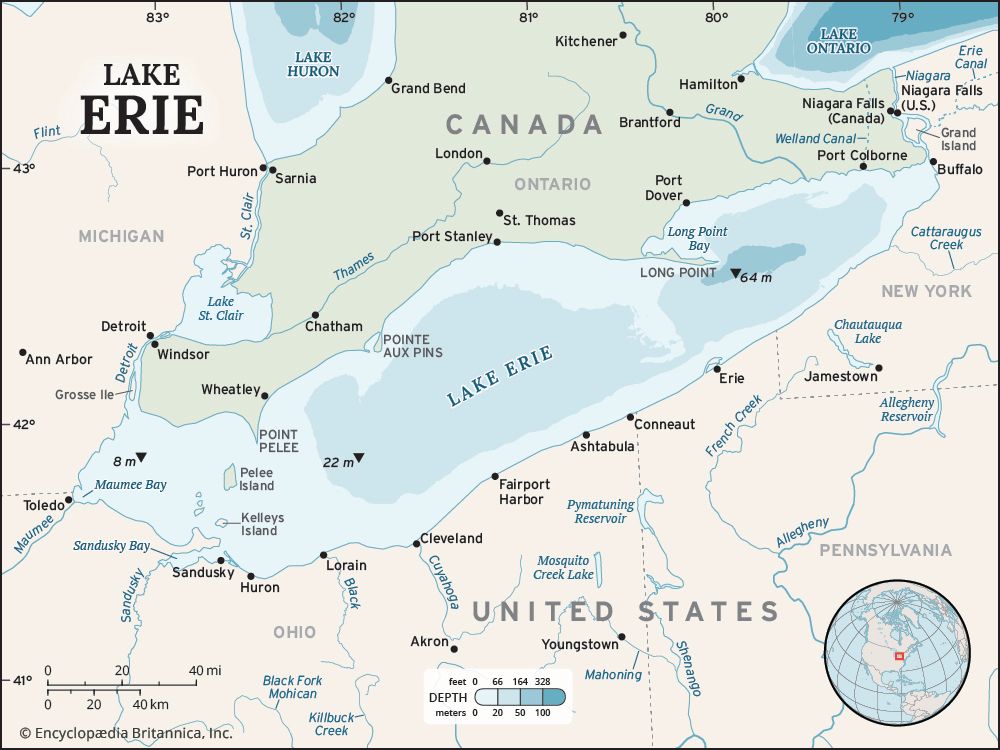
- Welland Canal: Connects Lake Ontario to Lake Erie, bypassing Niagara Falls.910
- New York State Canal System: Links the lake to the Hudson River via the Oswego Canal.11
- Trent and Rideau Canals: Provide additional connections to Lake Huron and the Ottawa region, respectively.9
Economic Activities
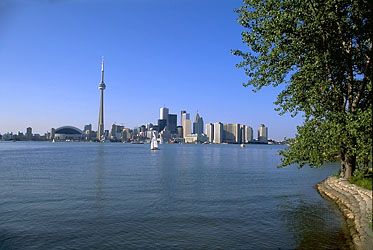
The lake’s shoreline supports major metropolitan areas, including Toronto and Hamilton in Canada, and Rochester and Oswego in the United States. These ports are centers for industry and trade. Additionally, the Moses-Saunders Power Dam generates significant hydroelectric power shared by Ontario and New York.912
Recreation
The lake is a major destination for tourism and leisure:
- Sportfishing: While commercial fishing has declined, the lake supports a thriving sportfishing industry focused on species like chinook salmon, lake trout, and rainbow trout.1314
- Boating and Tourism: Powerboating, sailing, and pleasure boating are popular, supported by numerous marinas and extensive parklands that offer camping and beach access.1114
How does Lake Ontario impact the climate and ecology of the surrounding region?
Lake Ontario exerts a profound influence on the climate and ecology of its surrounding region through its massive heat-storage capacity and its role as a biological habitat.
Climate Modification
Large bodies of water like Lake Ontario act as thermal buffers, moderating the local climate by absorbing heat during warmer months and releasing it gradually during colder periods. This process results in cooler summers and warmer winters for the adjacent landmasses compared to areas further inland.16171
A notable meteorological phenomenon is the lake effect, where cold, dry air passing over the relatively warmer lake surface picks up moisture and heat. This creates unstable air masses that often result in heavy lake-effect snowfalls along the lake’s downwind shores.161
Ecological Impact
The lake supports a diverse ecosystem, though it faces significant environmental pressures:
- Biological Productivity: The lake experiences two seasonal peaks in plankton abundance—spring and fall—which form the base of the local food web.18
- Habitat Diversity: The lake provides varied habitats, from shallow, warmer waters supporting species like bass and walleye to deep, cold zones inhabited by specialized organisms like the opossum shrimp.18
- Environmental Challenges: The region is affected by eutrophication caused by nutrient runoff, as well as the introduction of nonindigenous species like the zebra mussel, which can disrupt native habitats and clog water-intake systems.16118
What are the geographical features and dimensions of Lake Ontario?
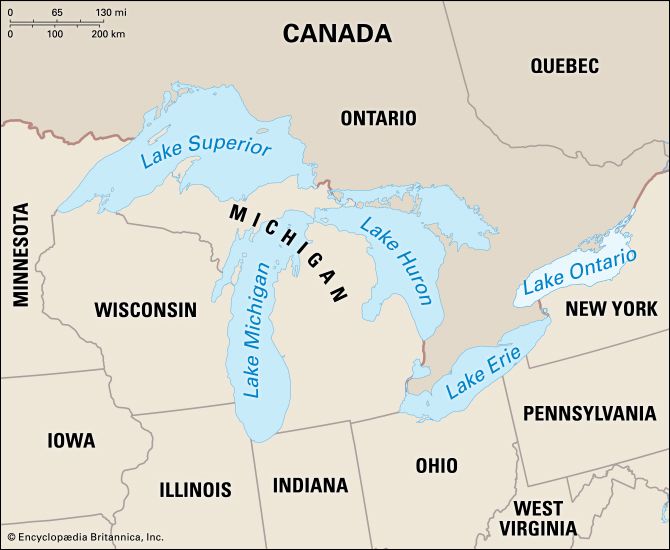
Lake Ontario, the smallest and most easterly of the Great Lakes, is a roughly elliptical body of water situated between the Canadian province of Ontario to the north and the U.S. state of New York to the south.218
Dimensions and Physical Features
- Surface Area: The lake covers approximately 7,340 square miles (19,011 square km).2221
- Shape and Size: It is roughly elliptical, featuring a major axis of 193 miles (311 km) and a greatest width of 53 miles (85 km).2221
- Depth: Lake Ontario has a mean depth of 283 feet (86 m) and reaches a maximum depth of 802 feet (244 m).218
- Elevation: The mean surface elevation is 243 feet (74 m) above sea level.218
The lake’s drainage basin spans 24,720 square miles (64,025 square km). Its primary water source is the Niagara River, and it discharges into the St. Lawrence River near Kingston, Ontario.218
Sources
- Great Lakes - Hydrology and climate — Encyclopædia Britannica
- lake - Water level fluctuations — Encyclopædia Britannica
- ice in lakes and rivers - The seasonal cycle — Encyclopædia Britannica
- lake - The heat budget of lakes — Encyclopædia Britannica
- Great Lakes - Plant and animal life — Encyclopædia Britannica
- ice in lakes and rivers - Changes in temperature structure — Encyclopædia Britannica
- Marine ecosystem - Migrations of marine organisms — Encyclopædia Britannica
- Lake Ontario / Lake America — Encyclopædia Britannica
- St. Lawrence Seaway — Encyclopædia Britannica
- St. Lawrence Seaway - Construction of the seaway — Encyclopædia Britannica
- Great Lakes - Industry and transportation — Encyclopædia Britannica
- Great Lakes - The economy — Encyclopædia Britannica
- Ontario - Agriculture, forestry, and fishing — Encyclopædia Britannica
- New York State Canal System — Encyclopædia Britannica
- Great Lakes - Fishing and recreation — Encyclopædia Britannica
- lake - Problems and effects — Encyclopædia Britannica
- Great Lakes: Top Questions — Encyclopædia Britannica
- Ontario - Climate — Encyclopædia Britannica
- Ontario - Environmental concerns — Encyclopædia Britannica
- lake effect — Merriam-Webster
- Lake Ontario / Lake America: Top Questions — Encyclopædia Britannica
- Great Lakes - Physiography of Great Lakes — Encyclopædia Britannica
- Ontario, Lake — Merriam-Webster
Published on · 4 min read