Detroit River
The Detroit River, which serves as a vital international border between Detroit, Michigan, and Windsor, Ontario, is crossed by several major infrastructure…
What major bridges and tunnels cross the Detroit River?
The Detroit River, which serves as a vital international border between Detroit, Michigan, and Windsor, Ontario, is crossed by several major infrastructure projects that facilitate trade and travel between the United States and Canada.
Bridges
- Gordie Howe International Bridge: Opened on July 27, 2026, this cable-stayed bridge is the longest of its kind in North America, spanning approximately 1.5 miles (2.5 km). It serves as a critical trade route connecting Interstate 75 in Michigan to Highway 401 in Ontario.1
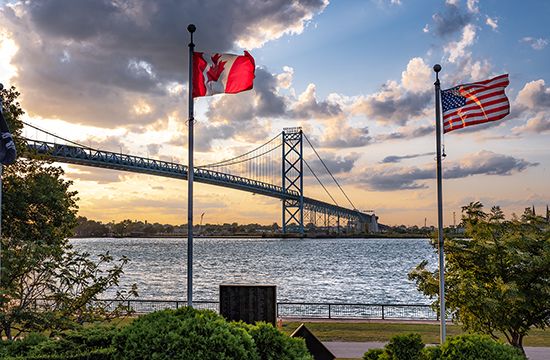
- Ambassador Bridge: A privately owned bridge that has served as a primary international crossing for the automotive industry and general trade since it opened in 1929.21
Tunnels
- Detroit-Windsor Tunnel: A long-standing vehicular tunnel that provides a direct subaqueous route between the two cities.21
- Detroit River Railroad Tunnel: A historic twin-tube railroad tunnel constructed between 1906 and 1910. It is notable for being the site where the immersed-tube method of tunneling was first developed.3
How does the Detroit River connect to the Great Lakes system?
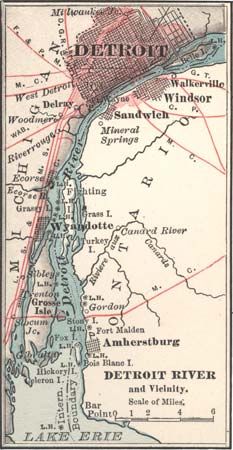
The Detroit River serves as a vital link within the Great Lakes system by acting as a connecting channel between two of the lakes. Specifically, the river flows south to connect Lake St. Clair to the north with the western end of Lake Erie to the south.4
This connection is part of a larger, continuous navigable waterway that allows for Great Lakes shipping. Lake St. Clair itself is fed by the St. Clair River, which links it to Lake Huron, further upstream in the system. Together, these rivers and lakes form a critical segment of the St. Lawrence Seaway, which enables deep-draft, oceangoing vessels to travel from the Atlantic Ocean into the heart of North America.56
How does the Detroit River serve as an international border between the United States and Canada?
The Detroit River serves as a critical international boundary between the United States (Michigan) and Canada (Ontario), flowing for 32 miles (51 km) between the cities of Detroit and Windsor.4
This waterway functions as a major corridor for international trade and travel, supported by significant infrastructure that connects the two nations:
- Gordie Howe International Bridge: Opened in July 2026, this cable-stayed bridge provides a modern link between Interstate 75 in Michigan and Highway 401 in Ontario. It features extensive ports of entry that house customs and border inspection operations for both passenger and commercial traffic.21
- Ambassador Bridge: A long-standing, privately owned bridge that has facilitated cross-border movement and automotive supply chains since 1929.2
- Detroit-Windsor Tunnel: A subaqueous route that provides an additional direct connection for vehicular traffic between the two cities.2
The river’s role as a border is defined by these crossings, which manage the high volume of daily trade—valued at hundreds of millions of dollars—between the U.S. and Canada.2
How has the Detroit River been used for industrial purposes throughout history?
The Detroit River has played a foundational role in the industrial development of the region, serving as both a transportation artery and a hub for heavy manufacturing.
Industrial Significance
- Shipping and Logistics: The river is a critical component of the Great Lakes shipping network. Its port facilities are essential for the movement of large quantities of raw materials, which have historically fueled the region’s manufacturing base.47
- Manufacturing Corridors: The river’s shores are home to significant heavy manufacturing areas, particularly in South Detroit and Trenton, where proximity to the water facilitated the transport of goods and resources.4
- The River Rouge Connection: While located on the River Rouge, the Ford River Rouge Complex exemplifies the industrial use of the local waterway system. Beginning in 1917, this site was developed to process raw materials transported by lake freighters. By 1927, it achieved “ore-to-assembly” vertical integration, producing every component for the Model T and later the Model A.8
Today, while the service sector has grown in importance, the region remains deeply tied to the automotive industry, with factories along the river continuing to produce motor vehicles, automotive parts, machinery, steel, and chemicals.7
Sources
- Gordie Howe International Bridge: Top Questions — Encyclopædia Britannica
- Gordie Howe International Bridge — Encyclopædia Britannica
- tunnels and underground excavations - Development of method — Encyclopædia Britannica
- Detroit River — Encyclopædia Britannica
- Lake Saint Clair — Encyclopædia Britannica
- canals and inland waterways - Major inland waterways of North America — Encyclopædia Britannica
- Dearborn — Encyclopædia Britannica
- Detroit - The people and economy — Encyclopædia Britannica
- Detroit — Encyclopædia Britannica
Published on · 3 min read