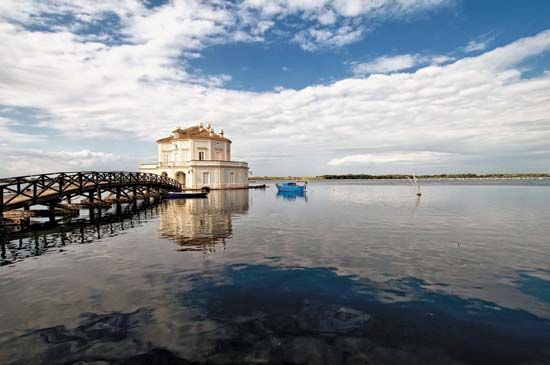
Lake of Fusaro
The Lake of Fusaro is a coastal lagoon located in the Campania region of southern Italy, situated west of Naples.
What is Lake of Fusaro?
The Lake of Fusaro is a coastal lagoon located in the Campania region of southern Italy, situated west of Naples.1
Separated from the sea by sand dunes, the lagoon was known in antiquity as the Palus Acherusia, or Acherusian Swamp, and may have served as the harbor for the nearby ancient city of Cumae. To manage the water, an outlet was constructed at its southern end during the first century CE, featuring a tunnel beneath the hill of Torre Gaveta, with a second outlet added in 1858–59. The surrounding area is historically significant, as the hill contains the remains of a large villa, which is believed to have belonged to the Roman statesman Servilius Vatia.1
What was the significance of the ancient city of Cumae?
The ancient city of Cumae, located approximately 12 miles west of Naples, holds significant historical importance as likely the oldest Greek mainland colony in the west, founded around 750 BCE by settlers from Chalcis.2
Its significance is defined by several key factors:
- Cultural Influence: As a Greek colony, it served as a vital conduit for Greek culture in Italy. It was famously home to the Cumaean Sibyl, a legendary prophetess who, according to tradition, offered the Sibylline Books to the Roman king Tarquinius Superbus.23
- Strategic and Economic Power: The city controlled the most fertile portions of the Campanian plain. Its influence was so pervasive that nearby settlements, such as the port of Misenum, were historically dependent on it.24
- Roman Integration: Following its subjugation by Rome in 338 BCE, Cumae became a symbol of the gradual spread of Roman influence. A notable milestone occurred in 180 BCE, when the city requested permission to change its official language from Oscan to Latin, signaling the broader cultural shift toward Roman hegemony in Italy.5
How do coastal lagoons form?
Coastal lagoons form primarily through the interaction of waves, sediment supply, and changes in sea level. The process generally involves the creation of a barrier that separates a body of water from the open ocean.
Barrier Island Formation
Barrier islands develop on low-lying coasts where the coastal slope is flatter than the equilibrium profile required by waves. In these environments, waves deposit sand to build up a barrier, which may be further elevated by wind-blown dunes. As sea levels rise, the low-lying land behind these barriers becomes flooded, creating a lagoon.67
Alternative Formation Processes
- Spits: Material carried alongshore can form a spit, which may eventually develop into a bay-mouth barrier that encloses a lagoon.7
- Glacial Outwash: Streams or rivers carrying sediment can provide enough material to build a barrier, even in the absence of typical wave-driven processes.7
- Coral Atolls: According to Charles Darwin’s hypothesis, lagoons in atolls form as fringing reefs around a subsiding volcanic peak grow upward to maintain their position relative to the sea surface.8
Who was the Roman statesman Servilius Vatia?
Publius Servilius Vatia, known by the agnomen “Isauricus,” was a prominent Roman general. He is best remembered for leading a rigorous three-year military campaign between 76 and 74 BCE against the inhabitants of Isauria, an ancient inland district in south-central Anatolia.
His conquest of the region, which was characterized by its mountainous terrain and a population described by Greco-Roman authors as warlike, was a significant military achievement of the late Republic. Following his victory, the territory was later incorporated into the Roman province of Cilicia under Pompey and eventually became part of the province of Galatia during the reign of the emperor Augustus.
Sources
- Lake of Fusaro — Encyclopædia Britannica
- Cumae — Encyclopædia Britannica
- Sibyl — Encyclopædia Britannica
- ancient Rome - Rome and Italy — Encyclopædia Britannica
- Misenum — Encyclopædia Britannica
- lagoon - Barrier bars and sediment sources — Encyclopædia Britannica
- lagoon - Waves , tides, and surf — Encyclopædia Britannica
- lagoon - The effect of time — Encyclopædia Britannica
- lagoon - Storms and catastrophic events — Encyclopædia Britannica
- Isauria — Encyclopædia Britannica
- Servilia — Encyclopædia Britannica
Published on · 3 min read