Lake Prespa
Lake Prespa is a lake located at the intersection of the North Macedonia, Albania, and Greece borders. Situated at an elevation of 2,800 feet (853 meters)…
What is Lake Prespa?
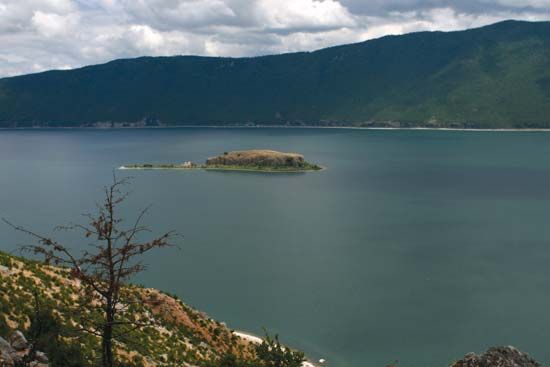
Lake Prespa is a lake located at the intersection of the North Macedonia, Albania, and Greece borders. Situated at an elevation of 2,800 feet (853 meters) above sea level, it covers an area of approximately 106 square miles (274 square km).12
The lake is primarily fed by underground streams and maintains a hydrological connection to Lake Ohrid through subterranean channels. While the majority of the lake lies within North Macedonia, it is situated north of Limni Mikrá Prespa (“Little Prespa Lake”), which sits on the Greece-Albania border. Historically, the region gained significance in the 10th century when the island of St. Achilius in Mikrá Prespa served as an early capital for the Bulgarian tsar Samuel. Following a period of limited development, the area emerged as a center for fishing and tourism starting in the 1970s.13
How are Lake Prespa and Lake Ohrid connected underground?
Lake Prespa and Lake Ohrid are connected through a system of subterranean channels. Because Lake Prespa sits at a higher elevation—approximately 2,800 feet (853 meters) above sea level—compared to Lake Ohrid, water flows from the former to the latter through these underground passages.12
This hydrological link is a defining feature of the region’s geography, as the water from Lake Prespa helps sustain the water levels of Lake Ohrid, which is the deepest lake in the Balkans.12
What makes the Balkan region’s geography unique?
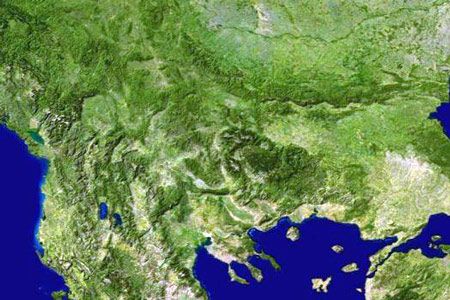
The geography of the Balkan Peninsula is defined by its rugged, mountainous terrain, which has significantly influenced the region’s climate, settlement patterns, and social history.4
Mountainous Relief and Climate
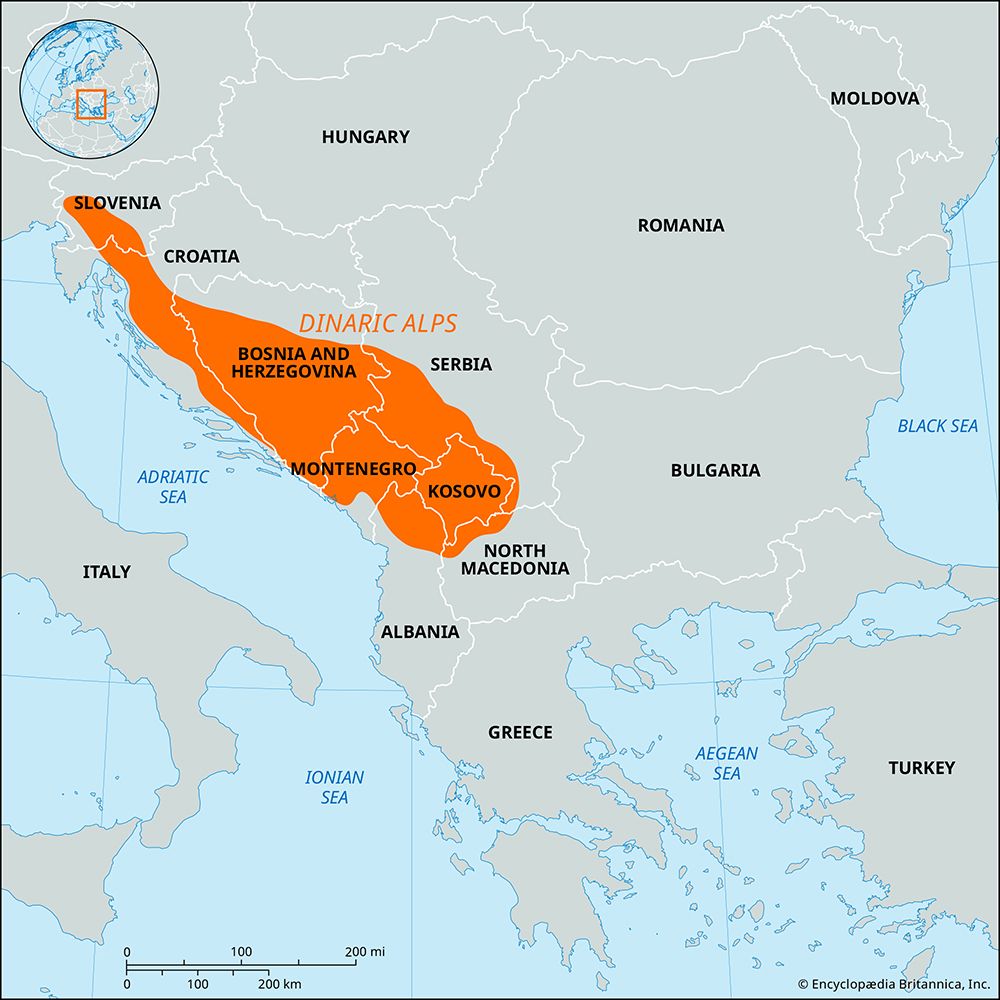
The region is dominated by mountain ranges, including the Balkan Mountains, the Rhodope Mountains, and the Dinaric Alps5. These ranges act as climatic barriers; for instance, the Balkan Mountains separate the continental climate of the Danube River valley from the transitional climate to the south. While the north and central areas experience cold winters and warm summers, the coastal regions are characterized by a Mediterranean climate with mild, rainy winters and hot, dry summers.54
Karst Landscapes
A unique feature of the western Balkans is karst terrain, named after the region extending from Slovenia to Montenegro. This landscape is formed by the dissolution of soluble bedrock, such as limestone, resulting in:6
- Internal Drainage: Much of the water flows through underground conduits rather than surface streams.67
- Distinctive Features: The terrain is marked by sinkholes, bare bedrock ledges, and extensive cave systems.6
Historical and Social Impact
The mountainous relief has historically contributed to the “Balkanization” of the region by compartmentalizing ethnic groups and isolating societies from Western developments for centuries. Furthermore, the valleys of rivers like the Morava and Vardar have served as vital corridors connecting central Europe to the eastern Mediterranean since prehistoric times.48
Who was Tsar Samuel and why is his history linked to the region?
Samuel (died 1014) was the tsar of the First Bulgarian Empire from 997 to 1014. Rising to power in the 980s, he established his capital in Ohrid and expanded his rule across Macedonia, Serbia, Albania, and northern Greece.10
His history is deeply linked to the Balkan region through his intense struggle against the Byzantine Empire. After early successes against Emperor Basil II, Samuel suffered a catastrophic defeat at the Battle of Kleidion in 1014. Following the battle, Basil II—later known as the “Bulgar Slayer”—reportedly blinded 15,000 captured Bulgarian soldiers. The shock of witnessing his blinded army is said to have caused Samuel’s death shortly thereafter.1011
Samuel’s reign represents a pivotal era in Balkan history, as his defeat led to the collapse of the First Bulgarian Empire and its subsequent incorporation as a Byzantine province for over 150 years.1011
Sources
- Lake Prespa — Encyclopædia Britannica
- Lake Ohrid — Encyclopædia Britannica
- Prespa, Lake — Merriam-Webster
- Balkan Mountains — Encyclopædia Britannica
- Balkans — Encyclopædia Britannica
- mountain - The western segment of the system — Encyclopædia Britannica
- cave — Encyclopædia Britannica
- Bosnia and Herzegovina - Drainage — Encyclopædia Britannica
- Serbia - Drainage of Serbia — Encyclopædia Britannica
- Samuel — Encyclopædia Britannica
- history of Bulgaria - Reign of Simeon I — Encyclopædia Britannica
Published on · 3 min read