Lake Pukaki
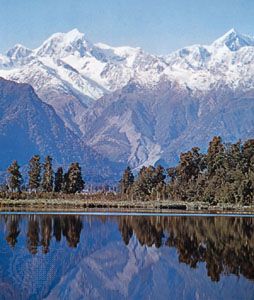
Lake Pukaki is a lake located in the central South Island of New Zealand. It covers 65 square miles (169 square km) within a valley formed by a terminal…
What is Lake Pukaki?
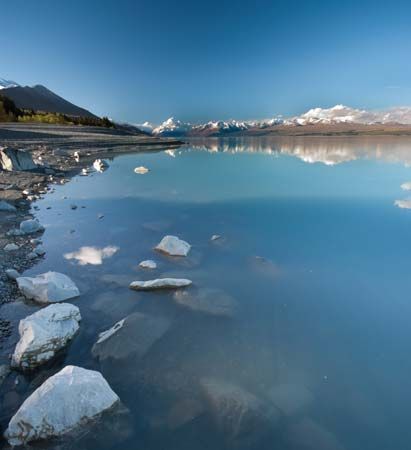
Lake Pukaki is a lake located in the central South Island of New Zealand. It covers 65 square miles (169 square km) within a valley formed by a terminal moraine, which is debris left behind by glaciers.1
Situated 1,640 feet (500 m) above sea level, the lake is fed by the Tasman and Hooker rivers, which carry meltwater from glaciers located east of the Southern Alps. The name Pukaki is a Māori term that translates to “bunched-up water”.1
The lake is regulated by a dam at its southern outlet, which manages water levels to support hydroelectric power stations along the Waitaki River.1
How do glaciers create the unique blue color of the water?
The unique blue or green color of water in lakes fed by glaciers, such as Lake Pukaki, is caused by the presence of rock flour.
As glaciers move, their immense weight and grinding action against the underlying bedrock produce this finely powdered material, also known as glacial meal. This sediment consists of particles that are often colloidal in size—frequently less than one micrometer in diameter.12
When these particles are washed into lakes by meltwater, they remain suspended in the water column for long periods. Because of their extremely small size, they scatter sunlight in a way that gives the water its characteristic turquoise or blue-green appearance.2
What are the Southern Alps and how were they formed?
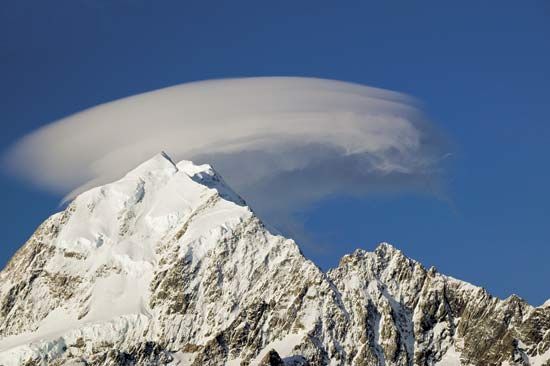
The Southern Alps (also known as Kā Tiritiri o te Moana) are the highest mountain range in Australasia, extending along the length of New Zealand’s South Island. The range stretches from Haast Pass to Arthur’s Pass, featuring 16 peaks that exceed 10,000 feet (3,050 meters), including the highest point, Aoraki/Mount Cook, at 12,316 feet (3,754 meters).5
It is important to clarify that the Southern Alps of New Zealand are distinct from the European Alps. While the European Alps were formed by the Alpine orogeny—a complex tectonic event involving the collision of the African and European plates—the provided search results do not detail the specific tectonic formation of New Zealand’s Southern Alps. The information regarding the formation of mountains through the folding of sedimentary rock and the subduction of the Tethys Sea refers specifically to the European mountain systems.678
The Southern Alps serve as a major climatic divide for the South Island, with the western slopes receiving significantly more precipitation than the eastern Canterbury Plains.5
How does hydroelectric power work in New Zealand?
Hydroelectric power is a cornerstone of New Zealand’s energy sector, long serving as the primary source of the country’s electricity. The process relies on converting the potential energy of water into mechanical energy and finally into electricity.1011
How the System Works
In New Zealand, hydroelectric generation typically utilizes the country’s mountainous terrain and swift, snow-fed rivers. The process generally involves:35
- Storage and Collection: Water is collected in natural lakes or artificial reservoirs, such as Lake Benmore, which serve as storage for power projects.5
- Conversion: Water is directed through large pipes or tunnels, known as penstocks, to a lower elevation. The resulting flow rotates turbines, which drive generators to produce electricity.11
- Transmission: Because much of the hydroelectric potential is located in the South Island, the national grid utilizes direct-current submarine cables across the Cook Strait to transport surplus power to the industrial and population centers of the North Island.10
Major developments, such as the Waitaki River Power Development, exemplify this infrastructure, utilizing water from alpine lakes to feed large-scale dam systems.1213
Sources
- Lake Pukaki — Encyclopædia Britannica
- rock flour — Merriam-Webster
- New Zealand - Relief of New Zealand — Encyclopædia Britannica
- glacier - Glacier hydrology — Encyclopædia Britannica
- Southern Alps/Kā Tiritiri o te Moana — Encyclopædia Britannica
- Southern Alps — Merriam-Webster
- Alps - Geology — Encyclopædia Britannica
- mountain - The western segment of the system — Encyclopædia Britannica
- Alpine orogeny — Encyclopædia Britannica
- New Zealand - Resources and power — Encyclopædia Britannica
- hydroelectric power — Encyclopædia Britannica
- New Zealand - Drainage — Encyclopædia Britannica
- Waitaki River — Encyclopædia Britannica
Published on · 3 min read