Canterbury Plains
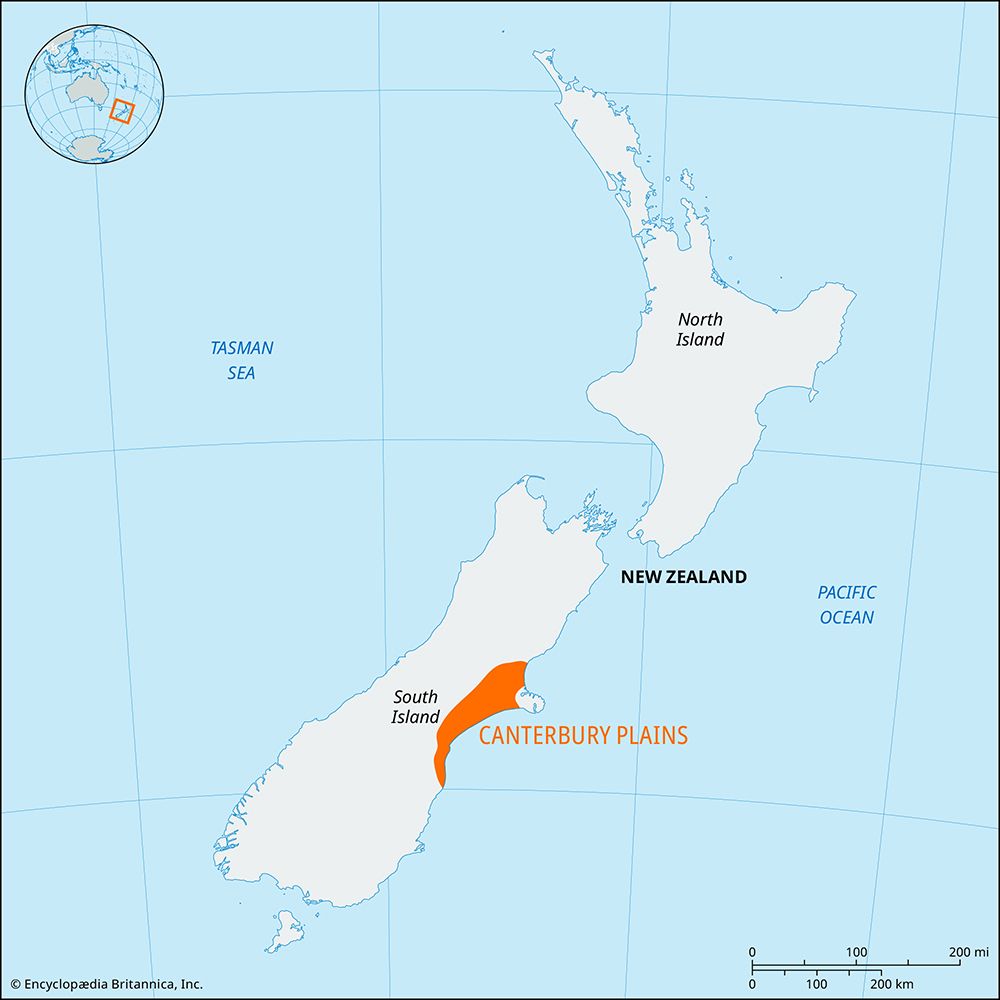
The Canterbury Plains are a prominent lowland region located in the east-central portion of the South Island of New Zealand.
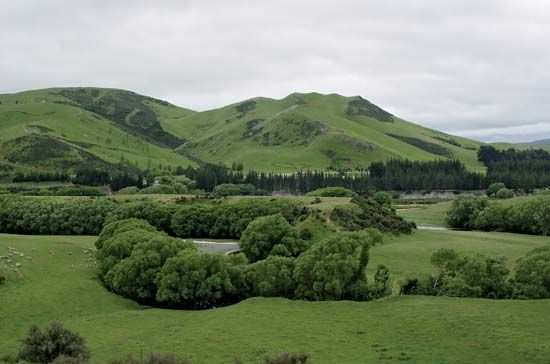
What are the geographical features and boundaries of the Canterbury Plains?
The Canterbury Plains are a prominent lowland region located in the east-central portion of the South Island of New Zealand.
Geographical Features and Boundaries
- Dimensions: The plains span an area approximately 150 miles long by 45 miles wide (240 by 70 km).1
- Boundaries: The region is bordered to the east by the Pacific Ocean and extends inland toward the Southern Alps.1
- Hydrology: The landscape is defined by several principal rivers—the Rangitata, Rakaia, and Waimakariri—which flow eastward from the Southern Alps across the plains to the sea.1
- Climate: The area is characterized by hot summers, low humidity, and a relatively dry climate, with a mean annual rainfall of less than 30 inches (750 mm).1
As the largest low-lying agricultural district in New Zealand, the plains are highly developed for mechanized farming, including grain production and livestock raising.1
What is the climate like in the Canterbury Plains region?
The climate of the Canterbury Plains is characterized by hot summers and generally low humidity. The region experiences a relatively dry climate, with a mean annual rainfall of less than 30 inches (750 mm).2
This dry environment is significantly influenced by the Southern Alps/Kā Tiritiri o te Moana, which act as a barrier to prevailing winds. In the lee of these mountains, the effect of the foehn—a warm, dry wind descending the leeward mountain slopes—is marked, which can cause humidity levels to become very low.1
What are the major cities and towns located in the Canterbury Plains?
The major cities and towns located within the Canterbury Plains of New Zealand’s South Island include:
- Christchurch: The largest city on the South Island and the primary urban center and outlet for the region.14
- Ashburton: A significant population center where irrigation is utilized for agricultural purposes.14
- Timaru: A population center known for its artificial harbour.4
Please note that while there is a historic city named Canterbury in Kent, England, it is geographically distinct from the Canterbury Plains region in New Zealand.5
What role did the Canterbury Plains play in New Zealand’s early colonial history?
The Canterbury Plains played a pivotal role in New Zealand’s early colonial history, serving as a cornerstone of the South Island’s economic prosperity during the 19th century.
Organized settlement began in the 1850s, most notably with the founding of Christchurch. This project was inspired by Edward Gibbon Wakefield and his New Zealand Company, with the Canterbury Association aiming to establish a model Church of England settlement. The first immigrants arrived between 1850 and 1851, and the region quickly became a hub for pastoral farming, particularly the introduction of merino sheep.
During the 1860s, the Canterbury region—along with Otago—drove the South Island’s economic growth. The plains provided essential provisions for the goldfields of Victoria, Australia, and later for New Zealand’s own gold rushes. This agricultural success allowed the South Island to hold a significant majority of the European population during that decade. By the 1880s, the development of refrigeration further transformed the region, enabling the export of meat and dairy to Great Britain and cementing the plains’ status as a vital agricultural district.
Sources
- Canterbury Plains — Encyclopædia Britannica
- New Zealand - Climate — Encyclopædia Britannica
- New Zealand - Relief of New Zealand — Encyclopædia Britannica
- Canterbury — Encyclopædia Britannica
- Canterbury — Encyclopædia Britannica
- Christchurch — Encyclopædia Britannica
- history of New Zealand - Fluctuation of the economy — Encyclopædia Britannica
- New Zealand - Early European settlement — Encyclopædia Britannica
Published on · 2 min read