Land Snail
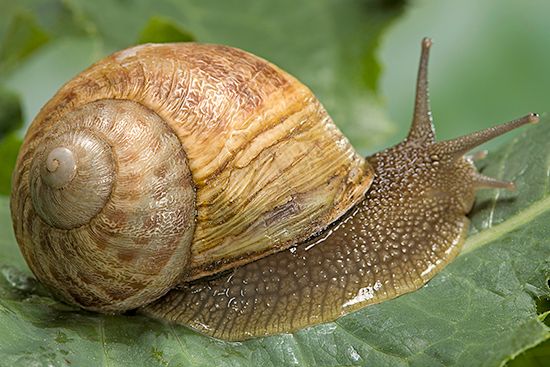
A land snail is any of the approximately 35,000 gastropod species that have adapted to life away from water. Most belong to the subclass Pulmonata, though a…
What is land snail?
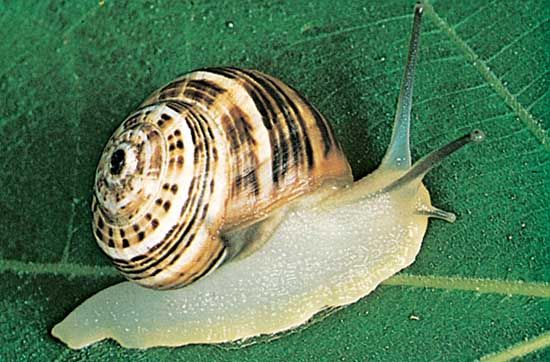
A land snail is any of the approximately 35,000 gastropod species that have adapted to life away from water. Most belong to the subclass Pulmonata, though a few are members of the subclass Prosobranchia.12
These mollusks are found worldwide, from tropical islands to cold regions where they hibernate. They typically inhabit surface litter and upper soil zones, feeding primarily on decaying plant matter. Because they lose water while moving, land snails have evolved various adaptations to avoid desiccation, such as retreating into their shells, sealing the aperture with mucus or calcium-impregnated seals, and remaining dormant during dry or cold periods.132
While terrestrial forms are usually drab, some arboreal species are brightly colored. They generally lay their eggs in soil or under moist debris, and they exhibit internal fertilization. Some species, such as those in the genus Achatina, can grow up to 20 cm (8 inches) across.14
How do land snails protect themselves from drying out?
Land snails have developed several physiological and behavioral adaptations to prevent desiccation (drying out) in terrestrial environments:
- Shell Protection: Prosobranch land snails use an operculum to effectively seal their shell opening against the exterior. While pulmonates lack an operculum, many secrete mucous coverings known as epiphragms across the shell aperture. In arid regions, some species create a calcium-impregnated seal that can be nearly as thick as the shell itself.3
- Behavioral Adjustments: Most land snails primarily rely on behavior to manage moisture. They typically remain in areas with high humidity, retreat into damp niches during dry spells, or burrow into the soil.3
- Dormancy: Many species enter a state of dormancy known as estivation during periods of heat and dryness. During this time, they may remain inactive for extended periods—sometimes years—to conserve energy and moisture.351
- Specialized Structures: In tropical environments, some land operculates have evolved elaborate breathing tubes that facilitate gas exchange during dry periods while minimizing water loss.3
What is the difference between a land snail and a slug?
The primary difference between a land snail and a slug lies in the presence and development of their shells. Both are members of the class Gastropoda, but they are distinguished by the following characteristics:
- Shell Presence: Land snails typically possess a well-developed, calcareous shell into which the animal can withdraw for protection against predators and desiccation. In contrast, slugs have evolved to have a greatly reduced shell, which may exist only as an internal plate, a series of granules, or be completely absent.367
- Evolutionary Context: The evolution of slugs from shell-bearing snails is often observed in humid mountain regions where moisture is abundant. Because the shell’s primary function is to protect against drying out, it becomes less necessary in consistently moist environments. Furthermore, because shell construction requires calcium—a resource often scarce in volcanic mountain soils—the reduction of the shell provides an evolutionary advantage.8
- Habitat and Behavior: While both occupy similar microhabitats like surface litter and soil zones, land snails rely on their shells and specialized structures (like an operculum or mucous epiphragms) to manage moisture. Slugs are generally restricted to moist habitats, as they lack these protective shell-based mechanisms.867
How do land snails move without legs?
Land snails move without legs by utilizing a specialized muscular organ known as the foot. This method of movement, called pedal locomotion, relies on a series of contraction waves that travel from the posterior to the anterior end of the foot’s gliding surface.910
To facilitate this process, the snail secretes a layer of mucus, which serves as a protective track that reduces friction and allows the animal to glide forward. In many land pulmonates, the foot is divided longitudinally, with movement primarily occurring in the central section as it glides along this mucous path. While some smaller species also utilize the beating action of cilia to assist in movement, the overall process is inherently slow due to the reliance on sequential muscle contractions and the weight of the protective shell.910
Sources
- land snail — Encyclopædia Britannica
- gastropod - Reproduction and life cycles — Encyclopædia Britannica
- gastropod - Ecology and habitats — Encyclopædia Britannica
- gastropod - Distribution and abundance — Encyclopædia Britannica
- estivation — Merriam-Webster
- gastropod - Classification — Encyclopædia Britannica
- gastropod - Size range and diversity of structure — Encyclopædia Britannica
- slug — Encyclopædia Britannica
- How fast are snails? — Encyclopædia Britannica
- gastropod - Locomotion — Encyclopædia Britannica
Published on · 3 min read