Jingle Shell
A jingle shell is a marine invertebrate belonging to the family Anomiidae within the class Bivalvia. These oysterlike mollusks are characterized by their…
What is jingle shell?
A jingle shell is a marine invertebrate belonging to the family Anomiidae within the class Bivalvia. These oysterlike mollusks are characterized by their thin, translucent, and often irregular shell valves.12
In most species, the animal anchors itself to a rock surface by pressing one shell valve against it. A large hole in this lower valve allows a calcified byssus—a tuft of horny threads—to pass through and secure the mollusk to the substrate. The upper valve is typically more convex and conforms to the shape of the surface to which the animal is attached.1
The name “jingle shell” originates from the sound these shells produce when they are dried and shaken against one another. Due to their pearly interiors and delicate appearance, they are frequently utilized in the creation of decorative items such as chimes, lampshades, and other ornaments.12
What is a byssus and how do mollusks use it to attach to rocks?
A byssus is a collection of long, tough, proteinaceous filaments used by certain bivalve mollusks to anchor themselves to firm substrates5. These threads are secreted by a specialized gland located in the animal’s foot.45
While the byssus is a larval feature in many bivalves, some groups—such as the true mussels (Mytilidae)—retain and enlarge these structures into adulthood. This adaptation allows them to colonize hard surfaces on wave-swept shores, where they use the threads to secure themselves against the force of the water.54
The mechanism of attachment varies by species:
- Anchorage: In some bivalves, the byssus serves as a primary anchor, sometimes forming an enclosing nest for protection within sediments.5
- Crevice Attachment: Other species use the byssus to attach securely within rock crevices, which often allows them to assume a laterally flattened, circular shape.5
- Retraction: Mussels utilize specialized byssal retractor muscles to pull their shells tightly against the substrate, ensuring a stable hold.4
How do bivalve mollusks feed in their marine environments?
Bivalve mollusks employ diverse feeding strategies, though the vast majority are ciliary suspension feeders that strain food particles from the water column.89
Suspension Feeding
Most modern bivalves use their gills, which have evolved into specialized filtering devices called ctenidia. These structures feature complex arrays of cilia that create water currents, drawing water into the mantle cavity. As water passes through the gill filaments, food particles—such as bacteria, algae, and plant detritus—are trapped in mucus and transported along food grooves to the labial palps. The palps further sort these particles before directing them to the mouth, while rejected material is expelled as pseudofeces.8106
Alternative Feeding Strategies
While suspension feeding is standard, some bivalves have adapted to different niches:
- Deposit Feeding: Primitive bivalves, such as certain protobranchs, use extensible proboscides on their palps to collect organic detritus directly from the sediment surface.86
- Carnivory: Deepwater groups like the septibranch Anomalodesmata and the scallop genus Propeamussium have modified their ctenidia to capture live prey, such as small crustaceans, by creating sudden pressure changes or using water currents to draw prey into the mantle cavity.86
- Symbiosis: Giant clams and some other species host symbiotic zooxanthellae (algae) within their mantle tissue, gaining nutrition from the algae’s metabolic products.89
- Wood Boring: Shipworms supplement their filter-feeding diet by digesting the wood they inhabit.8
What are some other common types of bivalves found on beaches?
Beaches are home to a variety of bivalve mollusks, each adapted to specific coastal environments like sandy shores or rocky intertidal zones. Common types include:
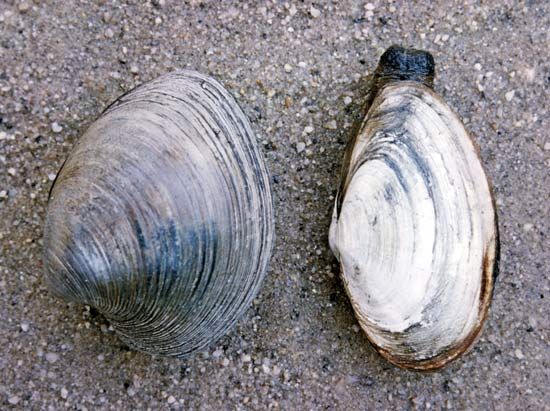
- Clams: These are frequently found burrowed into sandy or muddy substrates. Notable examples include the soft-shell clam (Mya arenaria), often used in chowders, and the coquina clam (Donax), which is known for its colorful, wedge-shaped shell and its habit of migrating up and down the beach with the tide.111213
- Cockles: Members of the family Cardiidae, these bivalves are distributed worldwide and typically live shallowly buried in sandy or muddy areas. They are often recognized by their rounded, ribbed shells.145
- Mussels: Often found in high-energy surf zones, mussels attach themselves to rocks or human-made structures using strong, proteinaceous byssal threads. They are typically oblong or triangular with dark-colored shells.1115
- Oysters: These are sessile bivalves that live in coastal regions, where they fuse their rough, irregularly shaped shells to hard surfaces, eventually forming reefs.11
- Scallops: Unlike many other bivalves, scallops are known for their ability to swim by clapping their shells together. They are easily identified by their distinctive, often fan-shaped shells.1115
Sources
- jingle shell — Encyclopædia Britannica
- jingle shell — Merriam-Webster
- bivalve - Annotated classification — Encyclopædia Britannica
- byssus — Merriam-Webster
- bivalve - Size range and diversity of structure — Encyclopædia Britannica
- bivalve - Internal features — Encyclopædia Britannica
- byssal — Merriam-Webster
- bivalve - Food and feeding — Encyclopædia Britannica
- Filter feeding — Encyclopædia Britannica
- mollusk - Habitats, feeding habits, and associations — Encyclopædia Britannica
- What’s the difference between clams, mussels, and oysters? — Encyclopædia Britannica
- clam — Encyclopædia Britannica
- cockle — Encyclopædia Britannica
- bivalve - Distribution and abundance — Encyclopædia Britannica
- coquina clam — Encyclopædia Britannica
Published on · 3 min read