Lake Trout
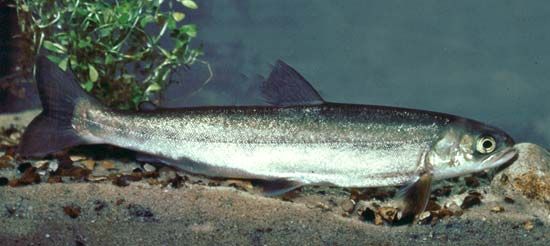
The lake trout (Salvelinus namaycush) is a large, voracious char belonging to the family Salmonidae. Native to northern Canada, Alaska, and the Great Lakes…
What is lake trout?
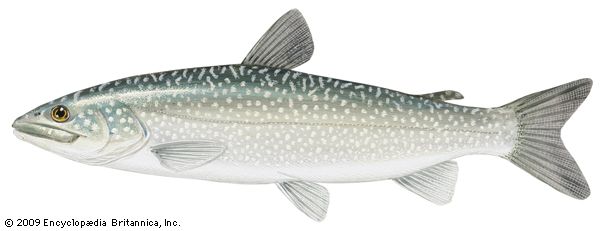
The lake trout (Salvelinus namaycush) is a large, voracious char belonging to the family Salmonidae. Native to northern Canada, Alaska, and the Great Lakes basin, this species typically inhabits deep, cool lakes.12
Physically, lake trout are greenish-gray and marked with pale spots. While they can reach weights of up to 45 kg (100 pounds), they are often caught in shallower waters during the spring. They spawn in the fall, depositing heavy eggs among reefs. Although once of significant commercial value, their populations in the Great Lakes were devastated in the 1930s following the arrival of sea lampreys via the Welland Canal.1
The name “lake trout” is also used colloquially to describe various other trout and salmon species found in lake environments.13
How did sea lampreys affect the lake trout population?
The invasion of the sea lamprey into the Great Lakes had a catastrophic impact on lake trout populations, which served as the ecosystem’s apex predator until the mid-20th century.45
The decline occurred through the following mechanisms:
- Parasitic Feeding: As a parasitic species, the sea lamprey uses a suction-cup mouth filled with sharp, hooked teeth to attach to host fish. It rasps a hole into the host’s flesh and secretes an enzyme to prevent blood from clotting, allowing it to feed on the fish’s fluids.46
- High Mortality Rates: While sea lampreys often do not kill their hosts in their native oceanic habitats, they are significantly more lethal in the Great Lakes, where they kill more than half of the fish they parasitize.4
- Population Collapse: The combination of sea lamprey predation, overfishing, and water pollution led to the total collapse of lake trout fisheries in Lakes Huron and Michigan by the early 1950s.45
Efforts to restore the population began in the 1960s after international programs successfully reduced sea lamprey numbers by approximately 90 percent using methods such as lampricides and physical barriers.45
What are the main differences between trout and char?
While both trout and char belong to the family Salmonidae, they are distinguished by specific anatomical and physical characteristics.73
The primary differences include:
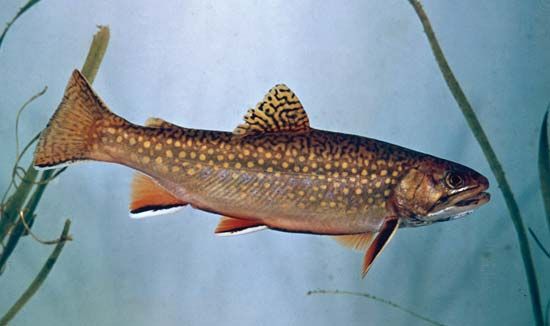
- Coloration and Spotting: Chars typically display light-colored (red, cream, or pale) spots on a darker body. In contrast, Oncorhynchus trout generally feature red or black spots on a lighter-colored body.73
- Vomer Bone Structure: The vomer bone on the roof of the mouth is a key diagnostic feature. In chars, this bone is boat-shaped and features teeth only on the front. In Oncorhynchus trout, the vomer is flatter and possesses teeth on both the front and the shaft.73
- Scales: Chars often possess smaller scales compared to their trout relatives.7
It is important to note that classification can be complex due to hybridization and historical naming conventions. For instance, several species commonly referred to as “trout”—such as the brook trout, Dolly Varden trout, and lake trout—are technically classified as chars within the genus Salvelinus.73
Why do lake trout prefer deep, cool water?
The provided search results do not explicitly state the physiological or biological reasons why lake trout prefer deep, cool water. They do, however, confirm that lake trout are a species of char typically found in such environments and note that these deep waters are home to specific organisms adapted to cold, northern latitudes.16
While the provided text identifies the lake trout’s preferred habitat, it does not detail the specific metabolic or environmental requirements that drive this preference.
Sources
- lake trout — Encyclopædia Britannica
- lake trout — Merriam-Webster
- trout — Encyclopædia Britannica
- sea lamprey — Encyclopædia Britannica
- agnathan - General features — Encyclopædia Britannica
- Great Lakes - Plant and animal life — Encyclopædia Britannica
- char — Encyclopædia Britannica
Published on · 3 min read