Lepidodendron
The extinct Lepidodendron trees, which thrived during the Carboniferous Period, could reach heights of up to 40 meters (130 feet) and diameters of 2 meters…
How tall could Lepidodendron trees grow, and how does this compare to modern trees?
The extinct Lepidodendron trees, which thrived during the Carboniferous Period, could reach heights of up to 40 meters (130 feet) and diameters of 2 meters (about 7 feet).12
When compared to modern trees, Lepidodendron was exceptionally tall for a lycopsid, a group now represented only by small, herbaceous club mosses. While Lepidodendron reached impressive heights, it is surpassed by some of today’s tallest species. For example, Pacific Coast redwoods can exceed 110 meters (350 feet) in height, and the Australian mountain ash can exceed 90 meters (300 feet). Unlike modern trees that rely on extensive wood production for structural support, Lepidodendron stems were characterized by a slender central strand of wood and a thick layer of bark.134
What other plant genera were closely related to Lepidodendron in the Carboniferous period?
Lepidodendron belonged to the order Lepidodendrales, a group of arborescent (tree-sized) lycophytes that were prominent during the Carboniferous Period. Within this order, several other genera are closely related to Lepidodendron due to their shared evolutionary lineage and structural characteristics, such as their reliance on a slender central strand of wood and thick bark for support.1564
Key related genera include:
- Lepidophloios: A close relative that shared similar reproductive features, though it notably wrapped its megasporangium in a layer of tissue, a trait independently derived in this lineage.1
- Sigillaria: One of the most dominant lycopod genera alongside Lepidodendron. While Lepidodendron is characterized by diamond-shaped leaf bases, Sigillaria is distinguished by its vertical ribs and round leaf scars. Unlike Lepidodendron, which favored peat-forming swamps, Sigillaria appears to have preferred the mineral soils of river floodplains.174
- Bothrodendron and Paralycopodites: These are also recognized as closely related genera within the same group of arborescent lycopsids.1
These plants, along with other Carboniferous flora like the sphenopsid Calamites, formed the dense, swampy forests that defined the period’s landscape.17
What were the main characteristics of Lepidodendron’s leaf-like structures called ‘lycophylls’?
The leaf-like structures of Lepidodendron, known as microphylls, were a defining characteristic of these ancient arborescent lycopsids. Their primary features included:
- Structure and Venation: Unlike the complex, branched leaves of ferns or seed plants, Lepidodendron microphylls were narrow and contained only a single, unbranched midvein.38
- Size Variation: While generally small, these leaves could reach lengths of up to one meter (three feet) during the plant’s juvenile stages. As the tree matured and began to branch, the leaves typically became shorter and awl-shaped.39
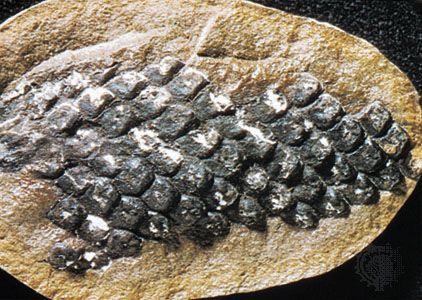
- Growth Pattern: In juvenile Lepidodendron, long, thin leaves sprouted in a cluster near the growing tip of the unbranched trunk. As the plant grew, it shed these leaves from the older sections of the stem, leaving behind distinctive diamond-shaped leaf bases that are often used to identify fossil specimens.9
- Reproductive Association: Some of these leaves were modified into sporophylls—specialized leaves that bore sporangia (spore cases) on their upper (adaxial) side. These sporophylls were often clustered into tight, cone-like structures known as strobili.3
During which geological period did Lepidodendron thrive, and when did it go extinct?
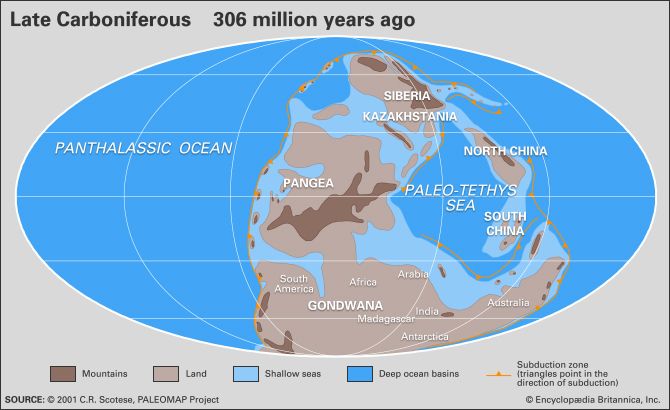
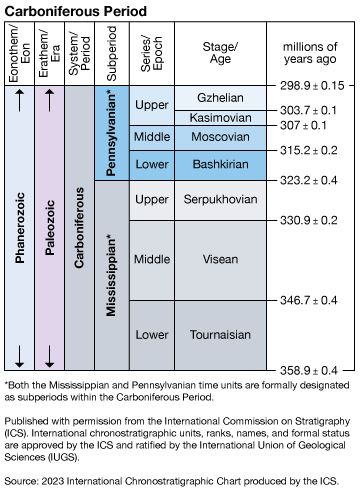
Lepidodendron thrived primarily during the Carboniferous Period, which spanned approximately 359 million to 299 million years ago. While the broader order to which it belonged, the Lepidodendrales, originated as early as the Lower Devonian, Lepidodendron itself was a dominant feature of the peat-forming swamps during the Early and Middle Pennsylvanian epochs (roughly 318 million to 307 million years ago).16
The genus went extinct following the disappearance of these extensive swamp environments, which were essential for their survival.1
Sources
- Lepidodendron — Encyclopædia Britannica
- tree - Trees of special interest — Encyclopædia Britannica
- lycophyte - General features — Encyclopædia Britannica
- Carboniferous Period - Plants — Encyclopædia Britannica
- Sigillaria — Encyclopædia Britannica
- Lepidodendrales — Merriam-Webster
- lycophyte - Annotated classification — Encyclopædia Britannica
- plant - Evolution of land plants from the Ordovician Period through the middle Devonian — Encyclopædia Britannica
- lycophyte — Encyclopædia Britannica
- lower vascular plant - Leaves — Encyclopædia Britannica
Published on · 3 min read