Pleuromeia
Pleuromeia is a genus of extinct lycopsid plants that lived during the Triassic Period, approximately 251 million to 200 million years ago.
What is Pleuromeia?
Pleuromeia is a genus of extinct lycopsid plants that lived during the Triassic Period, approximately 251 million to 200 million years ago.1
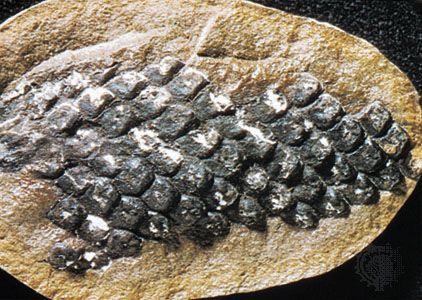
Unlike the arborescent lycopsids of the earlier Carboniferous Period—such as Lepidodendron and Sigillaria—Pleuromeia featured an unbranched trunk that reached up to 2 meters (6.6 feet) in height. Instead of a branching underground rhizome, it possessed a distinct four-lobed, bulblike base. The plant was topped with a crown of long, thin leaves, while its reproductive structures consisted of spores housed in cones at the apex of the trunk.12
Though the exact details of its reproductive process remain a subject of study, the genus was geographically widespread, with fossil specimens discovered in Russia, Europe, China, and Australia.1
How did the Triassic environment differ from the Carboniferous?
The environments of the Carboniferous Period and the Triassic Period differed significantly in their geography, climate, and biological landscapes.
Geography and Climate
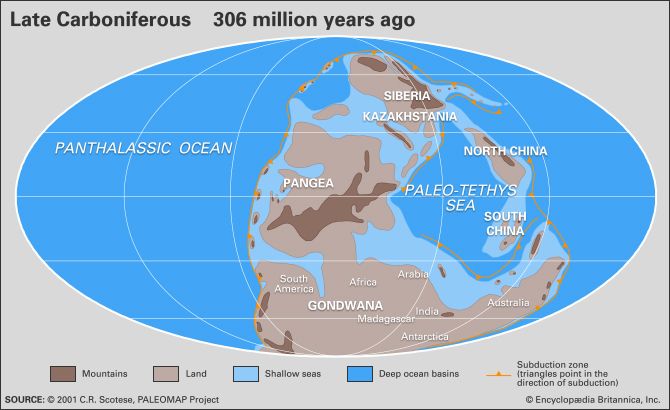
- Carboniferous: The period was characterized by highly variable depositional settings. Tropical conditions dominated equatorial regions, while higher latitudes were cooler and moist, supporting extensive continental glaciations in the southern continent of Gondwana.34
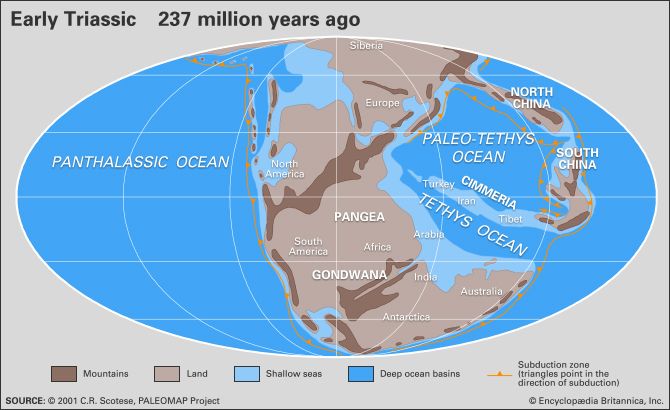
- Triassic: By the start of the Triassic, major landmasses had coalesced into the supercontinent of Pangea. The climate was generally warm and dry, with widespread aridity across much of the landmass, though seasonal monsoons provided moisture to certain regions. Unlike the Carboniferous, there is no evidence of polar ice during the Triassic.567
Biological Environment
- Carboniferous: This era is famous for its vast coal swamps, which were fueled by lush growth of vascular plants such as lycopods, sphenopsids, and seed ferns.4
- Triassic: Following the massive Permian-Triassic extinction, the Triassic saw a recovery and radiation of life. Gymnosperms became the dominant middle-story plants, and the period marked the emergence of the first dinosaurs and, eventually, the first mammals.568
What are lycopsids and how do they reproduce?
Lycopsids (subdivision Lycopsida) are a group of vascular plants characterized by small leaves and sporangia that are sessile and adaxial (attached to the upper side of the leaf base). This group includes modern club mosses, quillworts, and spike mosses, as well as extinct arborescent (tree-sized) forms like Lepidodendron.121314
Reproduction
Lycopsids reproduce via an alternation of generations, cycling between a spore-producing phase (the sporophyte) and a sex-cell-producing phase (the gametophyte).14
- Homosporous species: Some, such as the family Lycopodiaceae, produce only one type of spore. These develop into bisexual gametophytes that produce both sperm and eggs. Fertilization occurs when flagellated sperm swim to the egg-producing archegonia.15
- Heterosporous species: Genera like Selaginella and Isoetes produce two types of spores: microspores (which develop into male gametophytes) and megaspores (which develop into female gametophytes). In these plants, development is often endosporic, meaning it occurs largely within the spore wall.15
Extinct tree lycopsids also reproduced via spores, and some species produced spore-bearing cones at their branch tips, which may indicate they were monocarpic, reproducing only once in their lifetime.14
How do modern plants like Isoetes compare to Pleuromeia?
The extinct Triassic genus Pleuromeia and the modern quillworts (Isoetes) share a common evolutionary lineage within the lycophytes, specifically within the order Isoetales.
Key Comparisons
- Growth and Structure: Pleuromeia was an unbranched plant reaching up to 2 meters in height, featuring a four-lobed, bulblike base. In contrast, modern Isoetes are much smaller, herbaceous plants typically found in swampy or aquatic environments. Despite these size differences, Pleuromeia is often noted for having characteristics in common with Isoetes, such as the presence of a lobulated, root-bearing base and long, ligulate leaves.
- Reproduction: Both groups are heterosporous, meaning they produce two distinct types of spores. Pleuromeia bore cones at its apex, though the specific details of its reproductive cycle remain somewhat unclear. Modern Isoetes also utilize heterospory and are characterized by endosporic gametophytes, where the gametophyte develops largely within the spore wall.
- Classification: While Pleuromeia is placed in the extinct order Pleuromeiales, it is frequently compared to Isoetes due to their shared morphological traits, such as the specialized root-bearing base.
Sources
- Pleuromeia — Encyclopædia Britannica
- Pleuromeia — Merriam-Webster
- A Journey Through Time Since the Precambrian - Triassic Period: 252.2 million to 201.3 million years ago — Encyclopædia Britannica
- Triassic Period — Encyclopædia Britannica
- Triassic Period - Permian-Triassic extinctions — Encyclopædia Britannica
- Triassic Period - Plants — Encyclopædia Britannica
- Triassic Period - Paleoclimate — Encyclopædia Britannica
- Carboniferous Period - Paleoclimate — Encyclopædia Britannica
- Carboniferous Period - Distinctive features — Encyclopædia Britannica
- evolution of the atmosphere - Attainment of the modern O 2 level — Encyclopædia Britannica
- geologic history of Earth - Formation of the secondary atmosphere — Encyclopædia Britannica
- lycophyte — Encyclopædia Britannica
- Lepidodendron — Encyclopædia Britannica
- lycophyte - Life cycle — Encyclopædia Britannica
- lycopsid — Merriam-Webster
- Lycopsida — Merriam-Webster
- gnetophyte - Reproductive structures and function — Encyclopædia Britannica
- conifer - Strobili — Encyclopædia Britannica
- lycophyte - Annotated classification — Encyclopædia Britannica
Published on · 3 min read