Lesser Caucasus
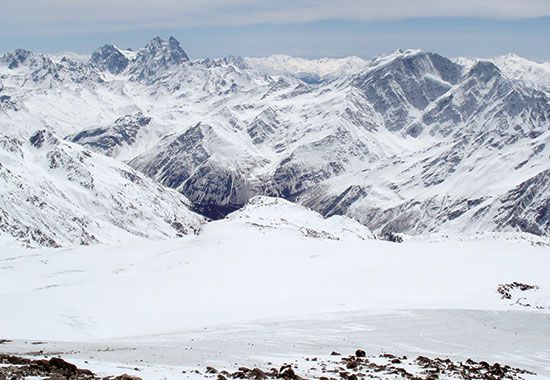
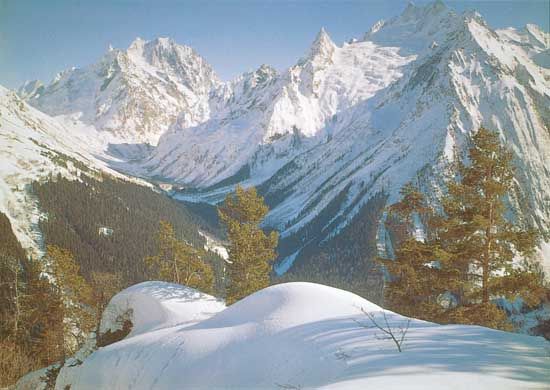
The Lesser Caucasus is a range of folded mountains located in the southern part of the Caucasus region. It spans portions of Georgia, Armenia, and…
What is Lesser Caucasus?
The Lesser Caucasus is a range of folded mountains located in the southern part of the Caucasus region. It spans portions of Georgia, Armenia, and Azerbaijan. The range is connected to the main Greater Caucasus Mountains by the Likhsky Mountains, which serve as a divide between the Rioni and Kura river basins.1
Geologically, the Lesser Caucasus originated from folds uplifted from the Alpine geosyncline. Its landscape is significantly shaped by volcanic action, particularly in the west, and it merges to the south with the Armenian Highland1. While the range features various elevations, few of its peaks exceed 8,000 feet (2,400 m), though the highest peak, Mount Aragats, rises to 13,418 feet (4,090 m).213
The climate of the region varies, with northern slopes experiencing conditions similar to the Greater Caucasus, while the southern highlands are characterized by a more continental climate with cold, prolonged winters.45
How does the Lesser Caucasus differ from the Greater Caucasus?
The Greater Caucasus and the Lesser Caucasus are distinct mountain systems separated by the Kura-Aras Lowland, with several key differences in their structure, geology, and climate:
Structural and Geological Differences
- Formation: The Greater Caucasus is a massive anticline (upfold) that serves as a major barrier between climatic zones. In contrast, the Lesser Caucasus is a range of folded mountains that merges southward into the Armenian Highland and is connected to the Greater Caucasus by the Likhsky Mountains.36
- Composition: The core of the Greater Caucasus features ancient, hard crystalline rocks like granite, schist, and gneiss. The Lesser Caucasus is characterized by significant volcanic activity; its landscape is heavily shaped by intrusive volcanic rock and debris from Cenozoic-era eruptions.6
Climatic Distinctions
- Barrier Effect: The Greater Caucasus acts as a climatic divide, blocking cold northern air from reaching Transcaucasia and warm southern air from moving north.2
- Continental Influence: While the northern slopes of the Lesser Caucasus mirror the Greater Caucasus, the southern highlands of the Lesser Caucasus and the Armenian Highland experience a much more continental climate. These areas face colder, longer winters and lower annual precipitation compared to the high-humidity, alpine conditions found at similar elevations in the Greater Caucasus.2
What role did volcanic activity play in shaping the Lesser Caucasus?
Volcanic activity has been a primary force in shaping the landscape of the Lesser Caucasus. While the range originated from folds uplifted from the Alpine geosyncline, its surface features have been significantly altered by geologically recent volcanism and contact metamorphism—the process where molten material intrudes into preexisting rock strata.21
The impact of this activity is particularly evident in the following ways:
- Western Sector: The western ranges are heavily affected by volcanic action, which has played a major role in their structural development.7
- Central and Eastern Sectors: These areas consist of sedimentary strata that have been intruded by volcanic rock of significant age.21
- Surface Masking: In regions such as the Dzhavakhet Range and the Armenian Highland, the original folded base of the mountains is largely masked by thick layers of volcanic debris resulting from eruptions during the Cenozoic Era.21
Which countries share the territory of the Lesser Caucasus?
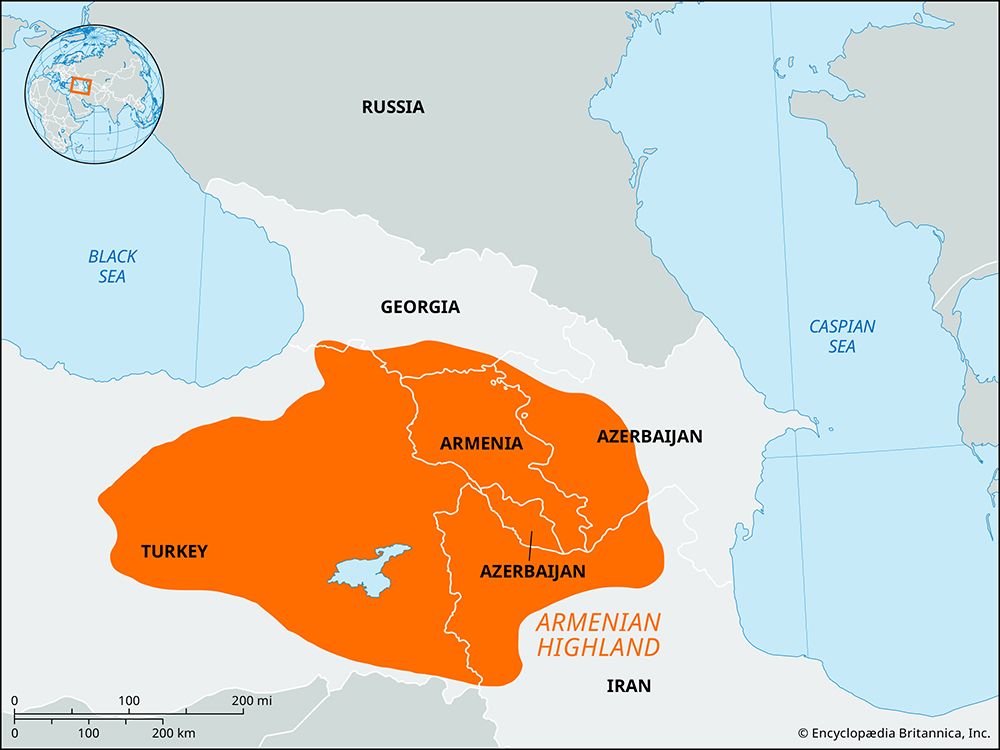
The territory of the Lesser Caucasus is shared by three primary countries:
- Georgia
- Armenia
- Azerbaijan
To the south, the range merges with the Armenian Highland, a broader mountainous region that extends into portions of Turkey and Iran.place/Turkey)** and Iran.1
Sources
- Lesser Caucasus — Encyclopædia Britannica
- Caucasus - Geology of Caucasus — Encyclopædia Britannica
- Caucasus - Physiography — Encyclopædia Britannica
- Caucasus - Climate — Encyclopædia Britannica
- Transcaucasia - Climate — Encyclopædia Britannica
- Greater Caucasus — Encyclopædia Britannica
- Transcaucasia - Geology of Transcaucasia — Encyclopædia Britannica
- Caucasus — Encyclopædia Britannica
- Armenian Highland — Encyclopædia Britannica
Published on · 3 min read