Greater Caucasus
The Greater Caucasus is a major mountain range that extends approximately 750 miles (1,200 km) across the Caucasian isthmus. It stretches west-to-east from…
What is Greater Caucasus?
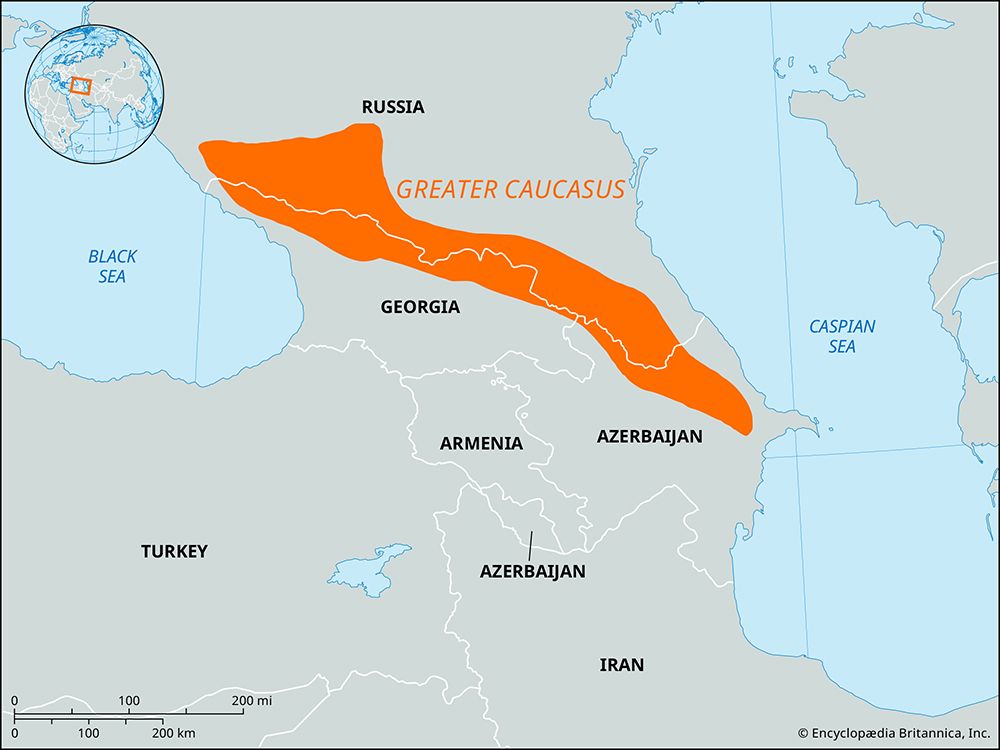
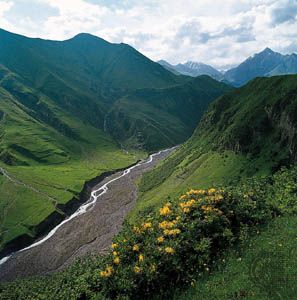
The Greater Caucasus is a major mountain range that extends approximately 750 miles (1,200 km) across the Caucasian isthmus. It stretches west-to-east from the Taman Peninsula on the Black Sea to the Abşeron Peninsula on the Caspian Sea.12
Geologically, the range represents a massive anticline (upfold) that formed at the margin of the Alpine geosyncline about 25 million years ago. Its structure features a core of ancient crystalline rocks, such as schists and gneisses, flanked by younger sedimentary layers like limestone and sandstone.3
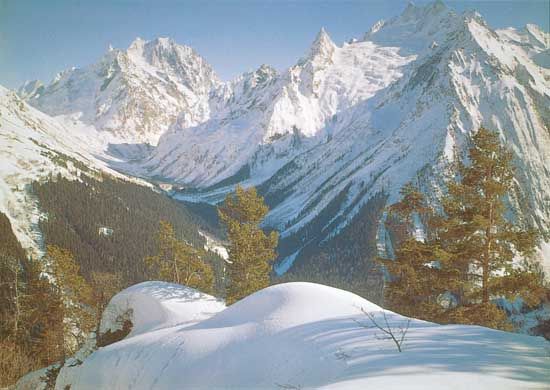
The range serves as a significant climatic barrier, separating temperate mid-latitude zones from subtropical regions by obstructing the movement of cold air from the north. Consequently, it creates distinct climatic contrasts between the northern plains and the southern lowlands. The higher elevations are characterized by a cold, alpine climate with perennial snow cover on the highest peaks, including Mount Elbrus and Mount Kazbek.452
What is the difference between the Greater and Lesser Caucasus ranges?
The Greater and Lesser Caucasus are distinct mountain systems separated by the Kura-Aras Lowland and the Shirak Steppe. While both originated from the Alpine geosyncline, they differ significantly in their physical structure and climatic influence.32
Physical and Geological Differences
- Greater Caucasus: This range acts as a massive anticline (upfold) stretching 750 miles from the Black Sea to the Caspian Sea. Its core consists of ancient crystalline rocks like schists, gneisses, and granites, while its spurs are composed of younger sedimentary layers. It features the highest peaks in the region, including Mount Elbrus and Mount Kazbek.32
- Lesser Caucasus: Located south of the Greater Caucasus, this range is geologically complex, featuring sedimentary strata mixed with intrusive volcanic rock. It is extended southward by the Dzhavakhet Range and the Armenian Highland. Its highest peak is Mount Aragats.23
Climatic Impact
- Greater Caucasus: It serves as a major climatic barrier, blocking cold air from the north and warm air from the south, which creates sharp temperature contrasts between Ciscaucasia and Transcaucasia.45
- Lesser Caucasus: While its northern slopes share some climatic similarities with the Greater Caucasus, the associated Armenian Highland exhibits a much more continental climate, characterized by colder winters and lower annual precipitation.45
Which famous mountain in the Greater Caucasus is the highest in Europe?
The highest mountain in the Greater Caucasus and the highest point in Europe is Mount Elbrus. Located in southwestern Russia, this extinct volcano features twin cones, with the taller peak reaching an elevation of 18,510 feet (5,642 meters).63
While its status as the highest point in Europe is widely recognized, it is sometimes subject to debate depending on the geographical interpretation of the boundary between Europe and Asia.3
How do the Black and Caspian Seas influence the region’s climate?
The Black and Caspian Seas play significant roles in shaping the climate of the Caucasus region, primarily through their influence on air masses and moisture distribution.
The Black Sea
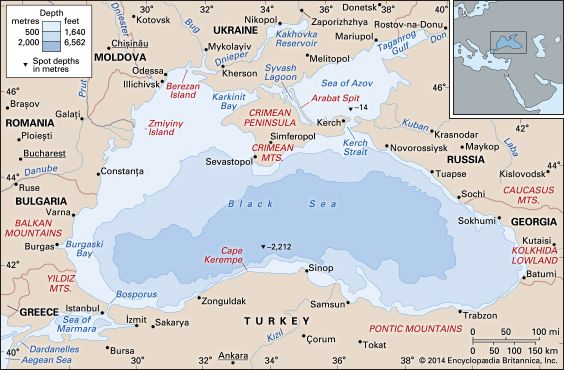
The Black Sea acts as a source of maritime influence, particularly for the western Caucasus. Its presence moderates temperatures, leading to a cooler maritime climate in the west compared to the more continental east. The southeastern portion of the sea is sheltered by high mountains, creating a humid subtropical climate characterized by abundant precipitation and warm winters. Additionally, westerly air currents passing over the sea strengthen maritime conditions, which moderate the climate at higher elevations in the Greater Caucasus.485
The Caspian Sea
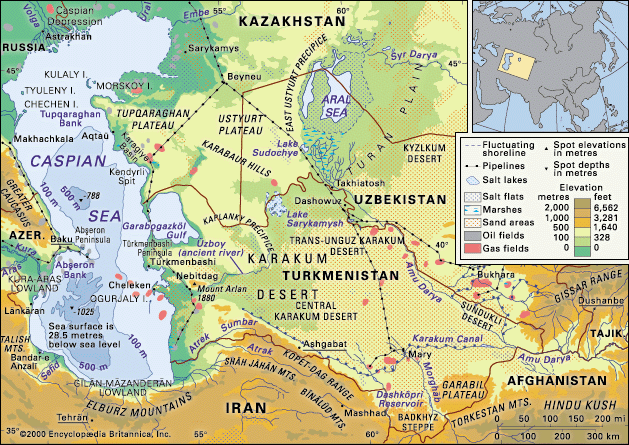
The Caspian Sea influences the region by contributing to the continental nature of the eastern Caucasus. While the sea itself experiences a range of climates—from moderately continental in the north to subtropical in the southwest—it is often subject to the Asiatic anticyclone in winter, which brings cold, clear air. The Caucasus Mountains interact with these systems by blocking cyclonic disturbances from the west, which complicates regional circulation patterns and contributes to the distinct temperature and precipitation differences between the sea’s eastern and western shores.9
Sources
- Greater Caucasus — Encyclopædia Britannica
- Caucasus - Geology of Caucasus — Encyclopædia Britannica
- Caucasus - Physiography — Encyclopædia Britannica
- Caucasus - Climate — Encyclopædia Britannica
- Transcaucasia - Climate — Encyclopædia Britannica
- Mount Elbrus — Encyclopædia Britannica
- The World’s Highest Mountains by Continent — Encyclopædia Britannica
- Caspian Sea - Climate — Encyclopædia Britannica
- Caucasus - Drainage — Encyclopædia Britannica
- Black Sea - Climate of the Black Sea — Encyclopædia Britannica
- Caspian Sea — Encyclopædia Britannica
Published on · 3 min read