Caucasus
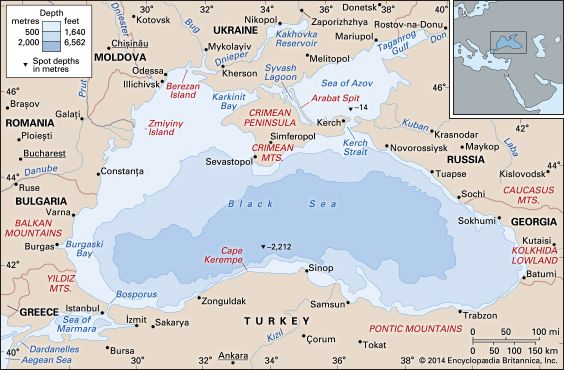
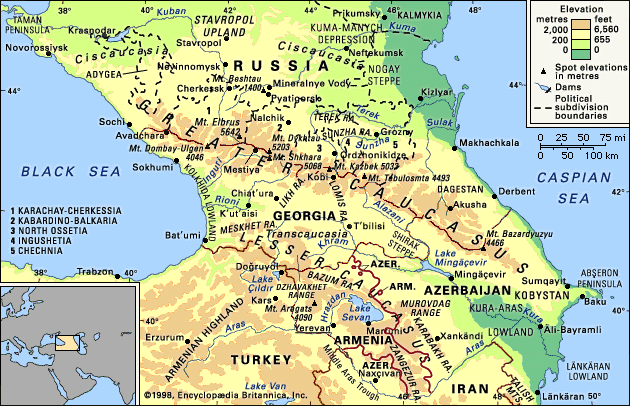
The Black and Caspian seas are fundamental to the climate and economy of the Caucasus region.
How do the Black Sea and Caspian Sea influence the climate and economy of the Caucasus region?
The Black and Caspian seas are fundamental to the climate and economy of the Caucasus region.
Climate Influence
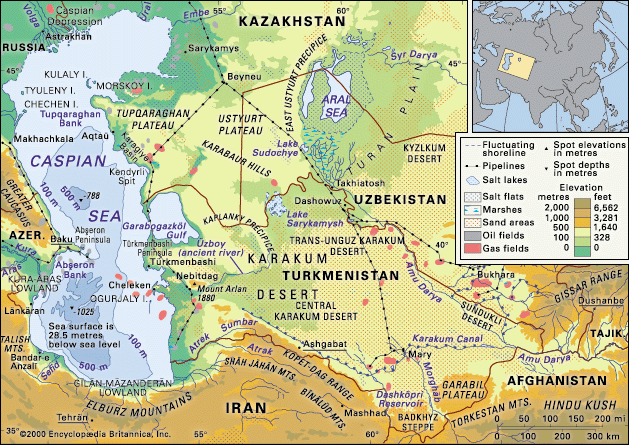
The seas act as major moderators of the regional climate. The Black Sea contributes to a maritime influence that moderates temperatures, particularly in western areas and at higher elevations. Conversely, the Caspian Sea experiences a range of climates, from continental in the north to subtropical in the southwest. The Greater Caucasus range acts as a barrier, blocking the movement of air masses between these seas and the surrounding plains, which creates distinct climatic zones, such as the humid subtropical climate found in the Kolkhida Lowland.123
Economic Impact
- Energy: The Caspian basin is a vital source of petroleum and natural gas, with extensive infrastructure, including pipelines like the Baku-Tbilisi-Ceyhan pipeline, connecting these resources to global markets.456
- Transportation & Tourism: Both seas serve as major transport hubs for freight and passengers. Their coasts are also popular resort areas, supporting a robust tourism industry centered on beaches and mineral springs.4678
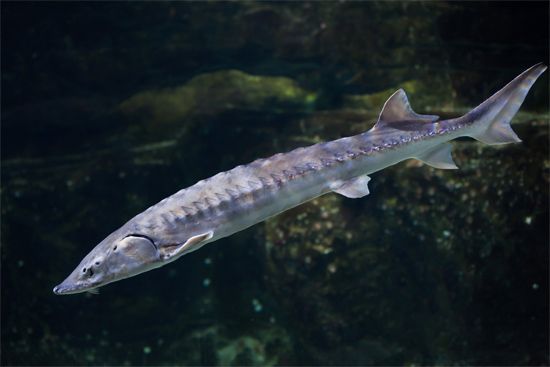
- Fisheries: The Caspian is globally significant for sturgeon and caviar production.5
What are some notable archaeological sites found in the Caucasus, and what do they tell us about early human history?
The Caucasus region is home to significant archaeological sites that provide critical insights into the evolution of early humans and the development of complex societies.
Early Human Evolution
The site of Dmanisi in southern Georgia is one of the most important paleoanthropological locations in Eurasia. Excavations have unearthed human remains, including jaws and skulls, dated to approximately 1.8 million years ago. These fossils, which share characteristics with both Homo habilis and Homo erectus, suggest that early Homo evolution may have been characterized by variations within a single lineage rather than distinct species. Dmanisi serves as a vital link in understanding the migration and early development of humans outside of Africa.11
Development of Early Societies
Archaeological findings across the Caucasus trace the progression of human society from the Paleolithic and Neolithic periods through the Bronze Age:
- Neolithic Settlements: Sites in the Kolkhida Lowland and central Georgia reveal early settled tribes engaged in agriculture and cattle raising, evidenced by stone tools like flint sickles and saddle querns.12
- Metallurgy and Burial Mounds: The region was a center for early metallurgy. The Kuban culture and the Kura-Aras culture are noted for their extensive kurgans (burial mounds). Sites like those in the Trialeti district have yielded refined metalwork, gold and silver vessels, and evidence of complex social hierarchies and trade connections with Mesopotamia.1213
How has oil and natural gas production impacted the modern economy and politics of the Caucasus region?
The extraction and export of oil and natural gas have profoundly shaped the modern economy and political landscape of the Caucasus, particularly in Azerbaijan.
Economic Impact
Hydrocarbons are the cornerstone of the regional economy. The Caspian Sea contains vast oil and natural gas deposits that have been exploited since the 1920s, with production expanding significantly after World War II. This resource wealth facilitated the development of heavy industry and infrastructure throughout the region. In the 21st century, the oil boom transformed Azerbaijan into one of the most hydrocarbon-dependent economies globally. To facilitate trade, the region developed extensive pipeline networks, such as the Baku-Tbilisi-Ceyhan pipeline, which connects Caspian resources to Mediterranean markets.281541617
Political Influence
The reliance on these resources has had significant political consequences. Azerbaijan, in particular, has evolved into a “rentier state,” where the government derives its revenue primarily from external actors—through the sale of hydrocarbons—rather than from its own citizens. This economic structure has centralized power and influenced the nation’s development trajectory since its independence following the collapse of the Soviet Union. Furthermore, the strategic necessity of transporting these energy resources has dictated regional infrastructure projects and international cooperation agreements.471617
What are the major mountain ranges in the Caucasus, and how do they affect the region’s geography?
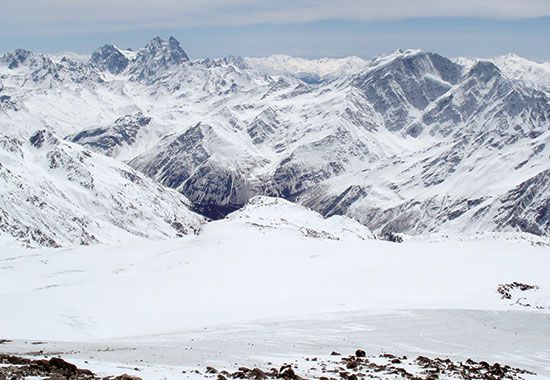
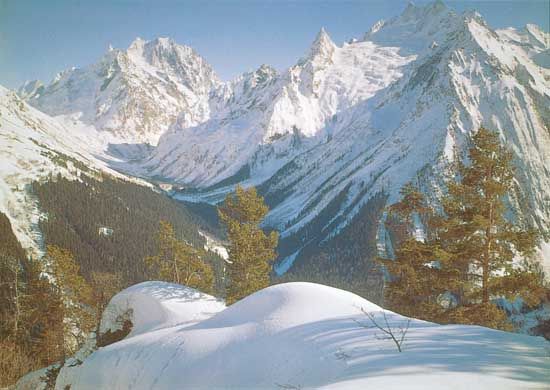
The Caucasus region is defined by two primary mountain systems that run northwest to southeast between the Black and Caspian seas: the Greater Caucasus in the north and the Lesser Caucasus in the south.18
Major Mountain Ranges
- Greater Caucasus: Extending approximately 750 miles (1,200 km), this range serves as the backbone of the system. It contains the region’s highest peaks, including Mount Elbrus, which rises to 18,510 feet (5,642 metres).1418
- Lesser Caucasus: Located south of the Greater Caucasus, this range is geologically linked to the Armenian Highland and the Dzhavakhet Range. Its highest peak is Mount Aragats, reaching 13,418 feet (4,090 metres).14
Geographic and Climatic Impact
The mountains profoundly influence the region’s geography and climate:
- Climatic Barrier: The Greater Caucasus acts as a significant climatic divide, impeding the movement of cold air from the north and warm air from the south. This creates distinct zones, such as the humid subtropical climate of the Kolkhida Lowland versus the more continental, semiarid conditions found in the north.3
- Topographic Diversity: The ranges create dramatic elevation changes, resulting in alpine environments at high altitudes and fertile lowlands like the Kura-Aras Lowland at their feet. These varied environments have fostered high biodiversity and unique ecosystems.319
- Structural Influence: Both ranges originated from the Alpine geosyncline, a structural downwarp in the Earth’s crust. This geological history continues to shape the landscape through ongoing seismic activity and volcanic features.2021
Sources
- Caspian Sea - Climate — Encyclopædia Britannica
- Caspian Sea - Transportation — Encyclopædia Britannica
- Caucasus - Climate — Encyclopædia Britannica
- Caspian Sea - Resources — Encyclopædia Britannica
- Caucasus - Drainage — Encyclopædia Britannica
- Transcaucasia - Climate — Encyclopædia Britannica
- Georgia - Transportation — Encyclopædia Britannica
- Caucasus - Resource utilization — Encyclopædia Britannica
- Transcaucasia - Drainage — Encyclopædia Britannica
- Caspian Sea — Encyclopædia Britannica
- Dmanisi — Encyclopædia Britannica
- Georgia - History — Encyclopædia Britannica
- history of Transcaucasia — Encyclopædia Britannica
- Caucasus - Geology of Caucasus — Encyclopædia Britannica
- Transcaucasia - Resources — Encyclopædia Britannica
- Azerbaijan — Encyclopædia Britannica
- Azerbaijan - Economy — Encyclopædia Britannica
- Caucasus - Physiography — Encyclopædia Britannica
- Transcaucasia - Geology of Transcaucasia — Encyclopædia Britannica
- Caucasus — Encyclopædia Britannica
- Caucasus - Animal life — Encyclopædia Britannica
- Mountain ecosystem - Fauna — Encyclopædia Britannica
Published on · 4 min read