Lionfish
Invasive lionfish, particularly the red lionfish (Pterois volitans), have caused significant ecological disruption since becoming established in the…
What environmental impact do invasive lionfish have on coral reef ecosystems?
Invasive lionfish, particularly the red lionfish (Pterois volitans), have caused significant ecological disruption since becoming established in the Caribbean Sea, the Gulf of Mexico, and along the Eastern Seaboard of the United States.12
As an invasive species, they pose a severe threat to coral reef ecosystems primarily due to their rapid rate of reproduction and the lack of natural predators in these non-native regions. This combination allows lionfish populations to expand unchecked, leading to the widespread decimation of local reef fish populations. By preying heavily on native species, lionfish disrupt the delicate balance of the reef food web, which can have cascading negative effects on the overall health and biodiversity of the ecosystem.12
Are there any natural predators of lionfish in their invasive habitats?
In their invasive habitats—such as the Caribbean Sea, the Gulf of Mexico, and along the Eastern Seaboard of the United States—lionfish are characterized by an absence of natural enemies.12
This lack of predators, combined with their rapid rate of reproduction and venomous fin spines, has allowed them to thrive as an invasive species and decimate local reef fish populations. While they are native to Indo-Pacific reef ecosystems, their introduction to western Atlantic waters has created a significant ecological imbalance because native predators in these regions do not typically hunt them.12
How do lionfish reproduce and what factors contribute to their rapid population growth?
Lionfish are highly successful as an invasive species due to their rapid rate of reproduction, which allows their populations to expand quickly in non-native environments like the Caribbean Sea, the Gulf of Mexico, and the Eastern Seaboard of the United States.12
While the provided search results confirm that this high reproductive capacity is a primary driver of their population growth, they do not detail the specific biological mechanisms of lionfish spawning or their reproductive cycles. Beyond their reproductive output, the rapid growth of these populations is significantly bolstered by the total absence of natural predators in these western Atlantic habitats, which allows them to thrive without the typical population checks found in their native Indo-Pacific reef ecosystems.12
What are the distinctive physical characteristics of lionfish?
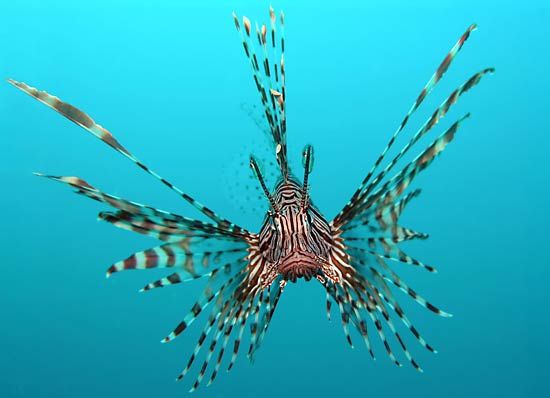
Lionfish, members of the scorpion fish family, are easily recognized by several distinctive physical features:
- Fin Structure: They possess enlarged pectoral fins and elongated, venomous dorsal fin spines. These spines are used for defense; when threatened, the fish spreads its fins and presents the spines to deter attackers.1
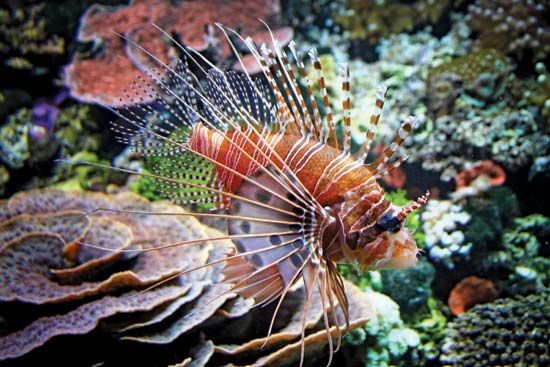
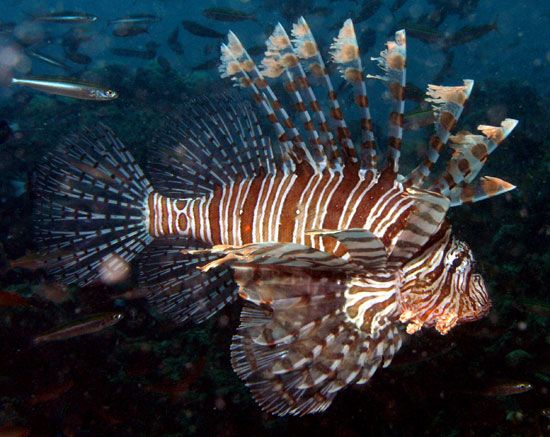
- Coloration: Each species is characterized by a bold, zebralike striped pattern. For example, the red lionfish displays a striking combination of red, brown, and white stripes.1
- Size: The red lionfish, one of the most well-known species, typically grows to approximately 30 cm (12 inches) in length.1
These showy fishes use their elaborate fins not only for display but also as a warning mechanism in their native reef ecosystems.1
Sources
- lionfish — Encyclopædia Britannica
- 10 of the World’s Most Dangerous Fish - Red Lionfish — Encyclopædia Britannica
Published on · 2 min read