Sea Lamprey
The sea lamprey (Petromyzon marinus) is a primitive, eel-like, jawless fish native to the North Atlantic Ocean and surrounding seas. Classified in the…
What is a sea lamprey?
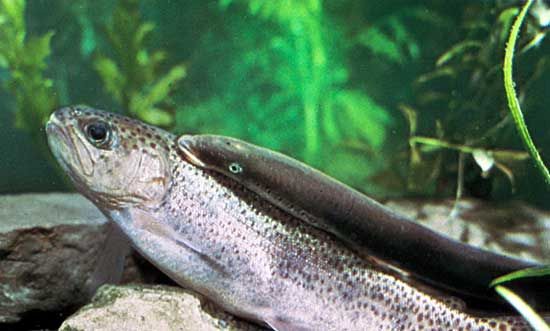
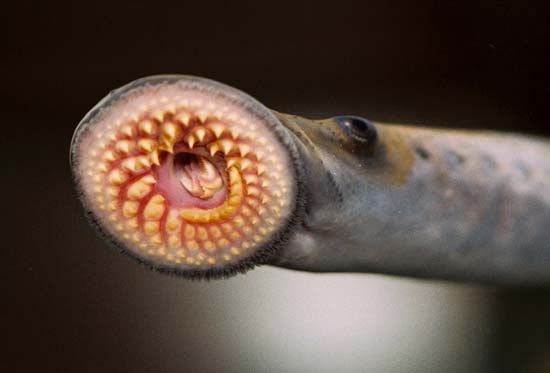
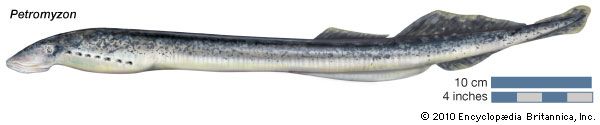
The sea lamprey (Petromyzon marinus) is a primitive, eel-like, jawless fish native to the North Atlantic Ocean and surrounding seas. Classified in the superclass Agnatha, it lacks scales, paired fins, and bones, possessing instead a cartilaginous skeleton. Its most distinctive feature is a circular, suction-cup mouth lined with sharp, hooked teeth, which it uses to attach to host fish and feed on their blood and fluids—a behavior that has earned it the nickname “vampire fish”.12
While native to coastal waters, the sea lamprey is a highly effective invasive species when landlocked in freshwater environments. After entering the Great Lakes in the 19th and 20th centuries, it caused significant ecological damage by preying on native fish populations, such as lake trout. Consequently, government agencies have implemented extensive control measures, including electrical barriers and specialized chemicals, to manage their populations.12
Why is the sea lamprey called a jawless fish?
The sea lamprey is classified as a “jawless fish” because it belongs to the superclass Agnatha, a group of primitive vertebrates that lack the hinged jaws, paired fins, and bony skeletons characteristic of most other fish clades.45
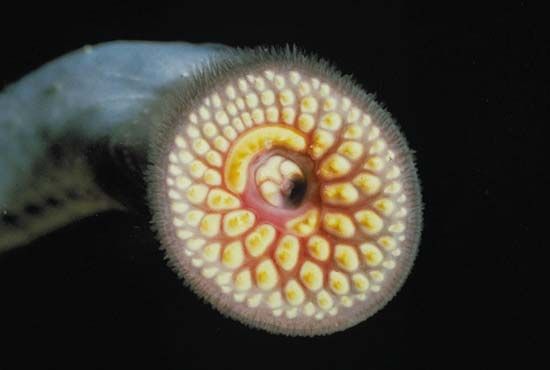
Instead of a jaw, the sea lamprey possesses a circular, suctorial oral disc. This specialized mouth structure, which is lined with sharp, horny teeth, allows the animal to attach itself to host fish to feed on their blood and tissues. While more advanced vertebrates evolved hinged jaws to grasp and process food, the sea lamprey and other agnathans retain a more ancestral body plan, relying on a cartilaginous skeleton and a rasping, tonguelike structure to feed.4653
Where do sea lampreys live?
Sea lampreys are native to the North Atlantic Ocean, the Gulf of Mexico, and the Adriatic, Baltic, and Mediterranean seas, where they inhabit coastal estuaries and rivers.3
As a diadromous species, they migrate into freshwater streams and rivers to spawn, where their larvae burrow into the beds of slow-moving waters for several years. Following metamorphosis, most juveniles migrate into the ocean to search for hosts.31
Additionally, sea lampreys have established landlocked populations in the Great Lakes of North America. After gaining access to these lakes through canal improvements in the 19th and 20th centuries, they became an invasive species, living and feeding entirely within the freshwater ecosystem.31
How does a sea lamprey feed?
The feeding habits of the sea lamprey change significantly throughout its life cycle:
- Larval Stage: As young ammocoetes, sea lampreys live in stream beds as filter feeders. They remain burrowed in silt and feed on detritus and microscopic organisms that they filter from the water using strands of mucus.173
- Adult Stage: After undergoing metamorphosis, the adult sea lamprey becomes a parasite. It uses its circular, suctorial oral disc—which is lined with sharp, hooked teeth—to attach itself to the side of a host fish. Once attached, it uses a specialized, toothed, tonguelike structure to rasp a hole into the host’s flesh. To facilitate feeding, the lamprey secretes an anticoagulant enzyme from its mouth, which prevents the host’s blood from clotting, allowing the lamprey to ingest the blood and tissues of the prey.173
Adults typically feed on host fish for 12 to 18 months before returning to freshwater to spawn, at which point they cease feeding entirely.73
Sources
- lamprey — Encyclopædia Britannica
- sea lamprey — Merriam-Webster
- sea lamprey — Encyclopædia Britannica
- agnathan - Form and function — Encyclopædia Britannica
- fish - Agnatha: early jawless fishes — Encyclopædia Britannica
- muscle - Jawless fishes — Encyclopædia Britannica
- agnathan - General features — Encyclopædia Britannica
Published on · 3 min read