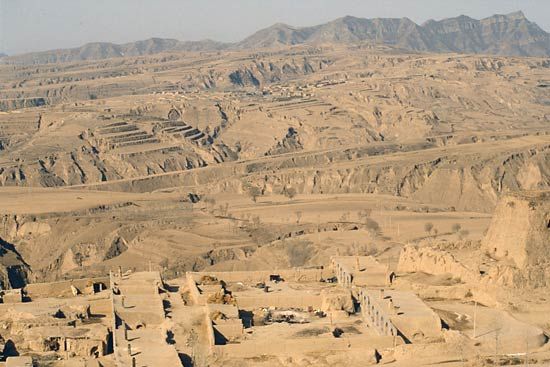
Liupan Mountains
The Liupan Mountains significantly influence their environment by acting as a climatic and geographical barrier. Because of their elevation, which reaches up…
How do the Liupan Mountains affect the local climate and ecosystem in the region?
The Liupan Mountains significantly influence their environment by acting as a climatic and geographical barrier. Because of their elevation, which reaches up to 9,825 feet (2,995 metres), the mountains receive more precipitation than the surrounding Loess Plateau, where the climate is otherwise extremely dry and prone to heavy erosion.1
This increased moisture supports a distinct ecosystem compared to the arid pasturelands nearby. While much of the surrounding region is characterized by grassland, the higher elevations of the Liupan range sustain patches of pine forest. These areas are notable for containing primeval forests, which remain despite the generally limited vegetation found throughout the broader mountain area. Additionally, the range serves as a critical watershed, dividing the Hulu River and Jing River tributary systems, further shaping the hydrology of the region.12
Are there any important rivers or water sources that originate in the Liupan Mountains?
The Liupan Mountains serve as a vital watershed in northern China, acting as a sharp divide between two major tributary systems of the Wei River.
The primary water sources originating in or shaped by the range include:
- Jing River: As the largest tributary of the Wei River, the Jing River rises in the Liupan Mountains within the Ningxia Hui Autonomous Region. It flows approximately 280 miles (450 km) through Gansu province before emptying into the Wei in central Shaanxi.13
- Hulu River: The mountains form a distinct watershed that separates the Hulu River system to the west from the Jing River system to the east.1
The region surrounding these rivers is characterized by heavy erosion and deep dissection, as the waterways carve through the loess-covered landscape of the plateau.14
What is the historical significance of the Liupan Mountains in Chinese culture and politics?
The Liupan Mountains have historically served as a significant cultural and geographical barrier in China. By separating the southern Wei River valley—a cradle of early sedentary, agriculture-based civilization—from the arid pasturelands of Gansu, the range acted as a natural divide between distinct regional lifestyles and economic systems.1
Politically and strategically, the mountains were defined by their limited accessibility. The range’s rugged terrain meant that movement between these regions was restricted to a few critical mountain passes, such as the Long and Dazhen passes in the south and the route between Pingliang and Jingning in the north.1
In modern times, the area has transitioned into a notable cultural and tourist destination. The region is home to significant historical sites, such as the grottoes at Mount Xumi, which feature Buddhist statues dating from the 6th to the 10th century, reflecting the area’s long-standing role along the northern route of the ancient Silk Road.5
We could dive deeper into the history of the Wei River valley or explore the cultural influence of the Hui people in the surrounding region.
How do the Liupan Mountains compare to other mountain ranges in China?
The Liupan Mountains are distinct from other major Chinese ranges due to their specific geological role as the uplifted western edge of the Loess Plateau structural basin. While many of China’s great ranges, such as the Qin Mountains, are characterized by massive, high-altitude barriers, the Liupan range is defined by its role as a sharp watershed and a cultural divide between sedentary agricultural regions and arid pasturelands.1
Key comparisons include:
- Elevation and Scale: With peaks reaching 9,825 feet (2,995 meters), the Liupan Mountains are significantly lower than the Qin Mountains, which lie to the south and are separated from the Liupan range by the Wei River valley fault line.1
- Geological Continuity: The range shares a structural connection with the Helan Mountains to the north, both serving as prominent features of the loess-covered landscape.1
- Vegetation: Unlike the surrounding arid plateau, the Liupan Mountains receive enough precipitation to support patches of pine forest, with some areas containing rare primeval forests that distinguish them from the more barren, heavily eroded terrain of the neighboring plateau.12
Sources
- Liupan Mountains — Encyclopædia Britannica
- Gansu - Plant and animal life — Encyclopædia Britannica
- Jing River — Encyclopædia Britannica
- Shaanxi - Relief and drainage — Encyclopædia Britannica
- Ningxia - Cultural life — Encyclopædia Britannica
Published on · 3 min read