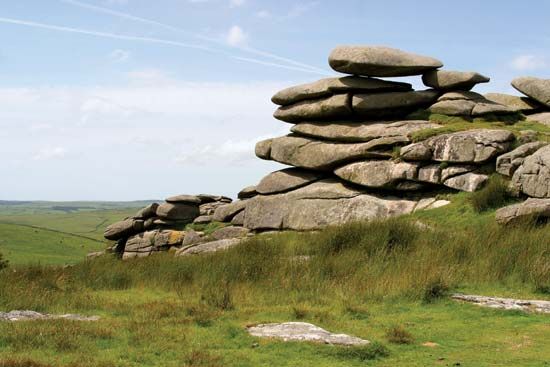
Lugnaquillia Mountain
Lugnaquillia Mountain is the highest peak in the Wicklow Mountains of County Wicklow, Ireland. Standing at 3,039 feet (926 metres), it is distinct from the…
What is Lugnaquillia Mountain?
Lugnaquillia Mountain is the highest peak in the Wicklow Mountains of County Wicklow, Ireland. Standing at 3,039 feet (926 metres), it is distinct from the surrounding granite hills of the range because it is capped with very hard mica-schist rocks. The mountain’s slopes are primarily characterized by bog-covered moorland and are intersected by the valley of Glenmalure to the southeast and the Ow River to the south-southeast.1
What are the Wicklow Mountains known for?
The Wicklow Mountains are a prominent mountain range in eastern Ireland, known for their rugged, glaciated landscape and historical significance.
Geological and Natural Features
The range is characterized by smoothly rounded granite hills, with the highest peak, Lugnaquillia Mountain, reaching 3,039 feet (926 meters). The area features deep valleys—such as Glenmacnass, Glendasan, and Glendalough—and is marked by waterfalls, river gorges, and glacial remnants like moraines and meltwater channels. The mountains are also traversed by the historic Military Road, which was constructed following the 1798 rebellion.23
Historical and Cultural Significance
The region is deeply tied to Ireland’s early Christian history. The Vale of Glendalough is home to a famous monastic center established by St. Kevin in the 6th century. This site is renowned for its 11th-century Round Tower, which served as a bell tower and a place of refuge for monks during Viking raids. Historically, the rugged terrain of the mountains also served as a refuge for fugitives and those resisting authority.453
How do granite and mica-schist rocks differ?
Granite and mica-schist differ fundamentally in their origin, texture, and mineral composition.
Origin and Formation
- Granite is an intrusive igneous rock, formed by the cooling and crystallization of magma deep within the Earth’s crust.6
- Mica-schist is a metamorphic rock, created through the alteration of existing rocks under conditions of temperature and pressure that cause recrystallization and deformation.78
Texture and Structure
- Granite typically has a coarse- or medium-grained, interlocking crystalline texture. It is generally nonfoliated, meaning its mineral grains are not arranged in parallel layers.68
- Mica-schist is defined by its schistosity, a type of foliation where the rock has a strong tendency to split into layers due to the parallel orientation of platy minerals like mica.78
Mineral Composition
- Granite is primarily composed of quartz and feldspar, with minor amounts of minerals like biotite or muscovite.6
- Mica-schist is characterized by an abundance of platy minerals, particularly muscovite or biotite mica. Unlike granite, quartz and feldspar are significantly less abundant in schist.7
What is a bog-covered moorland ecosystem?
A bog-covered moorland is a type of wetland ecosystem characterized by wet, spongy, and poorly drained peat-rich soil.12 While the term “moor” is often used to describe uncultivated, hilly, or open country, it can refer to either dry land covered in heather or wet, acid peat vegetation; when the latter is the case, the moor is generally synonymous with a bog.12
These ecosystems develop in areas where plant material decomposes so slowly that organic matter accumulates as peat each growing season. This process is favored by cool, moist climates where waterlogging creates anaerobic (oxygen-poor) conditions that retard the activity of decay organisms like bacteria and fungi.131415
Key characteristics include:
- Vegetation: Typical bogs are dominated by sphagnum mosses and heaths, along with sedges, grasses, and occasionally insectivorous plants like sundews and pitcher plants.1617
- Acidity: These environments are highly acidic, often with a pH of less than 5, as sphagnum mosses absorb minerals and release acid.1617
- Water Source: Bogs are typically fed by mineral-poor rainwater rather than mineral-rich groundwater.1613
Sources
- Lugnaquillia Mountain — Encyclopædia Britannica
- Wicklow Mountains — Encyclopædia Britannica
- Wicklow — Encyclopædia Britannica
- Vale of Glendalough — Encyclopædia Britannica
- Ireland Has It All, Including These 12 Incredible Feats of Architecture - Glendalough Round Tower — Encyclopædia Britannica
- schist — Encyclopædia Britannica
- texture — Encyclopædia Britannica
- granite — Encyclopædia Britannica
- migmatite — Encyclopædia Britannica
- metamorphic rock - Granulite facies — Encyclopædia Britannica
- greisen — Encyclopædia Britannica
- Bog — Encyclopædia Britannica
- peat — Encyclopædia Britannica
- Wetland - Peatlands — Encyclopædia Britannica
- Moor — Encyclopædia Britannica
- moor — Merriam-Webster
- Bog - Formation and structure — Encyclopædia Britannica
- Bog - Flora — Encyclopædia Britannica
Published on · 3 min read