Lizard Peninsula
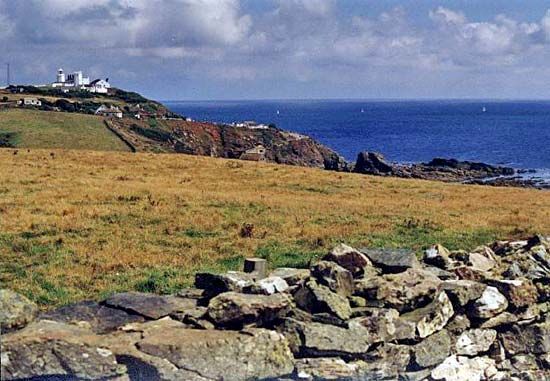
The Lizard Peninsula is a peninsula located in the Cornwall unitary authority of England, representing the southernmost point of the island of Great Britain.
What is Lizard Peninsula?
The Lizard Peninsula is a peninsula located in the Cornwall unitary authority of England, representing the southernmost point of the island of Great Britain.1
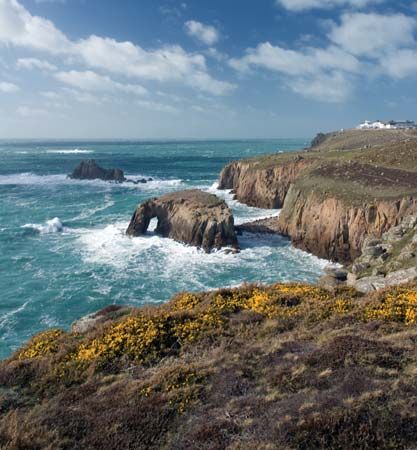
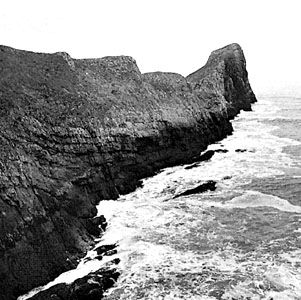
The region is characterized by its dramatic coastal scenery, which features rugged cliffs reaching heights of 250 feet (75 metres), offshore rocks, and small coves. In contrast to the dramatic coastline, the inland landscape is notably level and open. The area is also known for its local serpentine rock, which is frequently utilized in construction.1
Historically, the peninsula is significant for its role in telecommunications; a monument at Poldhu commemorates the site where Guglielmo Marconi successfully transmitted and received the first transatlantic radio message in 1901. The peninsula is home to several small villages.1
What is serpentine rock and how is it formed?
Serpentine refers to a group of hydrous magnesium-rich silicate minerals with the approximate chemical composition Mg3Si2O5(OH)4Mg_3Si_2O_5(OH)_4. Named for its resemblance to a snake’s skin, the mineral typically appears in shades of gray, white, or green, with the green coloration resulting from iron replacing magnesium.2
There are three primary polymorphs of serpentine:
- Chrysotile: A fibrous variety historically used as asbestos.
- Antigorite: A variety that occurs in corrugated plates or fibers.
- Lizardite: A very fine-grained, platy variety.2
Formation Serpentine is formed at temperatures below 500 °C (930 °F) through the addition of water and sometimes silica to magnesium silicates, such as forsterite or enstatite. It is characteristically found in altered peridotites, dunites, or pyroxenites, often along the crests and axes of major mountain chains or island arcs. When a rock is composed largely of these minerals, it is known as serpentinite, which is frequently polished for use as an ornamental stone.2
How did Guglielmo Marconi change communication history?
Guglielmo Marconi revolutionized global communication by pioneering the development of wireless telegraphy, which laid the foundation for modern radio and broadcasting services.34
His most significant contributions include:
- Transatlantic Communication: In 1901, Marconi successfully transmitted signals across the Atlantic Ocean, proving that radio waves could travel beyond the curvature of the Earth, contrary to the beliefs of many mathematicians at the time.35
- System Improvements: He developed the magnetic detector and horizontal directional aerial, which significantly increased the efficiency and range of transmission. His 1900 patent for tuning apparatus allowed multiple stations to operate on different wavelengths without interference.35
- Shortwave Innovation: Marconi pioneered shortwave wireless communication, which remains the basis for most modern long-distance radio systems.3
- Atmospheric Discovery: He discovered that radio transmission is often more favorable at night due to the ionization of the upper atmosphere by sunlight.3
For his groundbreaking work, Marconi was awarded the Nobel Prize for Physics in 1909.34
What are some other famous peninsulas in the United Kingdom?
The United Kingdom features a diverse coastline with several notable peninsulas, each defined by unique geological and historical characteristics. Some of the most famous include:
- South West Peninsula: As England’s largest peninsula, it is renowned for its dramatic headlands and drowned estuaries. It encompasses several distinct upland areas, including Exmoor, Dartmoor, and the Penwith upland, which terminates at the famous Land’s End.8
- Gower Peninsula: Located in Wales, this area is designated as an area of outstanding natural beauty. It is characterized by a limestone plateau, picturesque cliffs, and a rich history of human occupation dating back to the Paleolithic era.6
- Lizard Peninsula: Situated in Cornwall, England, this is the southernmost part of the island of Great Britain. It is well-known for its rugged cliffs and the local serpentine rock used in its architecture.1
- Kintyre: A 40-mile-long peninsula in southwestern Scotland that sits between the Atlantic Ocean and the Firth of Clyde, terminating at the Mull of Kintyre.7
- Buchan Peninsula: Located in Scotland, this low-lying area is known for its relatively smooth outlines, contrasting sharply with the glacier-scoured landscapes found elsewhere in the Scottish Highlands.8
Sources
- Lizard Peninsula — Encyclopædia Britannica
- serpentine — Encyclopædia Britannica
- Guglielmo Marconi - Long-distance radio communication and shortwave of Guglielmo Marconi — Encyclopædia Britannica
- Guglielmo Marconi — Encyclopædia Britannica
- Guglielmo Marconi - Education and early radio work — Encyclopædia Britannica
- Gower — Encyclopædia Britannica
- Kintyre — Merriam-Webster
- United Kingdom - The highland zone — Encyclopædia Britannica
Published on · 3 min read