Loganberry
The loganberry (Rubus loganobaccus) is a vigorous, trailing bramble belonging to the rose family. It is prized for its deep wine-red, tart, and highly…
What is a loganberry and how was it first developed?
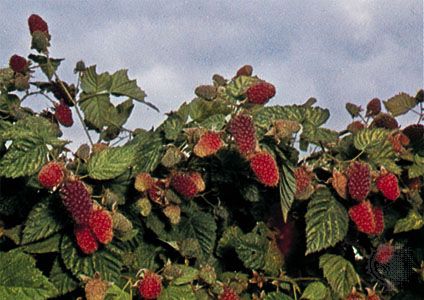
The loganberry (Rubus loganobaccus) is a vigorous, trailing bramble belonging to the rose family. It is prized for its deep wine-red, tart, and highly flavorful fruit, which is an aggregate of druplets similar in structure to a blackberry.1
The plant was first developed in 1881 in Santa Cruz, California, by James Harvey Logan, a lawyer and amateur horticulturist. Logan raised the plant from seed, and it is widely considered to be a natural hybrid between the Pacific coast’s wild blackberry (Rubus ursinus) and the red raspberry (Rubus idaeus).1
While the loganberry is hardy and resistant to disease, it is not as widely grown commercially as other berries because the fruit has a short shelf-life and the harvesting process is labor-intensive. Today, it is primarily cultivated in regions such as Oregon, Washington, England, and Australia, where it is often processed for use in pies, preserves, or wine.1
What is the scientific classification of the loganberry plant?
The scientific classification of the loganberry (Rubus loganobaccus) places it within the rose family (Rosaceae). As a member of the genus Rubus, it is categorized as a bramble.1
While specific taxonomic ranks beyond the family and genus are not explicitly detailed for the loganberry in the provided text, its classification follows the broader hierarchy shared by related species in the Rosales order and the Plantae kingdom.12
What are the unique characteristics of the loganberry plant?
The loganberry (Rubus loganobaccus) possesses several distinct physical and biological characteristics that set it apart as a unique bramble hybrid:
- Growth Habit: It is a vigorous, nearly trailing plant characterized by canelike stems that are typically armed with prickles, though thornless varieties have been developed.13
- Foliage: The plant features compound leaves composed of three to five leaflets.1
- Fruit Structure: The fruit is a deep wine-red, tart, and highly flavorful aggregate of druplets. Like a blackberry, the fruit is hollow when picked.1
- Hardiness: The plant is noted for being hardy and relatively resistant to both frost and disease.1
- Cultivation Challenges: Despite its hardiness, commercial production is limited because the fruit has a short shelf-life and the harvesting process is labor-intensive.1
How are loganberry plants propagated and cultivated?
The provided information does not contain specific details regarding the propagation methods for loganberry plants, such as tip layering or division. Regarding cultivation, the loganberry is a vigorous, nearly trailing plant that thrives in regions like Oregon, Washington, England, and Australia.
While the plant is noted for being hardy and resistant to both frost and disease, its commercial cultivation is constrained by two primary factors:
- Labor-intensive harvesting: The nature of the plant and its fruit requires significant manual effort during the harvest season.1
- Short shelf-life: The fruit is highly perishable, which limits its distribution and commercial viability.1
Because of these challenges, the fruit is most commonly processed by being canned, frozen for use in preserves or pie stock, or fermented into wine.1
Sources
- Loganberry — Encyclopædia Britannica
- Raspberry — Encyclopædia Britannica
- bramble — Encyclopædia Britannica
Published on · 2 min read