Lomariopsidaceae
Lomariopsidaceae is a family of ferns within the order Polypodiales, comprising four genera—Cyclopeltis, Dracoglossum, Dryopolystichum, and Lomariopsis—and…
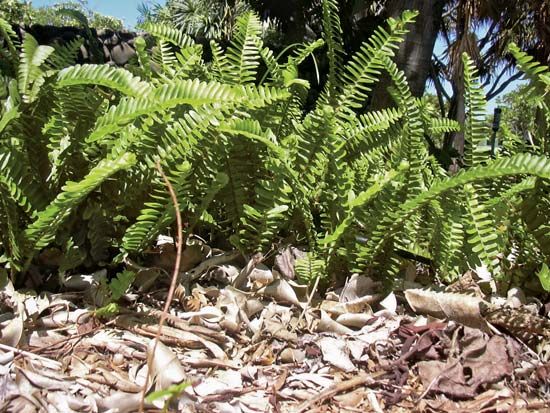
What is Lomariopsidaceae?
Lomariopsidaceae is a family of ferns within the order Polypodiales, comprising four genera—Cyclopeltis, Dracoglossum, Dryopolystichum, and Lomariopsis—and approximately 69 to 70 species. These plants are primarily distributed throughout tropical regions of both the Old and New Worlds, with only a few species reaching temperate zones.12
Members of this family occupy diverse habitats, ranging from terrestrial environments and rocky cliffs to climbing tree trunks or living as epiphytes. Their leaf morphology is often dimorphic, meaning immature and mature leaves appear different. The sporangia are typically naked and cover the undersurface of fertile leaves, producing bean-shaped spores, producing bean-shaped spores.1
Taxonomically, the group has been subject to revision; for instance, the ornamental sword ferns (Nephrolepis) were formerly included in this family but are now classified in their own family, Nephrolepidaceae.12
What does it mean for a fern to be epiphytic or hemiepiphytic?
In the context of botany, the terms epiphytic and hemiepiphytic describe different ways plants interact with their environment for support and growth.
Epiphytic Ferns
An epiphyte is a plant that grows upon another plant or object solely for physical support. These plants are not parasitic; they do not derive nutrients or water from their host. Instead, they obtain moisture from rain and water vapor in the air and collect nutrients from organic debris that accumulates on the host plant. In tropical forests, many ferns grow as epiphytes in the crowns or on the branches of trees to access sunlight that is otherwise blocked by the dense forest canopy.34
Hemiepiphytic Ferns
Some ferns are classified as hemiepiphytic (or climbing) plants. Unlike true epiphytes, which spend their entire life cycle above the ground, hemiepiphytic ferns typically originate on the ground. As they mature, they grow upward, using tree trunks as a support structure to climb toward the canopy.45
While the terms are distinct, both strategies allow ferns to thrive in competitive forest environments by utilizing vertical space.
How do dimorphic leaves help a fern survive in its environment?
Dimorphic leaves—where a plant produces two distinct types of leaves—serve as a specialized adaptation that allows ferns to optimize their energy and reproductive success in their specific environments.
Functional Specialization
In ferns with dimorphic leaves, the fronds are divided into two functional categories:
- Vegetative Leaves (Bathyphylls): These leaves are primarily dedicated to photosynthesis. By focusing their surface area and metabolic resources on capturing light and producing energy, these leaves ensure the plant has the necessary fuel to grow and maintain its structure.58
- Fertile Leaves (Acrophylls): These leaves are highly modified to support reproduction. They typically bear sporangia on their undersurfaces, often in a more compact or finely divided form than the vegetative leaves. This separation allows the plant to protect its reproductive structures—sometimes by using the leaf’s own margins to cover the sporangia—without compromising the photosynthetic efficiency of the vegetative fronds.589
Environmental Advantages
This division of labor is particularly beneficial for ferns living in competitive or specialized habitats, such as climbing ferns or aquatic species like the water fern. By separating these roles, the plant can tailor the morphology of each leaf type to its specific task. For example, in climbing ferns, the lower vegetative leaves are positioned to capture light in the shaded understory, while the fertile leaves are positioned higher up, where they are better situated for spore dispersal.5
Why is the taxonomy of plant families like Lomariopsidaceae often subject to change?
The taxonomy of plant families like Lomariopsidaceae is frequently subject to change because classification systems are increasingly based on phylogeny—the evolutionary history of organisms—rather than just physical appearance.1
Historically, plant classification relied heavily on comparative anatomy, which often led to grouping plants together based on similar habits or living conditions that were actually analogies rather than true evolutionary relationships. As scientific understanding has advanced, the integration of molecular genetics and DNA analysis has provided more accurate data to distinguish between these similarities.131
This shift has led to significant reclassifications. For example, the family Lomariopsidaceae previously included the sword ferns (Nephrolepis), which have since been moved to their own family, Nephrolepidaceae, based on updated phylogenetic consensus. Because the limits of many fern families and genera remain under active study, researchers continue to refine these groupings as new evidence emerges.14115
Sources
- Lomariopsidaceae — Encyclopædia Britannica
- fern - Annotated classification — Encyclopædia Britannica
- epiphyte — Encyclopædia Britannica
- Did you know? — Merriam-Webster
- fern - Ecology — Encyclopædia Britannica
- tree fern — Encyclopædia Britannica
- hemiparasitic — Merriam-Webster
- water fern — Encyclopædia Britannica
- fern - Shapes — Encyclopædia Britannica
- fern - Tissues — Encyclopædia Britannica
- fern - Comparisons with leaves of other plant groups — Encyclopædia Britannica
- plant reproductive system - Ferns — Encyclopædia Britannica
- fern - Chromosome numbers and polyploidy — Encyclopædia Britannica
- fern - Critical appraisal — Encyclopædia Britannica
- Polypodiaceae — Encyclopædia Britannica
- phylogeny - Evidence for specific phylogenies — Encyclopædia Britannica
Published on · 3 min read