Lystrosaurus
Lystrosaurus is an extinct genus of medium-sized, heavily built animals that lived from the middle of the Permian Period through the early Triassic Period.…
What is Lystrosaurus?
Lystrosaurus is an extinct genus of medium-sized, heavily built animals that lived from the middle of the Permian Period through the early Triassic Period. As a member of the Dicynodontia, it was a synapsid—a group of vertebrates that includes modern mammals.1
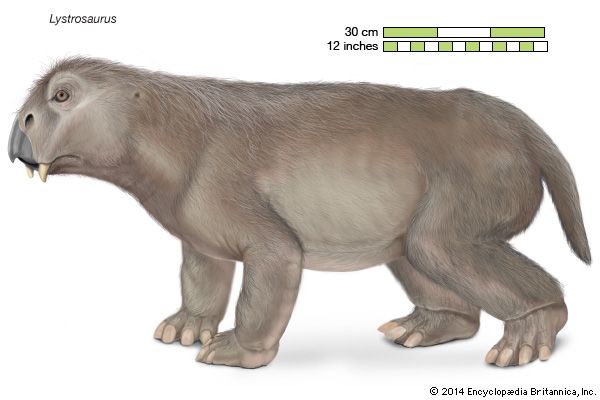
Measuring roughly one meter in length, Lystrosaurus featured a distinctive beaklike face and two tusks used for rooting out vegetation. Its anatomy suggests a herbivorous diet and a potentially semi-aquatic lifestyle. Notably, it was one of the few synapsids to survive the massive Permian extinction, becoming the most abundant vertebrate of its time.1
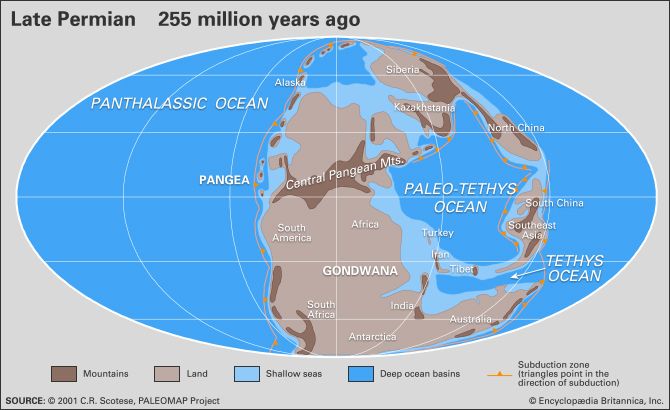
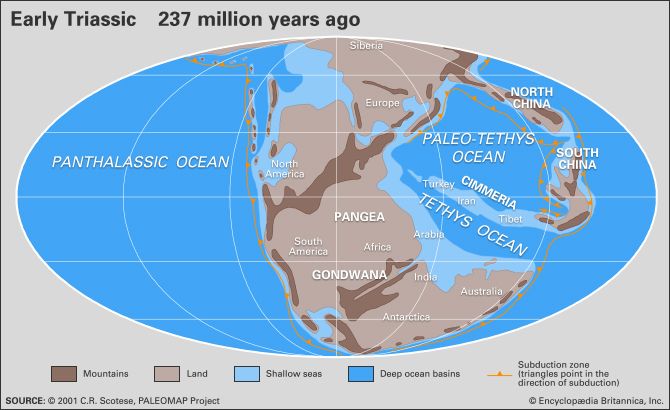
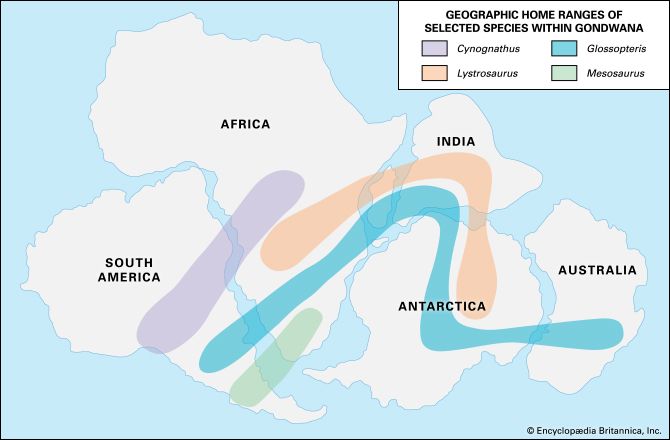
The discovery of Lystrosaurus fossils in Africa, India, and Antarctica provided critical evidence for the theory of continental drift. These findings supported the existence of the ancient supercontinent Gondwana, demonstrating that these now-distant landmasses were once connected.1
When and where did Lystrosaurus live?
Lystrosaurus lived during a significant span of geological time, ranging from the middle of the Permian Period (approximately 298.9 million to 251.9 million years ago) through the early Triassic Period (251.9 million to 201.3 million years ago).1
Geographically, the distribution of Lystrosaurus fossils confirms that the genus inhabited regions that are now part of Africa, India, and Antarctica. The presence of these fossils in such widely separated locations serves as key evidence for the theory of continental drift, indicating that these landmasses were once joined as part of the supercontinent Gondwana.1
What did Lystrosaurus look like?
Lystrosaurus was a medium-sized, heavily built animal measuring approximately 1 meter (about 3 feet) in length. Its physical appearance was characterized by several distinct features:2
- Head and Face: It possessed an unusual, beaklike face similar to that of a turtle, supported by a horny beak structure in the palate and mandible.2
- Tusks: Two tusks were set deeply in the upper jaw, which show wear patterns suggesting they were used for digging or rooting out vegetation.2
- Eyes: The eye orbits were located dorsally (on the top of the skull).2
- Body and Posture: The animal had a spreading posture and a short tail. Its skeletal morphology and microscopic bone structure suggest that at least some species may have been semi-aquatic.2
Unlike the gigantic Diplodocus, which was a long-necked dinosaur, Lystrosaurus was a synapsid—a member of the group that includes modern mammals—and exhibited rapid growth rates similar to those of modern mammals and birds1.
What kind of environment did Lystrosaurus live in?
Lystrosaurus inhabited diverse environments during the middle Permian Period through the early Triassic Period. Evidence from South Africa indicates that these animals lived in floodplain environments, where multiple species often coexisted.1
The skeletal morphology and microscopic bone structure of Lystrosaurus suggest that at least some species were semi-aquatic, spending significant time in or near water. While burrow structures are frequently found in the same rock units as Lystrosaurus fossils, there is limited evidence to suggest the animals created these burrows themselves; in one instance, a Lystrosaurus skeleton found in a burrow was likely dragged there by a predator.1
On a broader scale, Lystrosaurus lived during a time of significant climatic and ecological upheaval associated with the Permian extinction. As the supercontinent Pangea emerged, global environments shifted toward widespread aridity, characterized by hot summers and cold winters, though some regions experienced strong seasonal precipitation due to monsoonal climate patterns.3
Sources
- Lystrosaurus — Encyclopædia Britannica
- Diplodocus — Encyclopædia Britannica
- Triassic Period - Paleoclimate — Encyclopædia Britannica
- Permian Period - Temperature crises — Encyclopædia Britannica
- Triassic Period - Permian-Triassic extinctions — Encyclopædia Britannica
Published on · 3 min read