Mackerel
Mackerel are swift-moving, streamlined fish belonging to the family Scombridae. Their physical characteristics are adapted for active swimming and include…
What are the main physical characteristics of mackerel fish?
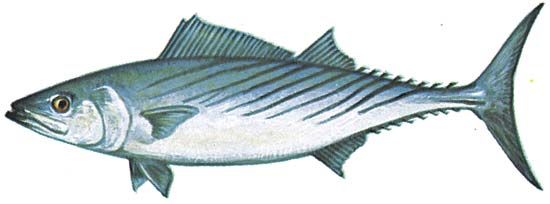
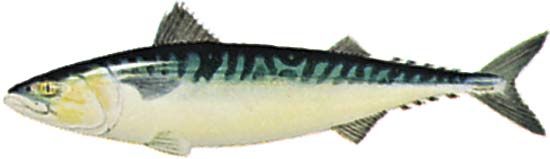
Mackerel are swift-moving, streamlined fish belonging to the family Scombridae. Their physical characteristics are adapted for active swimming and include the following features:
- Body Shape: They are typically rounded and torpedo-shaped with a slender, keeled tail base and a forked tail.1
- Fins: Mackerel possess two well-separated dorsal fins and a row of small finlets located behind the dorsal and anal fins.1
- Coloration: Many species, such as the common mackerel, are blue-green on their upper sides and silver-white below, often featuring dark, wavy vertical lines.1
- Variations: While many mackerels have an air bladder, some species, like the common mackerel, lack one. Other related species, such as those in the genus Scomberomorus, are more elongated with large mouths, teeth, and three keels on either side of the tail base.1
- Size: Sizes vary significantly by species, ranging from approximately 30 cm for the common mackerel to much larger sizes for species like the king mackerel, which can reach 170 cm in length.1
Where are mackerel typically found in the ocean, and what are their migration patterns?
Mackerel are found in temperate and tropical seas across the globe, inhabiting both the Atlantic Ocean and the Pacific Ocean, as well as the Gulf of Mexico and Indo-Pacific regions.1
Regarding their movement, these fish are highly active and typically congregate in schools. Their migration patterns are largely seasonal and depth-dependent:
- Seasonal Vertical Migration: During warmer months, mackerel swim actively in the upper 25–30 fathoms of the water. As temperatures drop in the winter, they descend to depths as great as 100 fathoms.1
- Spawning Migration: Mackerel move toward coastlines to spawn during the spring and early summer. Their buoyant eggs drift in the uppermost five fathoms of the water column.1
The common mackerel, for instance, is widely distributed along the North Atlantic coasts, ranging from North Carolina to Labrador and from Spain to Norway.1
What are the different species of mackerel, and how do they differ from each other?
Mackerel belong to the family Scombridae and encompass several distinct groups that vary in size, anatomy, and habitat. It is important to note that “mackerel shark” refers to a completely different group of predatory sharks in the family Lamnidae and should not be confused with the true mackerel fish discussed here.14
The primary species of mackerel include:
- Common Mackerel (Scomber scombrus): An abundant Atlantic species averaging 30 cm. It is blue-green with wavy dark lines and lacks an air bladder.1
- Chub Mackerel (S. colias): Similar to the common mackerel but features finer markings and possesses an air bladder.1
- Genus Scomberomorus: These are elongated, warm-water game fish with large mouths and teeth. Notable species include the barred Spanish mackerel, the king mackerel (reaching 170 cm), and the spotted cero.1
- Indian Mackerels (Rastrelliger): Stout, commercially valuable Indo-Australian fish.1
- Frigate Mackerels (Auxis): Small, elongated fish distinguished by a corselet of enlarged scales around the shoulder.1
What is a mackerel?
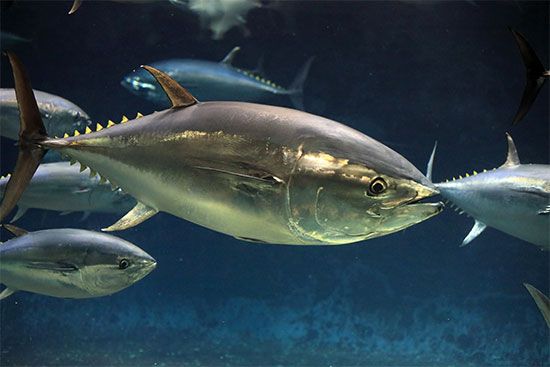
A mackerel is any of several swift-moving, streamlined fish belonging to the family Scombridae, which also includes tunas and bonitos. These fish are characterized by their rounded, torpedo-shaped bodies, slender keeled tail bases, forked tails, and a row of small finlets located behind their dorsal and anal fins.1
Mackerels are carnivorous, feeding on plankton, crustaceans, mollusks, fish eggs, and smaller fish. They are highly active, schooling fish that typically inhabit temperate and tropical seas worldwide. Their behavior is often seasonal; they swim in the upper layers of the water during warmer months and descend to greater depths during the winter.1
While the term is sometimes used broadly for various species in the Scombridae family, it is distinct from “mackerel sharks,” which are unrelated predatory sharks. Mackerels are economically significant as both food and sport fish and are primarily harvested using nets.15
Sources
- mackerel — Encyclopædia Britannica
- scorpaeniform - Annotated classification — Encyclopædia Britannica
- Locomotion - Stabilization and steering — Encyclopædia Britannica
- mackerel shark — Encyclopædia Britannica
- mackerel — Merriam-Webster
Published on · 3 min read