Madder
The madder plant (Rubia) has held significant cultural and historical importance for millennia, primarily as a vital source of the red dye alizarin. Its use…
What cultural or historical significance does the madder plant hold in different parts of the world?
The madder plant (Rubia) has held significant cultural and historical importance for millennia, primarily as a vital source of the red dye alizarin. Its use dates back to the earliest historical periods, with evidence of madder-dyed cloth found on ancient Egyptian mummies.1
Historical and Global Significance
- Ancient Usage: By the 5th century BCE, the historian Herodotus noted its use for dyeing the cloaks of Libyan women. The plant was also historically valued in ancient India, Persia, and Egypt, where the complex “Turkey red” dyeing process was developed.12
- Spread and Trade: Knowledge of madder cultivation spread to Asia Minor by the 10th century and was introduced to Europe by the 13th century.2
- Medicinal and Scientific Roles: Beyond textiles, madder was used in ancient and medieval times as a treatment for amenorrhea. In the 19th century, its ability to stain bones allowed physiologists to trace bone development.1
While synthetic production largely replaced natural madder in the late 19th century, it remains a part of artisanal traditions and is still used as an artist’s pigment.12
How does the madder plant relate to other plants in the Rubiaceae family?
The madder plant (Rubia tinctorum) serves as the type genus for the Rubiaceae family, which is also commonly referred to as the “madder family”. This large, diverse group of flowering plants includes over 13,150 species of herbs, shrubs, and trees, primarily distributed in tropical regions.456
The madder plant shares several key botanical characteristics with its family members:
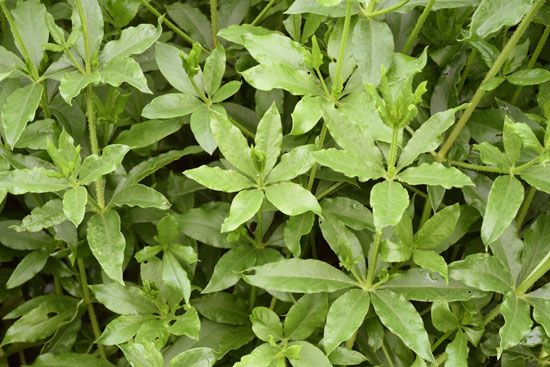
- Leaf Structure: Like many other Rubiaceae, madder features opposite leaves with stipules—small, leaflike appendages at the base of the leafstalk.46
- Floral Traits: The family is generally characterized by regular, often tubular flowers with parts typically occurring in fours or fives.65
- Diversity of Habit: While madder is a low-growing herb, the family encompasses a wide range of forms, including lianas and trees.65
Economically and culturally, the madder plant is linked to other Rubiaceae through its historical utility. Just as Rubia was valued for the red dye alizarin, other family members are famous for their chemical properties, such as coffee (Coffea), quinine (Cinchona), and ipecac.46
Are there any medicinal properties associated with the madder plant?
Historically, the madder plant (Rubia) has been employed as a medicinal treatment for amenorrhea, a condition characterized by the failure to menstruate, during ancient and medieval times.1
Beyond these historical applications, modern scientific interest in the genus remains active. Madder species produce various phytochemicals, including quinone derivatives, which are currently being studied by pharmaceutical researchers for their potential properties. Additionally, while not a direct medicinal use, the plant’s ability to stain bones due to the presence of alizarin was utilized by 19th-century physiologists to trace bone development and study cellular functions.1
It is worth noting that while the madder plant itself has a history of medicinal use, the broader Rubiaceae family to which it belongs is well-known for producing significant medicinal compounds, such as quinine for malaria and ipecac for inducing vomiting.54
What are some modern applications or uses of madder plant extracts?
While the large-scale industrial use of the madder plant as a textile dye declined following the 1871 commercialization of synthetic alizarin, the plant remains relevant in several modern contexts:
- Artisanal and Fine Arts: Natural madder continues to be used in artisanal cottage industries for textile dyeing. Additionally, natural rose madder is still occasionally employed as a lake pigment for artists’ colors, valued for its specific aesthetic qualities.12
- Pharmaceutical Research: The genus Rubia produces various phytochemicals, including quinone derivatives. These compounds are currently the subject of ongoing investigation by pharmaceutical researchers exploring their potential medicinal properties.1
- Historical and Scientific Study: Beyond its direct application, the plant’s historical role in physiology—specifically the ability of alizarin to stain bones—remains a significant reference point for understanding the history of biological research into bone development and cellular function.1
Sources
- Madder — Encyclopædia Britannica
- alizarin — Encyclopædia Britannica
- Indian madder — Merriam-Webster
- Rubiaceae — Encyclopædia Britannica
- Gentianales - Rubiaceae — Encyclopædia Britannica
- madderwort — Merriam-Webster
- madder family — Merriam-Webster
- Rubiaceae — Merriam-Webster
- rose madder — Merriam-Webster
Published on · 3 min read