Partridgeberry
The partridgeberry (Mitchella repens) is a trailing, evergreen plant belonging to the madder family (Rubiaceae). It is native to North America, found in dry…
What is Partridgeberry?
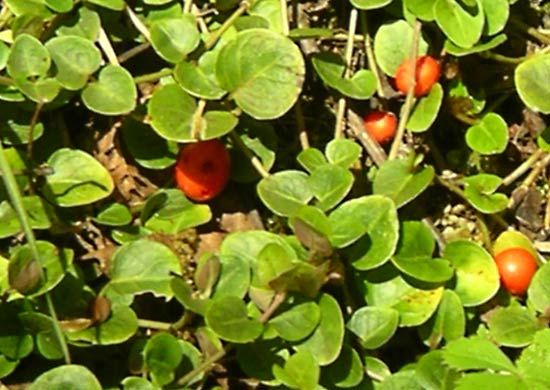
The partridgeberry (Mitchella repens) is a trailing, evergreen plant belonging to the madder family (Rubiaceae). It is native to North America, found in dry, shady woodlands ranging from Newfoundland to Minnesota and as far south as Florida and Texas.12
The plant is characterized by its slender, trailing stems and small, nearly round leaves, which are sometimes marked with white lines. It produces fragrant, white tubular flowers that typically appear in pairs. These are followed by scarlet, berrylike drupes that are edible but generally considered tasteless or slightly acidic.12
Due to its diminutive size and the visual appeal of its foliage and fruit, the partridgeberry is a popular choice for wild gardens and winter terrariums.1
What other plants belong to the madder family?
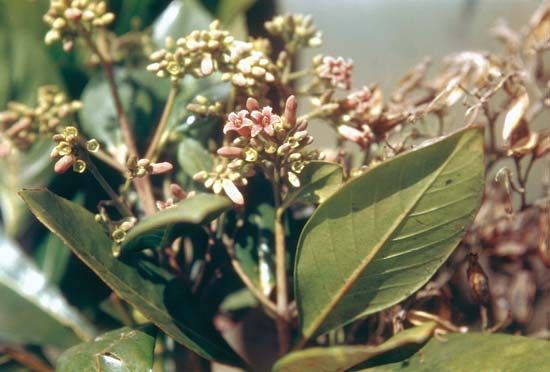
The Rubiaceae family, commonly known as the madder family, is a diverse group of over 13,150 species of flowering plants. Beyond the partridgeberry, this family includes many plants of significant economic and ornamental value:
- Economically Important Species:
- Coffea: The source of coffee beans.
- Cinchona: Known for producing quinine.
- Carapichea ipecacuanha: Used to produce ipecac.
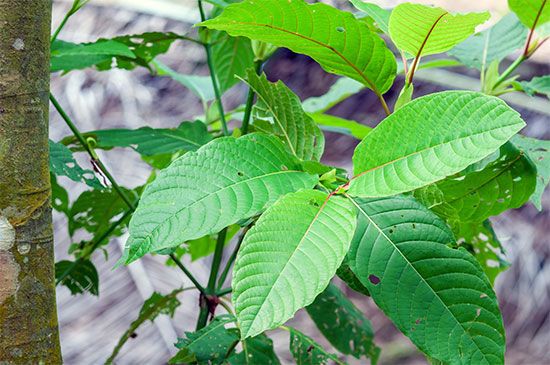
- Mitragyna speciosa: Known as kratom, used in traditional medicine.
- Rubia tinctorum: The common madder, historically used for the red dye alizarin.34
- Ornamental and Other Notable Genera:
- Gardenia, Bouvardia, and buttonbush (Cephalanthus).
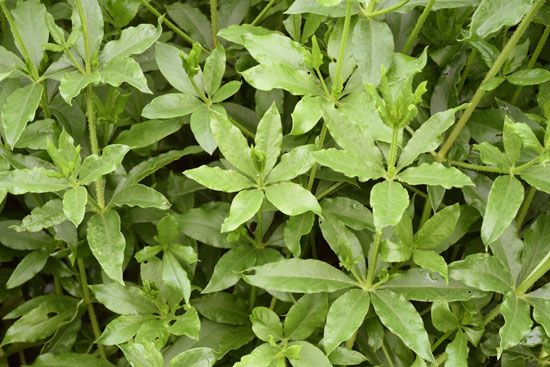
- Galium: Commonly known as bedstraw or cleavers.
- Myrmecodia: Notable for its symbiotic relationship with ants, which inhabit its hollow, swollen stems.3
How do evergreen plants survive in cold climates?
Evergreen plants survive in cold climates through specialized physical adaptations that protect their foliage from freezing and structural damage. Unlike deciduous species, which shed their leaves to avoid the risks of cold-weather cell rupture and physical breakage, evergreens are equipped with thick, leathery leaves—often needlelike or scalelike—that are coated in protective waxes and resins.56
These waxy layers act as a barrier against freezing temperatures, preventing the water within the leaf cells from expanding and fracturing the tissue, which would otherwise render the leaves incapable of photosynthesis. Furthermore, the compact, often needle-shaped structure of these leaves reduces the surface area exposed to harsh winter winds and minimizes the accumulation of heavy snow, thereby preventing physical breakage of the branches. By maintaining these hardened, durable structures, evergreens are able to withstand environmental stress that would be fatal to less resilient plants.65
What are some other common plants found in North American forests?
North American forests are home to a vast array of plant life, ranging from towering conifers to delicate forest-floor herbs. The composition of these forests varies significantly by region, elevation, and climate.
Common Trees
- Coniferous Forests: These are dominated by cone-bearing, evergreen trees such as pines, spruces, firs, and larches. In the western mountains, Douglas fir, western red cedar, and coast redwood are prominent.89
- Deciduous Forests: These hardwood forests feature broad-leaved trees including maple, oak, ash, hickory, beech, linden, and the tulip tree.810
Understory and Forest Floor
The forest floor and understory host a variety of smaller plants that thrive in the shade of the canopy:
- Shrubs and Small Trees: Common examples include dogwood, holly, and serviceberry.10
- Herbaceous Plants: Many species, such as trillium, violets, columbine, and Indian paintbrush, provide seasonal color.1112
- Mosses and Ferns: In damp, shady areas, you can find fern moss and tree moss, as well as various ferns that carpet the ground.81314
Sources
- Partridgeberry — Encyclopædia Britannica
- partridgeberry — Merriam-Webster
- Rubiaceae — Encyclopædia Britannica
- Madder — Encyclopædia Britannica
- Evergreen — Encyclopædia Britannica
- Why Do Leaves Fall in Autumn? — Encyclopædia Britannica
- horticulture - Frost control — Encyclopædia Britannica
- United States - Plant life — Encyclopædia Britannica
- Rocky Mountains - Plant life — Encyclopædia Britannica
- Temperate forest - Flora — Encyclopædia Britannica
- fern moss — Encyclopædia Britannica
- Coniferous forest — Encyclopædia Britannica
- Temperate forest - Population and community development and structure — Encyclopædia Britannica
- tree moss — Encyclopædia Britannica
Published on · 3 min read