Buttonbush
Buttonbush (genus Cephalanthus) refers to a group of at least six species of shrubs or small trees belonging to the madder family (Rubiaceae). These plants…
What is Buttonbush?
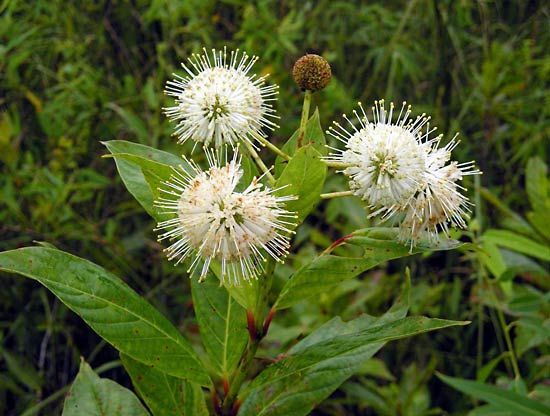
Buttonbush (genus Cephalanthus) refers to a group of at least six species of shrubs or small trees belonging to the madder family (Rubiaceae). These plants are native to Africa, Asia, and North America.1
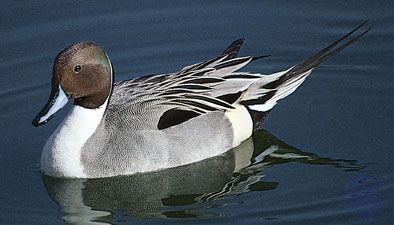
The plants derive their name from their distinctive, fragrant, creamy white spherical flowers. In North America, the most well-known species is the common buttonbush (Cephalanthus occidentalis), which thrives in marshes and swamps, sometimes reaching heights of up to 6 meters (20 feet). Beyond their use in landscaping, these plants serve as an important food source for ducks and other waterfowl. The term is also occasionally used interchangeably with “buttonwood shrub”.123
What other plants belong to the madder family?
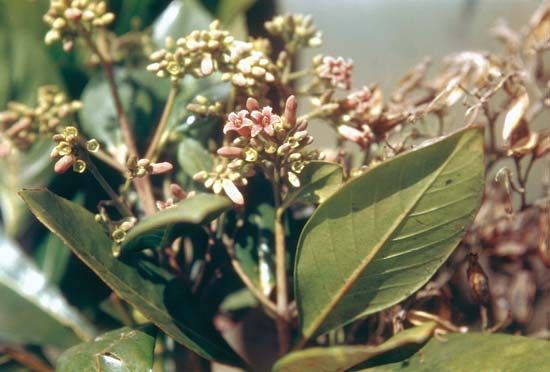
The Rubiaceae family, commonly known as the madder family, is a diverse group of over 13,150 species of flowering plants. These plants are economically significant, serving as sources for various products and as popular ornamentals.4
Key plants within this family include:
- Economically Important Species:
- Coffee: Derived from the seeds of Coffea species.4
- Cinchona: The bark of these trees is the source of quinine.4
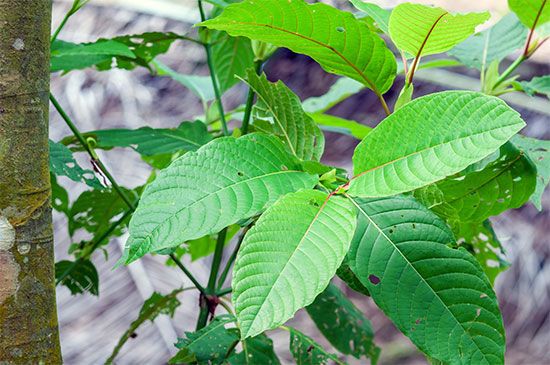
- Kratom (Mitragyna speciosa): Used in traditional medicine and as a stimulant.4
- Common madder (Rubia tinctorum): Historically cultivated for the red dye [alizarin].45
- Ipecac: Derived from the roots of Carapichea ipecacuanha.4
- Uncaria gambir: Used to produce gambier for tanning.4
- Ornamental and Native Species:
Some genera, such as Myrmecodia, have evolved unique symbiotic relationships, featuring swollen stems that provide housing for ants symbiotic relationships, featuring swollen stems that provide housing for ants.4
Why are buttonbush flowers shaped like spheres?
The buttonbush (Cephalanthus) is named for its distinctive, fragrant, creamy white spherical flowers, which serve as a primary identifying feature of the genus. While these flowers are famously shaped like spheres, the specific evolutionary or biological reasons for this unique morphology are not detailed in the available Britannica records.
The spherical structure is a characteristic trait of these shrubs and small trees within the madder family, helping to distinguish them in their native habitats across Africa, Asia, and North America.
We could dive deeper into the general pollination strategies of plants with clustered, spherical inflorescences if you would like to explore more.
What types of pollinators are attracted to buttonbush?
The available Britannica records do not specify the particular types of pollinators attracted to the buttonbush (Cephalanthus). While the genus is noted for its fragrant, creamy white spherical flowers, the specific insect or bird species that facilitate its pollination are not detailed in the provided search results.
We could dive deeper into the general characteristics of plants in the madder family to see if their pollination strategies are well-documented, or we could explore the general mechanisms of insect and bird pollination to understand what typically attracts visitors to fragrant, white-flowered plants.
Sources
- Buttonbush — Encyclopædia Britannica
- buttonbush — Merriam-Webster
- buttonwood shrub — Merriam-Webster
- Rubiaceae — Encyclopædia Britannica
- Rubiaceae — Merriam-Webster
- Madder — Encyclopædia Britannica
- Butterfly bush — Encyclopædia Britannica
- Pollination - Bees — Encyclopædia Britannica
- Pollination - Birds — Encyclopædia Britannica
Published on · 2 min read