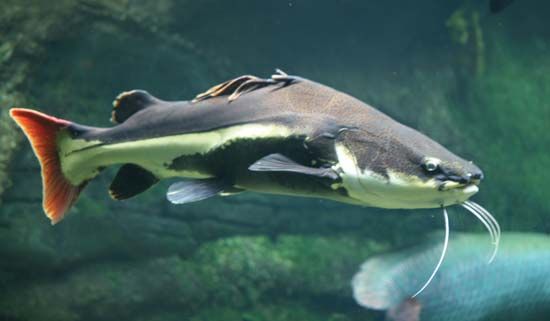
Madtom
A madtom is any of several small North American catfishes belonging to the genus Noturus within the family Ictaluridae.
What is madtom?
A madtom is any of several small North American catfishes belonging to the genus Noturus within the family Ictaluridae.1
Typically measuring between 5 and 7.5 centimeters (2 to 3 inches) in length, they are the smallest members of their family. They are easily identified by a long adipose fin that, in certain species, connects to the rounded tail fin.1
These fish are particularly notable for the stout, often saw-edged spines located in their pectoral fins. These spines are equipped with venom glands at the base, which allow the fish to inflict painful, jagged wounds if handled improperly. Madtoms are bottom-dwellers found in rivers, streams, and along lake shores throughout the central and eastern United States. Common examples include the stonecat and the tadpole madtom.1
How does the venom in a madtom’s spines work?
While the provided information confirms that madtoms possess poisonous pectoral spines capable of inflicting painful wounds, it does not detail the specific biological or chemical mechanism of how that venom functions.
Because the available search results do not contain information regarding the physiological process of the venom’s action, I cannot provide a technical explanation of how it works.
What other types of catfish are found in North America?
North America is home to a diverse array of catfish, primarily represented by the family Ictaluridae. These species are characterized by their wide heads, scaleless bodies, and prominent mouth barbels.34
Key groups and species found in North America include:
- Bullheads: Members of the genus Ameiurus, these fish are generally smaller than 30 centimeters and have squared tails. Notable species include the black bullhead, yellow bullhead, brown bullhead, and flat bullhead.5
- Large Food and Sport Species: This category includes the channel catfish (I. punctatus) and the blue catfish (I. furcatus), which can grow to significant sizes, with the blue catfish reaching up to 1.5 meters in length.4
- Madtoms: Small members of the genus Noturus, known for their venomous pectoral spines.34
Additionally, while not native to the continent, the walking catfish (Clarias batrachus) has been introduced into southern Florida, where it is considered a threat to native ecosystems due to its ability to travel over land.6
Why do madtoms hide under stones during the day?
Madtoms, which belong to the genus Noturus, are small catfish that typically inhabit the bottoms of streams, rivers, and lake shores.1
While the provided information notes that species such as the stonecat (N. flavus) are commonly found under stones during the day, it does not explicitly state the biological or behavioral reasons for this specific hiding habit. It is generally understood in ichthyology that such behavior serves as a protective strategy to avoid predators and minimize exposure to light, but the specific ecological drivers for the madtom remain outside the scope of the current data.1
Sources
Published on · 2 min read