Magnoliaceae
The Magnoliaceae family is recognized as a basal, or primitive, lineage within the angiosperm (flowering plant) tree. Its evolutionary significance is…
What are the evolutionary origins of the Magnoliaceae family?
The Magnoliaceae family is recognized as a basal, or primitive, lineage within the angiosperm (flowering plant) tree. Its evolutionary significance is defined by several ancestral morphological features that reflect early stages in the development of flowering plants.1234
Key evolutionary characteristics of the family include:
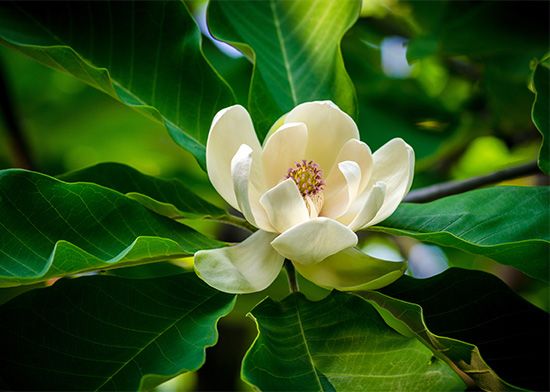
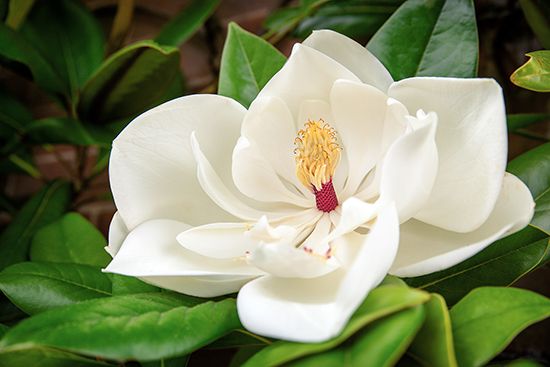
- Floral Structure: Members typically possess an elongated, conelike floral axis with numerous spirally arranged parts, including many stamens and one or more carpels. Unlike more advanced angiosperms, these floral parts are not clearly differentiated into distinct sepals and petals, often appearing as tepals.45
- Reproductive Biology: The family exhibits primitive wood anatomy, specifically simple water-conducting vessels. While some early magnoliids possess leaflike, three-veined stamens and carpels, the Magnoliaceae have evolved more conventional carpels featuring a stigma, style, and ovary.45
- Pollination: The evolution of the family is closely linked to early insect pollination, particularly by beetles, which were well-established before the rise of other major pollinator groups.5
- Fossil History: The fossil record indicates that the family was once widely distributed across North America and [Eurasia].4
How do the flowers of Magnoliaceae plants differ from those of other flowering plants?
The flowers of the Magnoliaceae family are distinguished by several primitive, ancestral traits that set them apart from more modern flowering plants. Unlike advanced angiosperms, which typically feature a clear differentiation between sepals and petals, Magnoliaceae flowers possess tepals—floral parts that are not distinctly different from one another.2
Key structural differences include:
- Floral Axis: They exhibit an elongated, conelike floral axis, a characteristic feature of their primitive evolutionary status.2
- Spiral Arrangement: The numerous stamens and carpels are arranged in a spiral pattern around this axis, rather than in the fixed, whorled arrangements found in more derived plant groups.862
- Carpel Development: While some other primitive magnoliids possess leaflike, three-veined carpels, the Magnoliaceae have evolved conventional carpels that include a distinct stigma, style, and ovary. These carpels are generally free (unfused) and attached to the receptacle.86
- Pollination: Their floral evolution is closely tied to beetle pollination, a strategy that predates the prominence of bees and butterflies.8
What are the main characteristics of plants in the Magnoliaceae family?
The Magnoliaceae family, belonging to the order Magnoliales, is considered a primitive lineage within the angiosperm tree. Its members are primarily trees and shrubs characterized by several ancestral traits.68
Key Morphological Characteristics
- Leaves: Most species have simple leaves. A defining feature of the family is the presence of stipules, which are large and fall off as the leaf expands, leaving a distinct scar.65
- Floral Structure: Flowers are typically bisexual and borne on branch tips. They feature an elongated, conelike floral axis with spirally arranged parts. Instead of distinct sepals and petals, they possess six or more tepals.65
- Reproductive Parts: The flowers contain numerous spirally arranged stamens and one or more carpels. The wood anatomy is also primitive, characterized by simple water-conducting vessels.65
- Fruit and Seeds: The fruit is often conelike and composed of separate or united carpels. In many species, these carpels split longitudinally to release seeds that hang by silky threads.65
What are some of the unique adaptations found in Magnoliaceae plants?
Plants in the Magnoliaceae family possess several unique adaptations that reflect their status as a primitive lineage of flowering plants. These adaptations span their reproductive strategies, chemical defenses, and structural development.
Reproductive Adaptations
- Beetle Pollination: Magnoliaceae flowers are highly adapted for pollination by beetles, an ancient insect group that predates the prominence of bees and butterflies. Their flowers often release specific odors to attract these pollinators, and the floral parts are sometimes partially consumed by them.2
- Seed Dispersal: Many species produce follicles that split open when ripe. The seeds are often brightly colored and sweet, dangling from the fruit by long, silky stalks to attract vertebrates, particularly birds and mammals, which aid in dispersal.10
- Floral Structure: Unlike more advanced angiosperms, Magnoliaceae flowers lack a clear differentiation between sepals and petals, instead featuring tepals. They also possess an elongated, conelike floral axis with numerous stamens and carpels arranged in a spiral pattern.2
Physiological and Defensive Adaptations
- Chemical Defense: A notable adaptation in the leaves and aerial parts of many magnoliids is the presence of ethereal oil cells, which often contain isoquinoline alkaloids. These are believed to function as a chemical defense mechanism against various pathogens and predators.11
- Vessel System: While primitive, Magnoliaceae have evolved a vessel system within their wood. This system allows for more efficient water conduction compared to the tracheids found in gymnosperms, enabling these plants to occupy a wider range of habitats.11
Sources
- Magnoliales - Evolution — Encyclopædia Britannica
- magnoliid clade - Reproductive structures — Encyclopædia Britannica
- magnoliid clade — Encyclopædia Britannica
- magnoliid clade - Reproduction and life cycles — Encyclopædia Britannica
- Magnoliales — Encyclopædia Britannica
- Magnoliaceae — Encyclopædia Britannica
- magnoliid clade - Ecology and habitats — Encyclopædia Britannica
- Magnoliales - Magnoliaceae — Encyclopædia Britannica
- magnoliid clade - Diversity of structure — Encyclopædia Britannica
- magnoliid clade - Vegetative structures — Encyclopædia Britannica
- angiosperm - Mechanisms of dispersal — Encyclopædia Britannica
Published on · 4 min read